How it is checked
rulec makes a small number of claims and spends a lot of machinery on each one. This page is the map: every layer, what it reaches, where it stops, and the command that runs it. Nothing here asks you to take the layer above on trust — each one is a different program, and several of them share no code with the checker at all.
The short version is the order they run in. A rule that fails a layer never reaches the next.
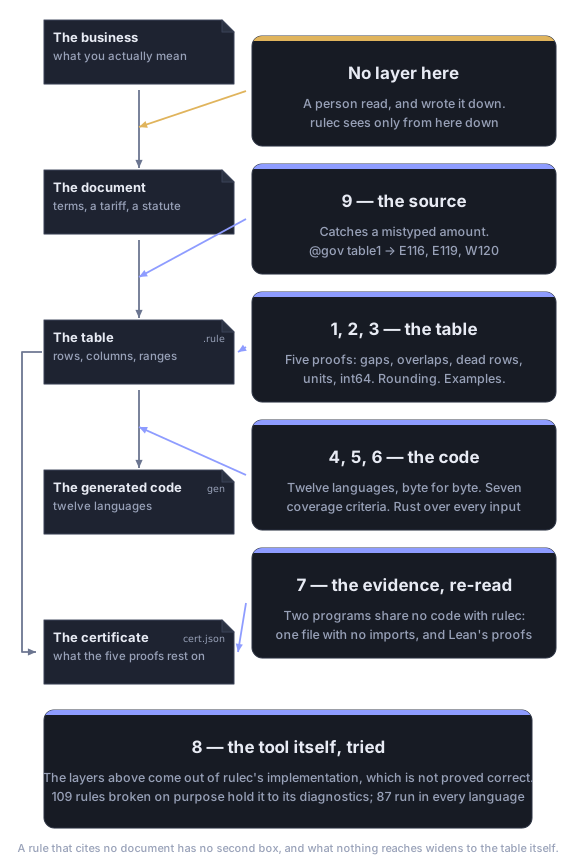
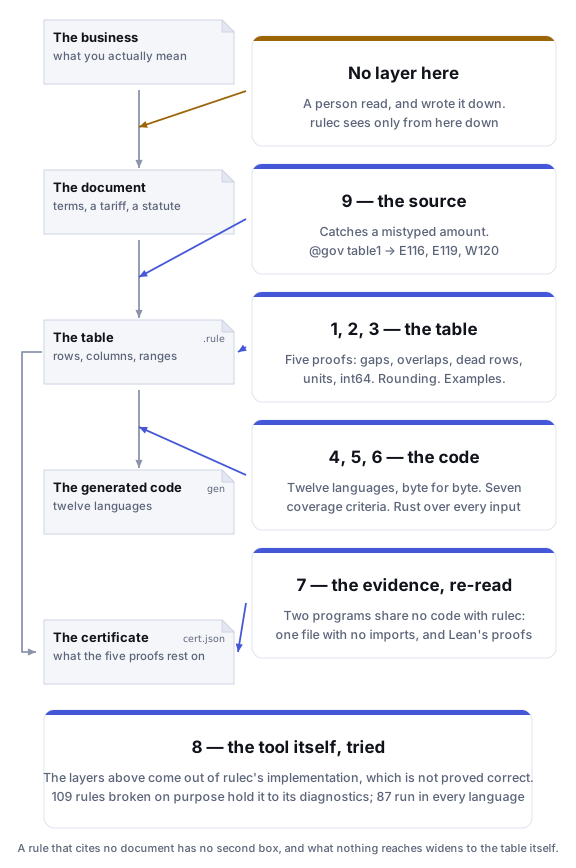
Drawn out, the layers fall into place. The spine is four things, each a copy of the one above it, and most of the checking lives at a joint, holding two of them to each other. The table produces one more thing — the certificate, the JSON the five proofs rest on — and layer 7 is the two programs that read it back. Only two layers stand at no joint: 1, 2 and 3, which look at the table on its own, and 8, which is aimed at the tool. At the topmost joint there is no layer at all: a person read the world and wrote the document down, and nothing here can check that reading.
| what it settles | run it with | |
|---|---|---|
| 1. The five proofs | over every input the declarations allow: no gap, no overlap, no dead row, no unit confusion, no overflow | rulec check |
| 2. The two declarations | rounding is written down, not guessed; an overlap the proof could not settle becomes a runtime guard that refuses rather than picks | rulec check |
| 3. The examples | the cases a person wrote by hand still hold | rulec check |
| 4. The vectors | the generated code answers like the reference evaluator, in twelve languages, byte for byte | rulec test |
| 5. The seven coverage criteria | the vector suite actually reaches every row, every boundary pair, every shadowed pair, every computed value at two values, every rounding tie, every fold transition and every transition of a state machine | rulec coverage |
| 6. The model checker | the generated Rust, over every input in the declared domain, read by a tool that shares no code with rulec | rulec test --proofs |
| 7. The certificate | the evidence, small enough to hand over, re-checked by two programs that share no code with rulec — one of them carrying machine-checked proofs | rulec certificate |
| 8. The repository's own tests | 109 deliberately broken rules each produce the diagnostic they should; 87 rules are checked, generated and run on every commit | cargo test |
| 9. The source | an amount that disagrees with the document the row cites fails | rulec source fetch, then rulec check |
1. The five proofs
Completeness (E101), overlap (E105), dead rows (E102), units (E103) and int64 (E108) are decided over the whole declared input space, not over samples of it. What makes that finite is the compression of §6.2: a column is cut at the boundaries its own cells name, and everything between two boundaries behaves alike, so a space of 1018 combinations becomes a few hundred boxes that can be walked.
A rule that is one step of a state machine gets its claims about every sequence of calls
decided the same way: that no call leaves a final state (E124), that every state a case can
reach can still finish (E125), and what its never and once lines say (E126, E127). The
states are a finite enum and every other input is cut at the table's own boundaries, so the
sequences are walks on a finite graph, and a claim that fails comes back as the shortest
sequence of calls that breaks it.
Where it stops: at the table as written. A tariff transcribed wrong passes every one of the five. That is what layer 9 is for, and even that only ties the table to a copy.
2. The two declarations
Rounding is not inferred. A numeric output without a round is E104, and the message
shows the money the choice moves. Which way to round is a business decision, so the tool
refuses to make it.
An overlap that could not be settled becomes a guard. Where neither an input matching two rows nor a proof that none exists could be constructed, W114 names the pair and the generated code returns an error instead of quietly preferring one row. It is the one place with no static answer, and it is visible in the output rather than buried.
3. The examples
examples is an executable specification: every row runs through the reference evaluator on
every rulec check, and a row that does not hold is E107, reported with the rows that fired.
They exist because the layers below them can all agree on the same mistake. That happened once: rounding for multiple outputs was missing in the reference evaluator and in every generated language at the same time, and the agreement check stayed green throughout. The only thing that can catch that is an answer a person wrote down.
4. The vectors, and twelve languages
rulec gen writes a vector suite beside the code: cases built from the boundaries of the
rule, each with the answer the reference evaluator gives. rulec test then runs every
generated language over them and compares byte for byte — not "close enough", and not
only the answer: the rows that fired are compared too.
Twelve languages, and more doors than languages: the module itself, the MCP server, the same server over HTTP, the Rust runner compiled to WASI, the Wasm component, the SQL query and the same query as a PostgreSQL function. Each door is a separate run. A rule that refuses an input has a suite for that too — the refusals are cases, and a door that answers where it should refuse fails. A rule that carries a state has sequences of calls as well, and each language hands the state it answered to its own next call, so the hand-over is compared too.
Where it stops: this is a test, not a proof of equivalence. It is strong evidence over a suite designed to be adversarial, which is a different thing from a theorem.
5. The seven coverage criteria
A suite that runs is not a suite that reaches. rulec coverage states the obligations the
rule itself implies and says which are met: every row wins somewhere, every boundary
pair has the two cases on either side of it, every shadowed pair under policy first
is exercised, every computed value — a row that returns a name rather than a literal, an
output a define computes — is seen at two values one input apart, as the implementation's
answer shows it, every rounding tie lands on the exact half, every fold transition is
taken, and, for a state machine, every transition a case can make and every two that can
follow one another are played from the initial state. The obligations come from the rule, never from the suite — an auditor that says
"all satisfied" of an empty set says nothing, and a test in the repository holds it to that. A
rounding tie the rule's arithmetic shows no input can reach raises none; one that was merely not
found still counts, and shows as missing.
6. The model checker
Beside the generated Rust, gen writes proof harnesses for
Kani, behind #[cfg(kani)] so rustc never reads
them. They hold the generated code over every input in the declared domain: no table
falls through, no runtime guard of layer 2 fires, nothing overflows an i64, and the rows of
each unique table cover the domain exactly once.
It is worth running because the model checker and the checker that proved the table share no code. Where they agree, two unrelated tools say the same thing; where they disagree, one of them is wrong and the input that shows it comes back.
Where it stops: at Rust. And two kinds of rule get no harness at all, the file saying
which: one with a string input, which a harness cannot quantify over, and one that works
out a share with allocate, where two divisions by a value rather than by a constant do not
come back from the model checker.
7. The certificate, and two re-checkers
rulec certificate prints what the five proofs rest on: the tree that tiles the input space
with the row covering each box, the axis on which each pair of rows parts, a point that
reaches every row with the values behind it, the interval and the type every computed value
is forced into — and where every cell stands in your file, down to the byte. Where no axis
parts a pair, or no row takes a box, and the rule's derives and constraints rule it out
together, it prints the multipliers that add those up to a contradiction; a re-checker does
the addition. For a contract the rule reads its inputs from, it prints the contract's
condition opened into cases, and for each case why it keeps what the rule's door asks — each
declared range, each constraint between two inputs, each enum's values — so that a request
the caller's own validation lets through is one the rule takes. For a state machine, it prints
the claims laid on the rows: a set of states closed under a call that holds every state a case
can reach, the pairs a never or once line is read over, and, from every one of those
states, a sequence of calls that reaches a final state.
Two programs read it, and neither shares code with rulec:
tools/recheck.py— one file, no dependencies. It recomputes each box from the cell it was read from, reads every cell back out of the.ruletext at the byte span the certificate names, and holds the rest to those claims. Milliseconds.proofs/— a Lean 4 development in which the meaning of a rule, the checks a certificate has to pass, and the theorems that each check settles its claim are all written down and machine-checked. The programlake buildproduces runs those very check functions, so what it prints is the theorems applied to one document. There is nosorryand noaxiomanywhere in it, and#print axiomson the results shows only the three axioms Lean itself rests on.
Writing the second one, and reading it back adversarially, found a soundness bug in the
completeness check, a witness that could break the rule's own constraint, and eleven ways a
forged certificate got past a re-checker.
Where it stops: the certificate is tied to one text by a digest and, cell by cell, by those byte spans. Everything else in it — the declared ranges, the types, the groups, the constraints, each value's expression — is the document's own word, and going behind that would take a parser for the rule. A checker that reads a rule the way rulec reads it is not independent of it. The reading of a contract — which inputs it feeds, which conditions it places and how they open into cases — is the document's word too: the certificate is tied to the contract's text by a digest, and neither re-checker reads CEL or a schema.
8. The repository's own tests
The five proofs come out of rulec's implementation, and that implementation has not been proved correct. What stands in for a proof is evidence, and it is kept deliberately:
- 109 deliberately broken rules, each producing the diagnostic it should — and the expected codes are pinned, so a mutant that starts reporting something else fails.
- 87 rules — 34 transcribed from a published source, 53 written to reach the corners of the language — checked, generated and run on every commit, in every language that takes them.
- The documents are held to the tool. The diagnostic ledger is regenerated from the code, the generated-code page is held to the tool's own output, and the examples on this site are held to the corpus files they came from. A page that drifts is a failing test.
- Every diagnostic is in the ledger: 113 codes, each with a smallest reproduction that is run on every commit to check it still produces that code.
9. The source a rule was transcribed from
A rule can cite the document it came from: a law in the government's own database
(source stamp_act = law "342AC0000000023" asof 2026-04-01) or a file beside it, pinned by digest.
Rows, tables, clauses and derivations then carry @stamp_act 別表第一, and rulec check compares
the amounts in the table with the amounts in the copy. One that is nowhere in the copy — or,
where the copy heads a row or a column with the row's own word, nowhere under that heading — is
E116; a value of the copy that no row uses is W120, which is what usually comes with a
mistyped digit. A threshold is compared too, in the one way it can be: the copy's Under 18
puts 18 in the band above, <=18 puts it in the band below, and that is E119.
Where it stops: agreement with the copy, not with the world. And a rule with no citation gets none of it — transcribe the tariff wrong and everything stays green.
What none of it reaches
Stating this plainly is part of the job.
- Whether the table says what the business means. Every layer above is about the table as written. Layer 9 narrows it to "agrees with the copy we cited", and that is as far as any of this goes.
- Whether rulec itself is right. Layers 6, 7 and 8 attack it from three directions — an unrelated model checker, two independent re-checkers, and mutants — but none of them is a proof that the checker is correct. What is proved is the step after it: that a certificate passing its checks settles the claims it makes.
- The pairs W114 could not settle. They are named, and they become a runtime error rather than a silent choice.
- Anything a rule does not declare. The proofs quantify over the declared ranges. Widen an input's range and the claims are about the wider space; narrow it and the generated guard refuses what falls outside.