What it proves
rulec check is the centre of the tool. Everything else — the code
generation, the vectors, the replay — is downstream of it, and a rule
that does not pass it does not generate.
$ rulec check rules/
note rules/yupack_base_fee.rule: 21 shadow pairs (21 structural, 0 equivalent, 0 needs review)
ok rules/yupack_base_fee.rule
Exit codes are 0 (notes only), 1 (errors), 2 (bad arguments or an unreadable file). Read the exit code, not whether the output looks empty.
The seven
| Completeness | if some input matches no row, it stops — with that input |
| Overlap | under policy unique, an overlap is an error. Under policy first, structural shadowing (the staircase) is told apart from the pairs whose outputs differ and therefore deserve a decision |
| Dead rows | a row nothing reaches. The message tells apart "earlier rows already cover it" from "the upstream table never emits the value it names" |
| Units | adding yen to grams stops. So does tax-inclusive plus tax-exclusive |
| Rounding | a numeric output must declare one. Without it, the message shows the money: "down(1JPY) gives 0JPY, half_up(1JPY) gives 0JPY and up(10JPY) gives 10JPY, so the rounding mode moves the result by up to 10JPY" |
| Overflow | that every intermediate fits in int64, proved from the declared ranges and steps |
| Examples | every example runs; a failure names the rows that fired; a missing output column stops |
A constraint narrows what completeness quantifies over: no row is demanded for a
combination declared not to happen, and the generated code refuses one at the door
instead. In a rule that walks a sequence, the same completeness check asks whether
every verdict the table can produce has an arm in the fold (E024).
In a rule that binds an enum to a .proto with import proto,
completeness reaches across the contract. Every rulec check reads
that file: a set that no longer agrees is E032, and once the sets agree,
a value that no row names and no default marks is E033. Adding a value
to an enum is a compatible change on the wire, so the tools that guard
the contract let it through — this is the check that stops it from
passing quietly through a table with a - row.
A rule whose inputs say where the caller's object holds them (shape and from) is held to
that contract the same way. The path is resolved on every rulec check: one the contract does
not have is E121, which says how far it got and which fields were there; a type that does
not fit the input is E120; a contract nothing projects from is W122. None of this
changes a check of the table — what comes out of a projection is a scalar input like any other
— and what it stops is the glue between an application and a rule going stale in silence.
How to write one is in Write a rule, and two worked rules are in
Examples.
The contract also says which values can come from there, and that is held to the input.
Protovalidate's rules on a .proto field and a schema's minimum, maxItems, enum and
required are compared with the input's range, its enum and the range of a count: a value
the contract lets through and the input refuses is E122 — a request the API itself
accepted, refused at the door of the generated code. fix.text is the annotation to add to
the contract. A row reached only by values the contract never lets through is W123. A
proto3 number field with no rule lets 0 through, because that is what an unset field is, and
that is the mismatch this finds most often. A message field that is not required may be left
unset, and Protovalidate then validates nothing inside it: the value under it arrives as its
default whatever its own rules say, so an input that refuses the default is E122 as well.
A contract also relates fields to each other — a CEL expression on a .proto message such
as this.declared_jpy <= this.cover_jpy, a oneof, JSON Schema's allOf, anyOf, oneOf,
not and if/then — and those conditions are read too. A constraint between two inputs of
one contract that the contract does not keep is E123: some request passes the contract's
validation and breaks the constraint, and the generated code refuses it at the door. The
example is that request, and for a .proto fix.text is the (buf.validate.message).cel that
would promise it. A row whose cells ask for a combination the contract never lets through —
express above 5 kg where the contract caps express at 5 kg — is W124. What cannot be read of
a condition (a remainder, a string function) is taken as true, so neither can miss. When the
contract keeps everything the rule asks of these values, rulec certificate writes down why,
case by case, and both re-checkers verify it — the Lean one on the theorem included_sound
(How it is checked).
A rule that declares its documents with source and cites them with @source fragment is
held to its copies: every cited fragment has a copy beside the rule and its digest pinned in
the rule. No pin is E037, a pin that differs from the copy is E038 (naming the tables, clauses
and rows that cite it), a missing copy is E039, a pin no citation uses is W119. check never
reads the network: rulec source fetch brings the copies, rulec source pin writes the pins,
and, for a statute, rulec source outdated asks e-Gov, the Japanese government's statute
database, whether a later amendment changes the text of a cited fragment.
What is cited from a document is a table. For a tariff sheet or a company rule, @source
table1 takes that table out of the document, writes it beside it, and holds the rule to that copy
ever after (a sheet in a workbook, a table in a Word file, what it looks like in Markdown and
CSV; for a PDF or a scan, hand an extractor to --via). That is where one more check comes
in.
- E116 — an amount a row writes is nowhere in the copy it cites. This is the error no
check of the table alone can reach:
1100JPYwritten as1000JPYsits on the rounding grid, leaves no gap and overlaps nothing. Where the copy has a heading that says a word of the row (関東), the amount is looked for in that heading's row and column, so the amount of the next row, which is somewhere in the copy too, is caught as well. - W120 — a number the copy states as a whole cell is used by no row, which is what a row that was never transcribed looks like. Completeness cannot see it: the inputs of a dropped row fall into one of the rows that remain.
- E119 — a boundary falls on the other side of itself from where the copy puts it: the copy
says
Under 18and the row says<=18. Nothing else can see this either. The number 18 is still used, so W120 is quiet; move both of the rows that share the boundary and the table is still complete with no overlap; and exactly one input in the whole space changes hands.
A threshold cannot be compared as text — it is rewritten as it is transcribed (1,949,000円まで
becomes <=1_949_000JPY) — but one thing survives the rewriting: which of the two bands the
boundary value itself falls in. 60cm以下 and 60cmを超え agree that 60cm is in the band below,
and so do <=60cm and >60cm, so a rule that writes a band from either end can still be held
to the copy. The word is read beside the number (60cm以下, Under 18, Not over $11,925) or
in a heading over its column (円以上, 円未満 — the shape a Japanese premium table takes). A
boundary the copy words neither way, 18 to 20 or 60〜80, is left alone: naming the numbers
that bound a band does not say which band holds them. The page for people quotes the copy under
the table and adds two lines to what was verified: every amount in this table is a value the
copy shows, and its boundaries fall on the side the copy puts them on.
A rule that applies another (apply, the way a statute applies one provision to another case
with its terms read differently) is held to the applied rule's digest (E040), has to substitute
every input of the applied rule (E041) with agreeing types (E042), and has to keep what it
passes inside the applied rule's ranges and constraints (E043, with a value outside them as the
example). A rule that cannot be applied — it applies a rule itself, walks a sequence, or fails
check — is E044. The applied rule's tables and clauses are expanded into the rule and checked
with it; the rows this rule never reaches stay silent, and only a whole table none of whose
rows is reached is W118.
A rule in which two or more tables define the same output — a main rule and the special case
that says overrides over it, a clause written as one line of prose among them — runs the
first three checks over those tables as one set.
Completeness is judged over their union. An overlap passes when a precedence is written and
stops as E105 when none is. A row the rows taking precedence cover entirely is E102, and an
overrides line whose rows meet none of its target's is W117. The page for people says in one
sentence which table is the exception to which.
A rule that is one step of a state machine (machine) is checked for what every sequence
of calls can do as well. A call that moves a case out of a final state is E124; a state
a case can reach and never finish from is E125; a sequence that reaches a never state
after its after state is E126; two calls in one case that answer what a once cell
accepts is E127. The case each of them carries is a sequence of calls from the initial
state — the shortest that breaks the claim, each call an input the rule takes. A state no
sequence reaches is W125, and a row that applies only in such states W126. A
scenario, an example several calls long, runs as the examples do.
Every diagnostic writes its first line in the words of the business, always carries a concrete case, and states the fix down to the rewritten form.
Proved is not type-checked
Type checking says a value has the right shape: a member of the enum, an integer, the unit it claims. APIs and models that return typed values are common now, which makes the two easy to run together. A right shape says nothing about a right answer.
What rulec check proves is not a shape but a property of the table: every input in the
declared range matches some row; no input matches two; every row can be reached; units never
mix; every intermediate fits in int64. Those five are shown exhaustively — not sampled.
Why it can be exhaustive at all. A cell only ever tests its own column (<=2000g is the
weight column, remote the destination column), so a row is the product of its columns'
conditions — one box of the input space — and a numeric column only has to be cut where the
table itself cuts it. The declared range therefore falls into a finite number of boxes, and
looking at all of them terminates. The cell language is kept narrow to keep that true. Nothing
is waved through when it does not terminate either: over the budget, E109 stops.
Four things it does not prove, and they are kept beside the word:
- That the table matches reality. What is proved is what can be said about the table as
written. Cite the document a table was transcribed from (
@source table1) and an amount that disagrees with the copy does fail (E116, W120) — but even then what is shown is agreement with the copy, not with the world. With no citation, transcribe the tariff wrong and everything stays green - That the generated code answers like the table. That is a test: cases built from the boundaries run through the reference evaluator and every generated language, compared byte for byte. Strong evidence, not an equivalence proof
- The row pairs W114 could not settle. Those move to a guard at run time — so "the rows do not overlap" is not always provable, and the pairs where it was not are always named
- That the checker itself is right. The five above come out of rulec's own implementation,
and that implementation has not been proved correct. The evidence is 109 deliberately broken
rules (
tests/mutants/) each producing the diagnostic it should, the corpus rules — the transcriptions of published terms and statutes among them — passing on every commit, and the reference evaluator agreeing with twelve languages. Evidence, not proof
For the Rust, a second tool reads what was generated: gen writes proof harnesses for
Kani, and over every input in the declared domain
they hold that no table falls through, that the guard of (3) never fires, that nothing
overflows an i64, and that the rows of each unique table cover the domain exactly once.
It shares no code with the checker above, so agreement is two unrelated tools saying the
same thing, and disagreement comes back with the input that shows it
(generate).
The evidence can be handed over, and the checks behind it are proved. rulec
certificate writes out what the five proofs rest on — the tree that tiles the input space,
the axis each pair of rows of a unique table parts on, a point that reaches every row
with the values behind it, and the interval and the type of every computed value — together
with where each cell stands in your file, down to the byte, and what stands there. Two
programs re-check it: tools/recheck.py, one dependency-free file, and the program
proofs/ builds, a Lean 4 development in which the meaning of a table, the checks, and the
theorems that each check settles its claim are all written down and machine-checked. That
moves what (4) asks you to take on trust from 42,000 lines of Rust to a few hundred lines
of checking whose soundness is proved — plus the reading of the document itself, which is
not. It does not remove (4): whether the tool produces a right certificate is still
evidence, the declared ranges and types and constraints in it are its own word, and five
things are named in a run rather than proved. Both programs end by saying which. See
formats for the document, its limits, and both re-checkers.
Reading a diagnostic
error[E101]: Completeness gap: some input matches no row
  --> rules/parcel_rate.rule:30 table base_rate
   |
30 | table base_rate
   |       ^^^^^^^^^ the input space is not fully covered
   |
 An input that matches no row: dest = overseas, size = small, weight = 1lb
 hint: add a row that matches this input.
 The shape of the row to add: `| overseas | small | 1lb | 6USD |`. Its output values are copied
 from the first row to give a shape that parses; they are not the right amounts. …
The witness is the part to reason about. dest = overseas, size = small, weight = 1lb
is not an illustration — it is an input the checker constructed, and it
is the sentence you hand to whoever knows the answer.
--terse, when there are many
$ rulec check rules/ --terse
error[E101]: Completeness gap: some input matches no row
  --> rules/parcel_rate.rule:30 table base_rate
  witness: dest = overseas, size = small, weight = 1
note rules/parcel_rate.rule: 3 shadow pairs (3 structural, 0 equivalent, 0 needs review)
details: rulec explain <code>
Heading, position, witness. The pointer to the rest is printed once, at the end of the run.
--format json, when a program is reading
The same finding as data. The prose is still there, but nothing downstream has to take a sentence apart:
$ rulec check rules/parcel_rate.rule --format json | jq -c 'select(.code=="E101") | {table:.where.table, witness:.witness.inputs, fix:.fix}'
{"table":"base_rate","witness":{"dest":"overseas","size":"small","weight":1},"fix":{"kind":"add_row","text":"| overseas | small | 1lb | 6USD |"}}
where says which table and row, witness is an assignment of values
in the canonical unit, rows names every row that takes part, and fix
carries the rewritten form ready to paste. witness and fix do not
change with --lang — only fields whose names say prose do. The full
shape is in Formats.
fix.text is a form, not a decision
It parses, and it removes the code — both are tested. It does not
know the right amount, the right rounding direction or the right
grid. Those are business decisions, and the caveat sits in notes,
which is prose, because fix.text is bytes.
Looking a code up
Every code has an entry: when it appears, how to fix it down to the
rewritten form, the smallest .rule that reproduces it, and the
codes next to it.
$ rulec explain E101
error[E101]: Completeness gap: some input matches no row

When
  The union of the rows does not cover the declared input space. …

Fix
  Add a row that matches the witness. If a new enum value caused it, …

Smallest reproduction
  rule t(t) v1

  enum k(k) = a(a) | b(b) | c(c)
  …

Related codes: E102 E105 W111
rulec explain --all --format markdown prints every one of them — and is
exactly what Diagnostics on this site is built from. Every
reproduction in it is run by the test suite, so an example cannot rot
into something that reads well and is no longer true.
Only what is new
Findings that were already present at that revision are hidden, and the count of what was hidden is printed. Pairs are matched on the canonical form of their cells rather than on line numbers, so inserting one row does not make everything look new.
That is what makes warnings usable in CI: a table can carry an intended
policy first shadowing for years without drowning the one overlap this
change introduced.
When it cannot prove something
It says so. It does not approximate and pass.
- E109 — the check ran out of its node budget, so completeness was
not proved. Split the table or raise
--budget; nothing is assumed. - W114 — two rows of a
uniquetable might overlap, and the checker could neither construct an input that proves it nor prove that none exists. It warns, and the generated code carries a guard that returns an error rather than silently picking the earlier row. If that guard ever fires, the overlap was real. Two derived values that share an input, and the thresholds inside a boolean definition, no longer land here: those are decided by eliminating one variable at a time. What is left is what that cannot decide because it works over the rationals — a pair kept apart only by the values being whole.
Over the days a koyomi date comes to
A date input can take its range from a date of a koyomi file:
pay_day : date range from koyomi "payment_terms.cal" date payment.
koyomi computes the date on every input of its own range, so the days it
comes to are known exactly, and the seven checks run over those days and
no other: a table needs no row for the days between two payment days, a
payment day no row takes is E101 with that day as the example, and a row
that takes none of them is E102. The generated code refuses any other
day at its door, and the certificate carries the days with the koyomi
file's SHA-256. The days are read through ritsu, with koyomi joined
(ritsu rulec check, ritsu check); a rulec with no koyomi does not
check the rule over every day instead, and says so (E129). See
the reference.
Showing it to people
A .rule is already almost markdown, so transcribing its syntax is
worth nothing. What doc adds is the facts the checker knows that the
text does not show: that a group of six values and its complement of
41 really do cover all 47, which rows shadow which, where a rounding was
assumed rather than sourced.
This is what rulec doc writes (excerpt; --lang ja asks for Japanese).
## Groups

A group is a named subset of an enum. One word written in a table cell stands for all the values below.

- **kinki** (6 values) — Shiga, Kyoto, Osaka, Hyogo, Nara, Wakayama
- **cs** (9 values) — Tottori, Shimane, Okayama, Hiroshima, Yamaguchi, Tokushima, Kagawa, Ehime, Kochi
- **okinawa** (1 value) — Okinawa
…

These 6 groups partition the 47 values of jp_prefecture exactly (counted from the declarations by this rendering).

## Table fee_table (policy unique)

Source: Japan Post, base fee table (Tokyo)

| Column | Source |
|---|---|
| dest | Input |
| size | Output of table size_of |
| → fee | Output of this rule |
…
Write # Source: Japan Post, base fee table (Tokyo) at the end of a row or of the table line, and
those words appear in the document too. The reader's job turns from "read the whole table
again" into "compare this row with that cell".
A page a reader can try a case on
--format html renders the same document as one HTML page, laid out as a board. The form
is on the left; the middle holds one card per decider — one table, one derive, one
define — with that table itself inside the card. A reader types a case: the row that
fired lights up inside the card it belongs to, the card says which row that was, the answer
appears on the card that produced it, and the line the generated code would write to a log
is shown as it is. The example buttons fill in the rule's own verified examples. The page is
drawn light or dark, as the reader's browser is set.
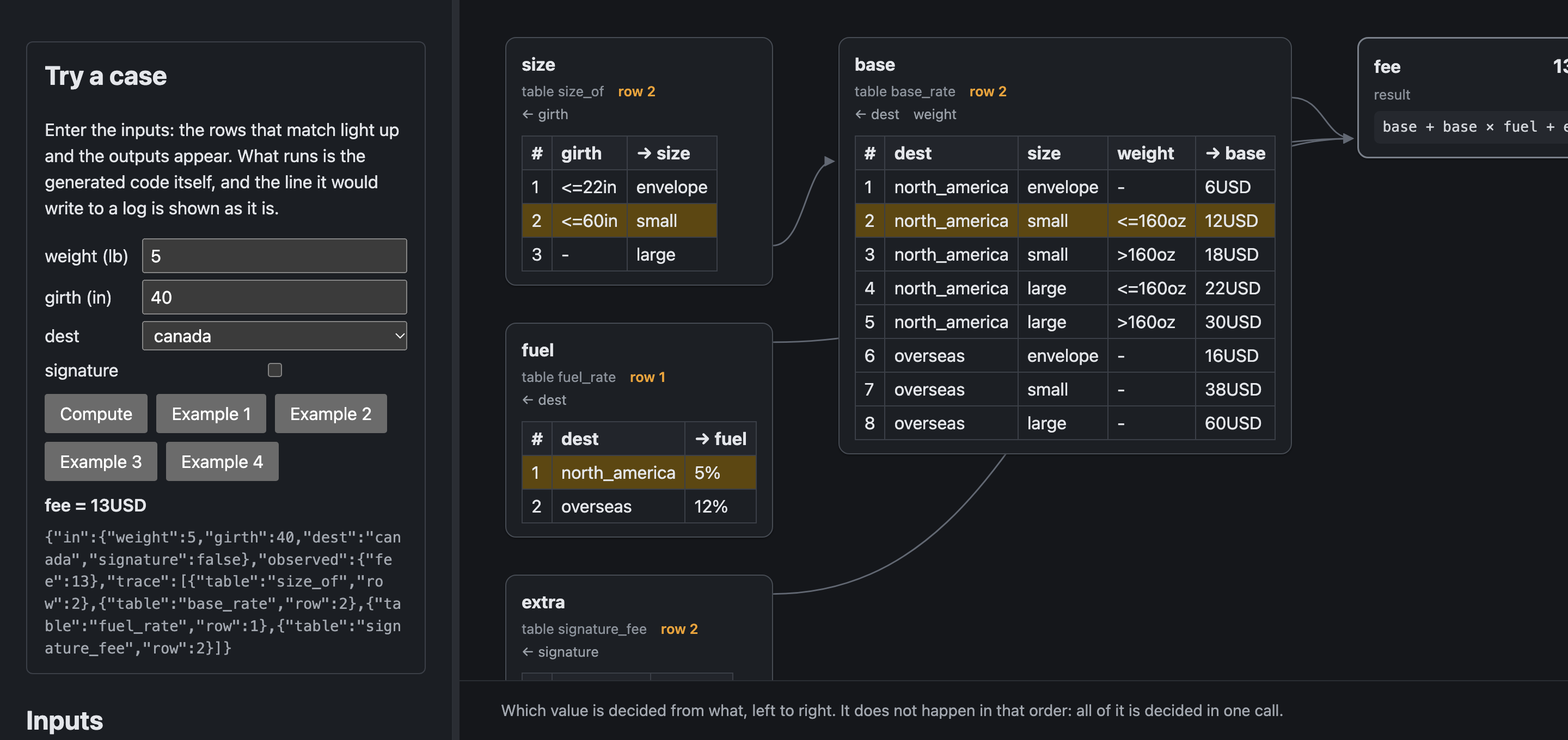
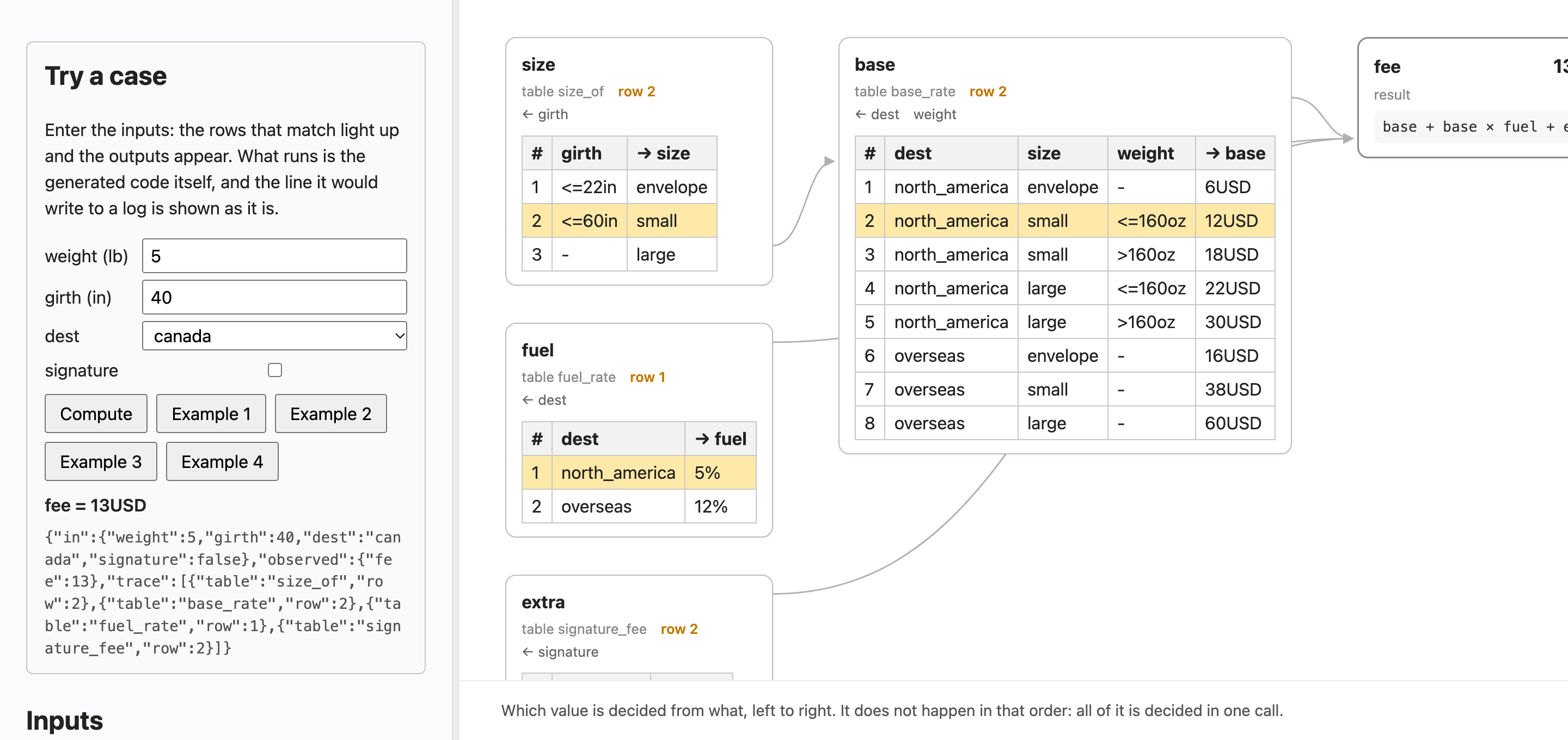
Selecting a card opens a dock below it: where that table's columns come from, and what
rulec check verified about it. Only the selected card carries colour, so which one you
are reading is never in doubt.
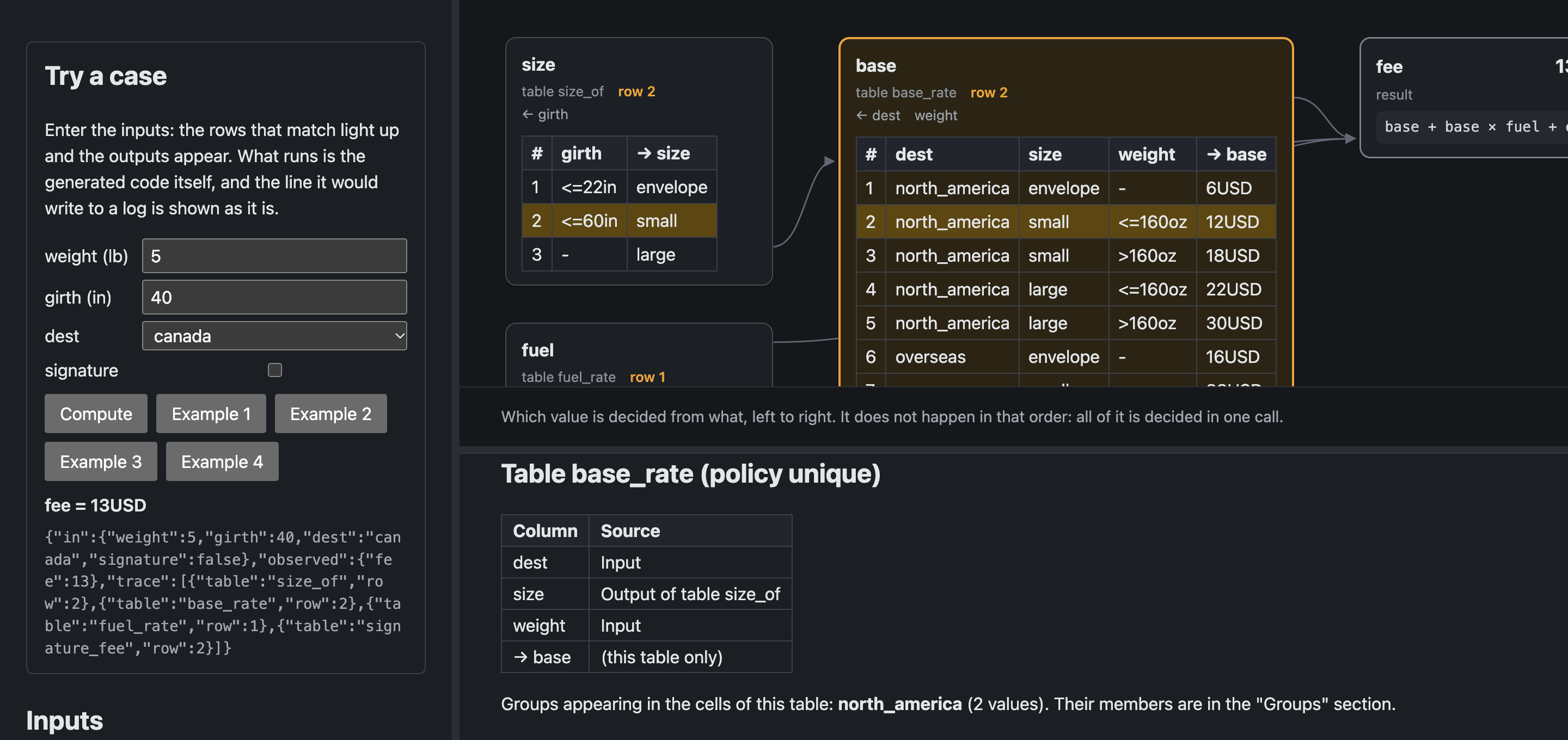
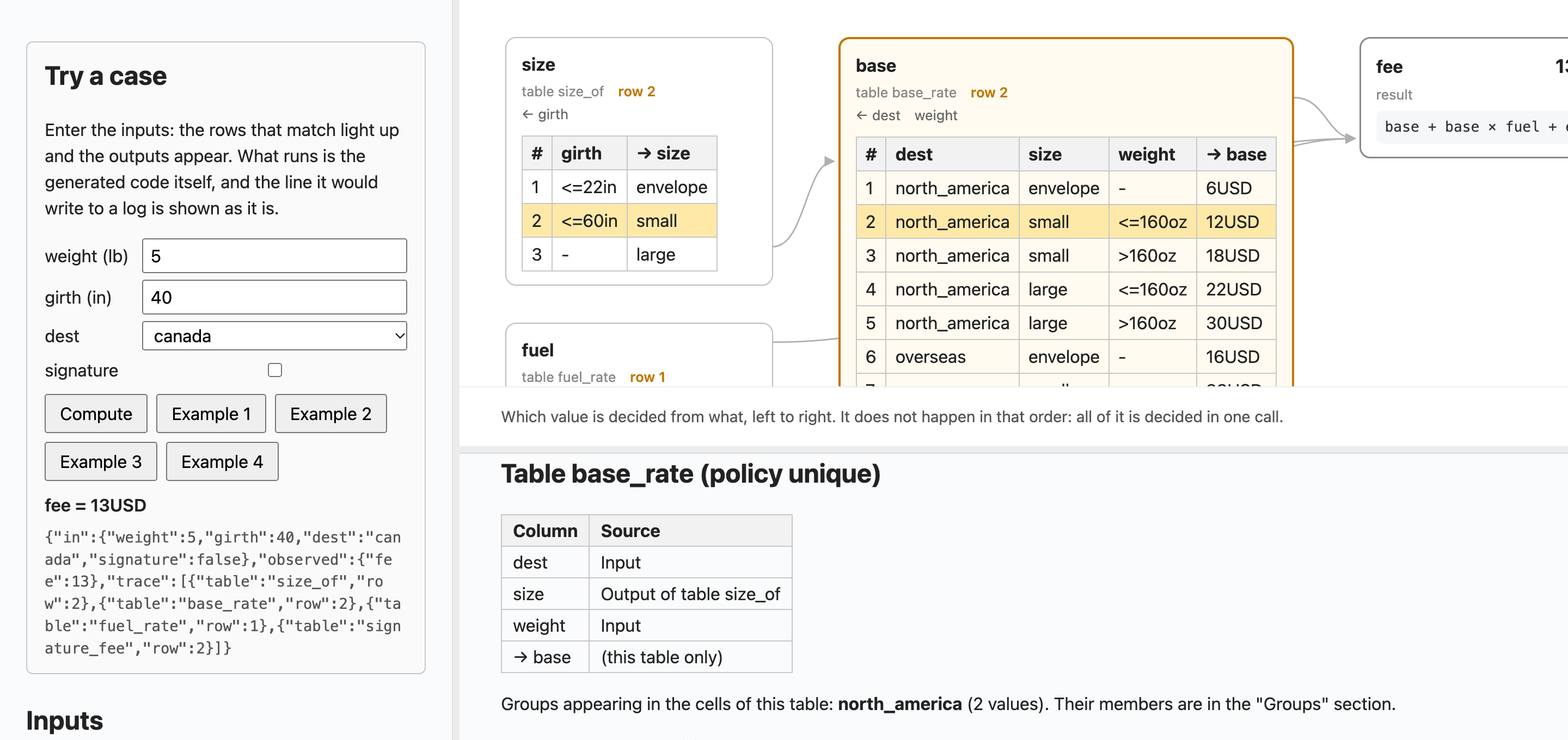
What runs in the page is the generated JavaScript itself, so the page says nothing the code
does not. The case and the card both stay in the page's address
(?weight=5&girth=40&dest=canada&…#t-base_rate), so "look at this table on this case" is a link.
There is one prohibition. It writes no sentence that is not in the checker's output — every line traces back to the source or to a check result, and the two are named apart ("rulec check confirmed" versus "this rendering counted it from the declarations"). It is never committed: CI renders it and pastes it into the PR, because a stale rendering that still looks authoritative is the danger it was designed against.
All the diagnostic codes Generate and call
Showing it to the customer
The same rule as the article a help centre publishes. Aliases, declared
ranges and diagnostic codes are left out; what is added is the case on
either side of every threshold, taken from the boundary-pair vectors,
so a reader — or a model reading a retrieved page — is never left to
decide what <=60cm means for 61cm.
## At the thresholds

How the answer changes on either side of a threshold.

- girth 60cm → fee 1410JPY; 61cm → fee 1710JPY (dest Hokkaido, weight 1g)
- girth 80cm → fee 1710JPY; 81cm → fee 2020JPY (dest Hokkaido, weight 1g)
…
This page is one layer. How it is checked is the map of all of them — what each one reaches, and where each one stops.