

Gomamochi
Write Go. Ship what you saw.
Gomamochi builds desktop apps in Go on pixie's engine, and
gomamochi gate is how you check that what you saw
while writing is what you ship. gomamochi run
reads your file and runs it interpreted, with no build step: save, and
the window takes the new code and keeps the values it had.
gomamochi build compiles the same file with the Go compiler
into a native binary. Both reach the same drawing engine
(gpui, the engine behind the Zed editor) through
pixie's
C face, opened without cgo, and the gate drives both with one script
and compares what they drew, byte for byte. An app is a Go struct with
a View method; what Gomamochi adds is the elements that
build the screen, and the check that the two runs agree.
The whole picture
One source, two roads to run it.
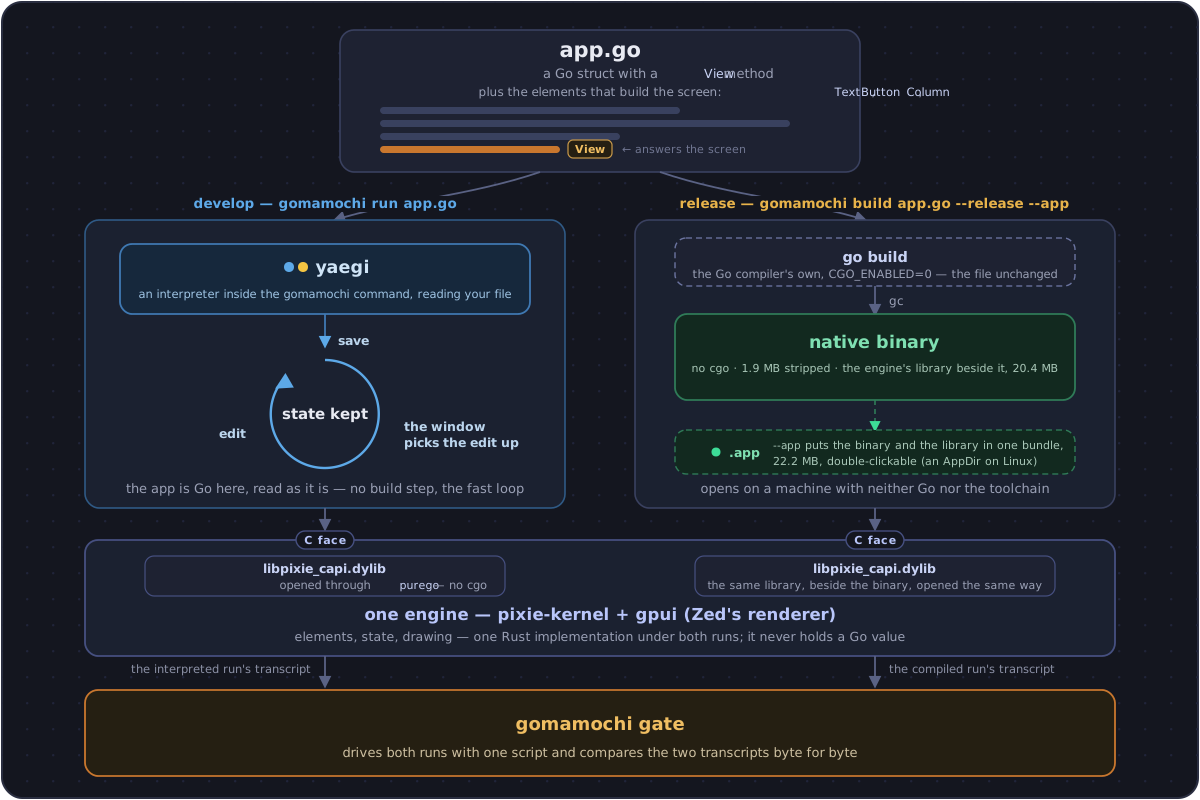
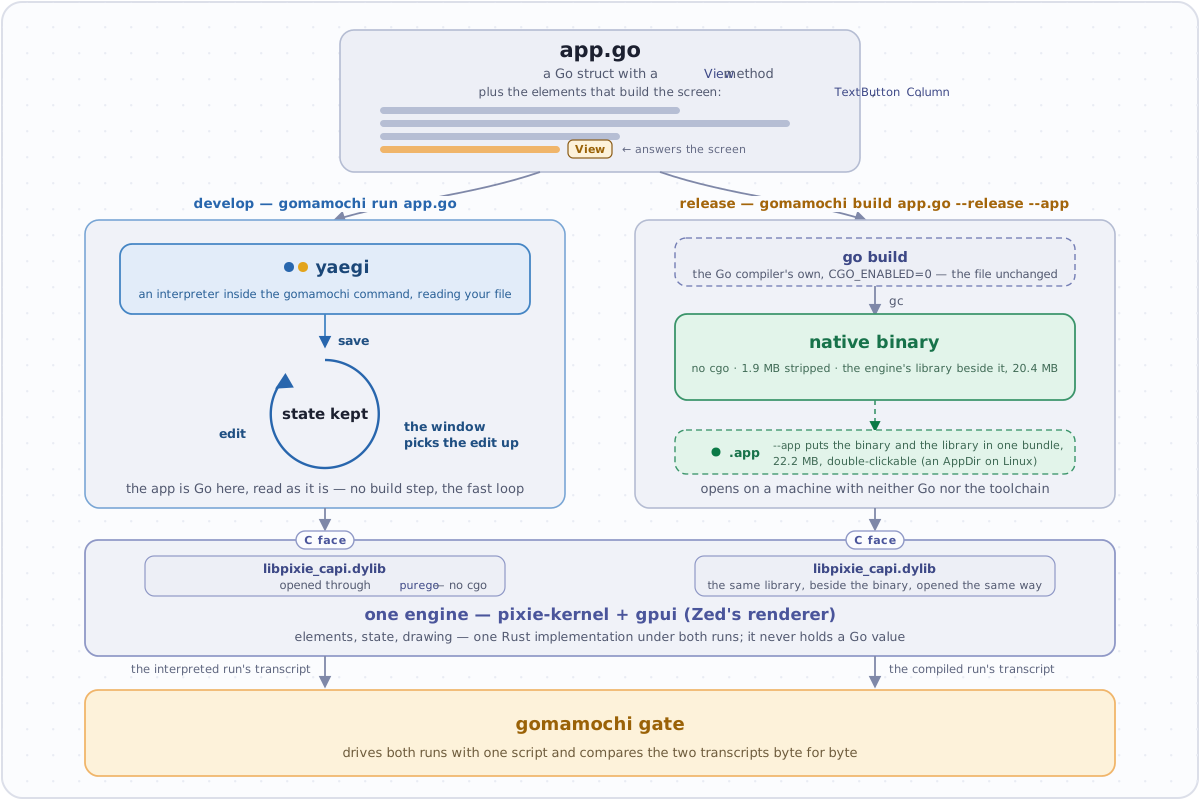
Both roads end at one engine, and both reach it the same way: pixie's C
face is one shared library, and each run opens it through purego,
without cgo. The interpreted run is yaegi,
inside the gomamochi command; the compiled run is the binary
go build makes from the same file, with that library beside it. The
engine never holds a Go value, which is what lets an interpreter and a
compiled binary drive exactly the same code.
Write it, run it, ship it
The smallest complete app:
package main

import (
    "fmt"

    . "github.com/i2y/yokan/gomamochi"
)

type Counter struct {
    count int
}

func (c *Counter) View() Element {
    return Column(
        Text(fmt.Sprintf("count: %d", c.count)).Size(34),
        Button("+1").OnClick(func() { c.count += 1 }),
    ).Spacing(12).Padding(16)
}

func main() {
    Run(&Counter{}, Title("counter"))
}
An app is a struct. Its state is its fields, View answers one
element, and a handler is a closure over the fields. There is nothing
to inherit from, nothing to register, and nothing to mark as
observable. Go has no keyword arguments, so an element's keywords are
methods on it, and a chain reads the way the keyword list would:
Text("…").Size(34), Column(…).Spacing(12).Padding(16).
The dot import is a matter of taste. Import the package under a name
and every call reads gm.Text(…), gm.Run(…) instead, and the app may
then use any name it likes for its own types. Both runs take either
form.
That opens a window and watches the file. Save an edit and the window picks it up: a fresh interpreter reads the file again, and the struct the window is holding carries every value it had into the new code. There is no build step, and no Go toolchain in the loop either: the command holds the interpreter.
Ship it:
$ ./bin/gomamochi build demo/counter.go --release --app
built: demo/.gate/counter/counter (1.9 MB)
bundle: demo/dist/counter.app (22.2 MB)
The binary is the Go compiler's own, built without cgo, and the engine
rides beside it as one shared library; --app puts the two in one
bundle (an AppDir on Linux, which --appimage packs into one file).
The person receiving it installs neither Go nor the toolchain.
What it looks like
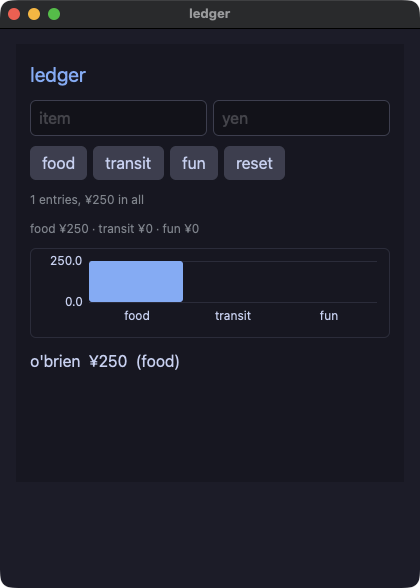
demo/ledger.go — money kept in a database, every value bound rather
than spliced, with a chart over the totals. Ordinary Go; ships as the
Go compiler's own binary.
"But it worked on my machine"
Hand it a sequence of interactions and it replays them against the interpreted run and the compiled binary, then compares the resulting screens. Gomamochi calls it the gate:
$ ./bin/gomamochi gate app.go --script "click:+1,dump"
GATE OK — 3 dump lines identical in both runs
The compiled run is the Go compiler's, so what a green gate says is that the window you were writing in agreed with what ships, on everything the script touched. The interpreter is the one that could differ, and the places where it does are named, with reasons, on The two runs, and refused by name before anything is built.
Go's standard library is the same code in both runs
fmt, strings, strconv, math, sort, time, encoding/json,
net/http, os: Go's own, not a library of ours standing in front of
them. The interpreter calls the packages compiled into the command,
and the binary links the same ones, so a number formats the same, an
integer overflows the same and a string upper-cases the same, with no
table needed to keep them honest.
    sort.Slice(order, func(a, b int) bool { return scores[order[a]] < scores[order[b]] })
    line := fmt.Sprintf("mean %.1f, %d over five", mean, len(big))
A database, the clipboard, the platform's dialogs, sound and notifications come from the framework instead, and there one implementation, inside the engine, answers both runs through the C face:
    SqliteExec(db, "INSERT INTO expenses VALUES (?, ?, ?)", name, strconv.Itoa(yen), cat)
    rows := SqliteQueryRowsOr(db, "SELECT name, amount, cat FROM expenses ORDER BY rowid")
Two games, ported
Two of Pyxel's own examples (Takashi Kitao, MIT) are in the bundled demos, ported almost line for line: the same pixel canvas, the same thirty frames a second, the same keys read while they are held. A script of keystrokes and frames replays both runs, so the gate compares every frame of the game.
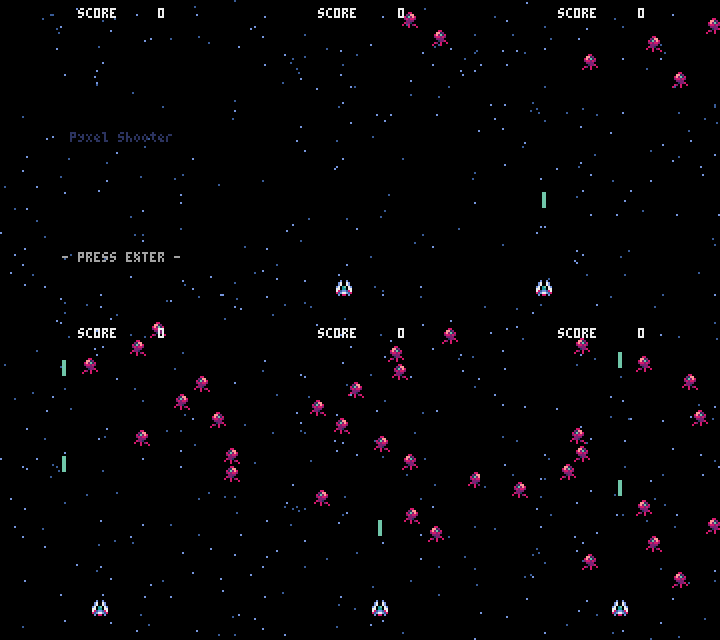
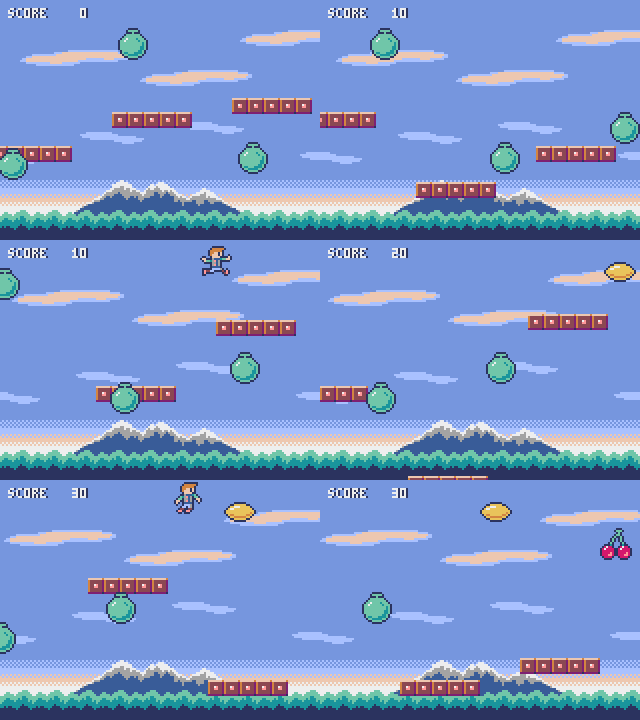
demo/shooter.go and demo/jump.go — inside a canvas a color is a
number, the index of a color in the palette, which is what lets drawing
code written for a pixel machine port with its numbers unchanged.
When an agent is writing it
An agent writes a file and reads what comes back, so what comes back decides how the session goes. Two of the commands build nothing and open no window, and each answers in about a second or less: a refusal that names what to write instead, and the screen as text. The gate is the proof at the end.
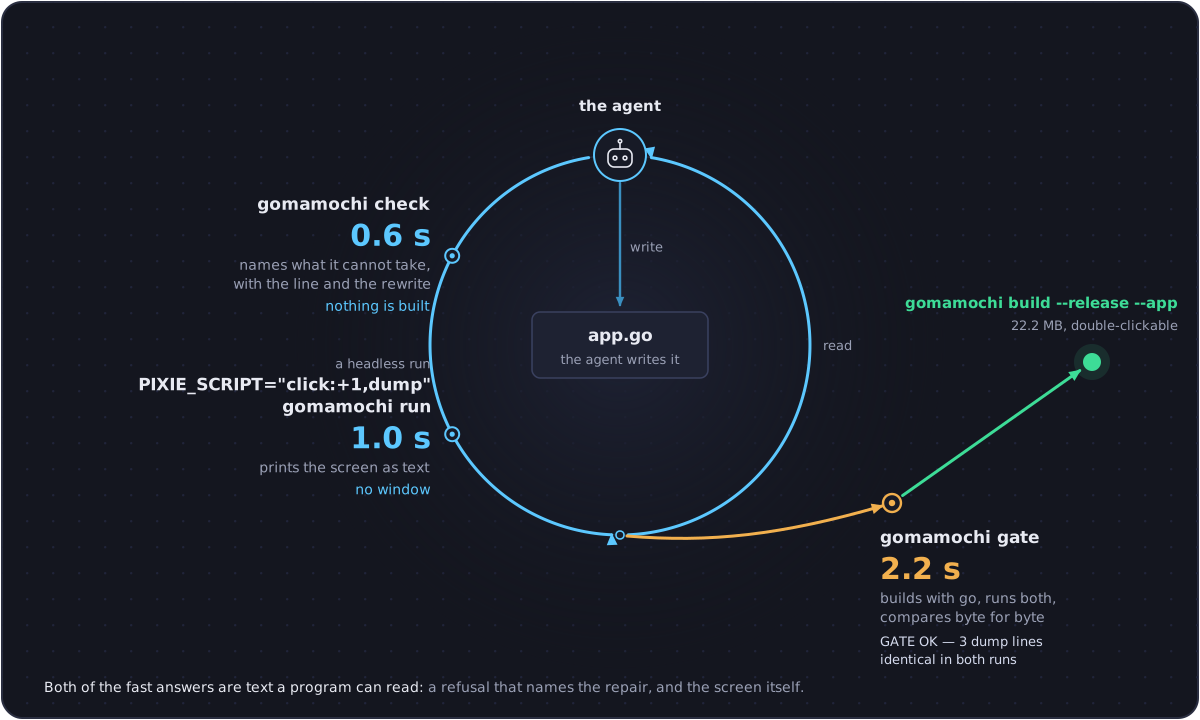
Building with an agent walks the whole loop.
What else is in it
-
One table, one vocabulary
Thirty-three elements, fifteen shared keywords and ten drawing commands, written once in
elements.toml. The Go an app calls, the interpreter's view of it and the numbers the engine counts with are generated from it, so an element cannot mean two things — and the other three languages on this engine read the same table. -
A canvas, and the keyboard
A grid of virtual pixels painted command by command, colors by palette index, keys read as a device from the tick, and a WAV played with
AudioPlay— and a PNG of any frame without opening a window at all. -
Refusals that teach
What the interpreted run cannot run the way the compiler does is refused by name, with the line and the rewrite, before anything is built, and Go's own errors come in Go's own words. Each refusal has a file holding the message it must print, word for word.
The limits, named
- The interpreted run is yaegi, whose Go is 1.22's.
minandmax,rangeover a number or a function, and what the standard library gained after 1.22 are not in it; the first three are refused by name, and the tour's closing section is the whole list. - An app is one file that imports the standard library and this package. A module outside the standard library is refused, because the interpreted run cannot read it yet.
- A shipped app is the binary and the engine's library beside it, or the bundle that holds both. There is no single-file form.
- Under a dot import the package's exported names (
App,Element,Text,Runand the rest) are taken, so an app names its own types around them, or imports the package under a name. - macOS on Apple silicon and Linux.
What does not work yet on the tour has the reasons.
Where next
-
What you need, the one-time setup, and the four commands. macOS on Apple silicon and Linux today.
-
One pass over how apps are written — state, views, the canvas, the window, a database, the gate — closing with what does not work yet.
-
Forty-four apps, each with its screenshot and its whole source.
-
The command, the door, the engine, and the demos.
The name is 胡麻餅 — gomamochi, mochi with black sesame kneaded through. Like Yokan, Wakakusa and Rakugan, the three languages it shares an engine with, it is named after a Japanese sweet.