Demos
Every demo is one file (opsboard and multi are directories) and runs
as-is from crates/yokan/ in the repository:
$ cd crates/yokan
$ uv run demo/counter.py            # substitute any demo's name
$ ./tools/gate_all.sh               # gate-check every demo at once
The three numpy demos (pystats / csv_viewer / app) run with
uv run --with numpy, and transcribe declares its own dependencies,
so uv run demo/transcribe/app.py fetches them; it downloads a
Whisper model the first time it transcribes, and is gated on its own
(just transcribe-gate) rather than in the sweep.
Two demos — app and csv_viewer —
use dict state and are development-only by design (see the
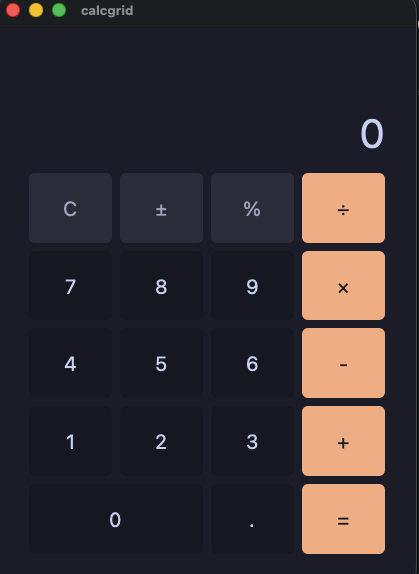
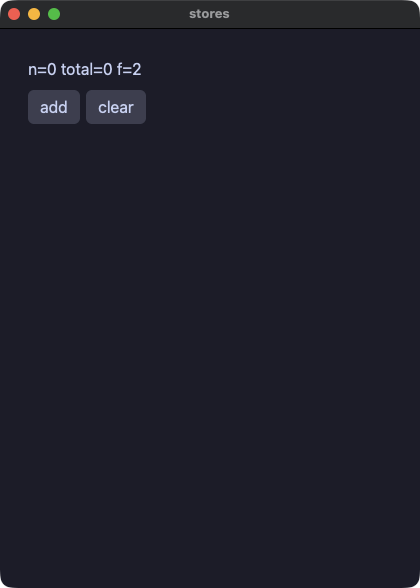
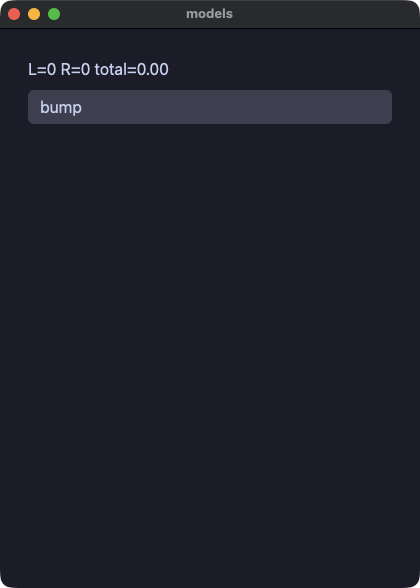
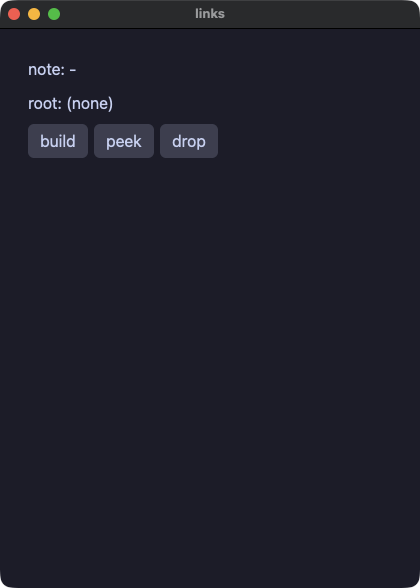
What does not work yet section); they are listed here, not gated. All screenshots show
the initial state, right after launch, except transcribe, which
shows a finished transcript — its launch state is an empty table.
Start here
counter — the smallest app. The same app in two other spellings: counter_state.py (typed State cells) and counter_with.py
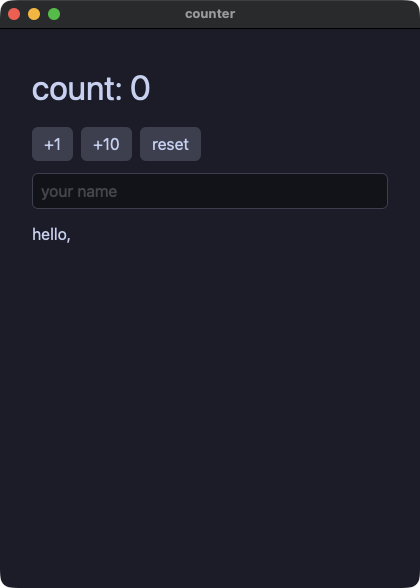
counter.py
# /// script
# requires-python = ">=3.14"
# ///
"""The dialect reference: everything in this file translates to .pix.

Develop:  uv run demo/counter.py
Ship:     python3 yokan_gate.py gate demo/counter.py --script "click:+1,input:Momo"
"""
import os
import sys

sys.path.insert(0, os.path.join(os.path.dirname(os.path.abspath(__file__)), ".."))

from yokan import button, column, row, run, State, text, text_field  # noqa: E402


count: State[int] = State(0)
name: State[str] = State("")


def view():
    return column(
        text(f"count: {count()}", size=34),
        row(
            button("+1", on_click=lambda: count.set(count() + 1)),
            button("+10", on_click=lambda: count.set(count() + 10)),
            button("reset", on_click=lambda: count.set(0)),
            spacing=8,
        ),
        text_field(name(), placeholder="your name", on_change=name.set),
        text(f"hello, {name()}"),
        spacing=12,
        padding=16,
    )


if __name__ == "__main__":
    run(view, title="counter")
opsboard — the flagship: a three-module dashboard (two stores, a sum-typed health model, charts, a virtualized alert feed, theme flip, fs report export)
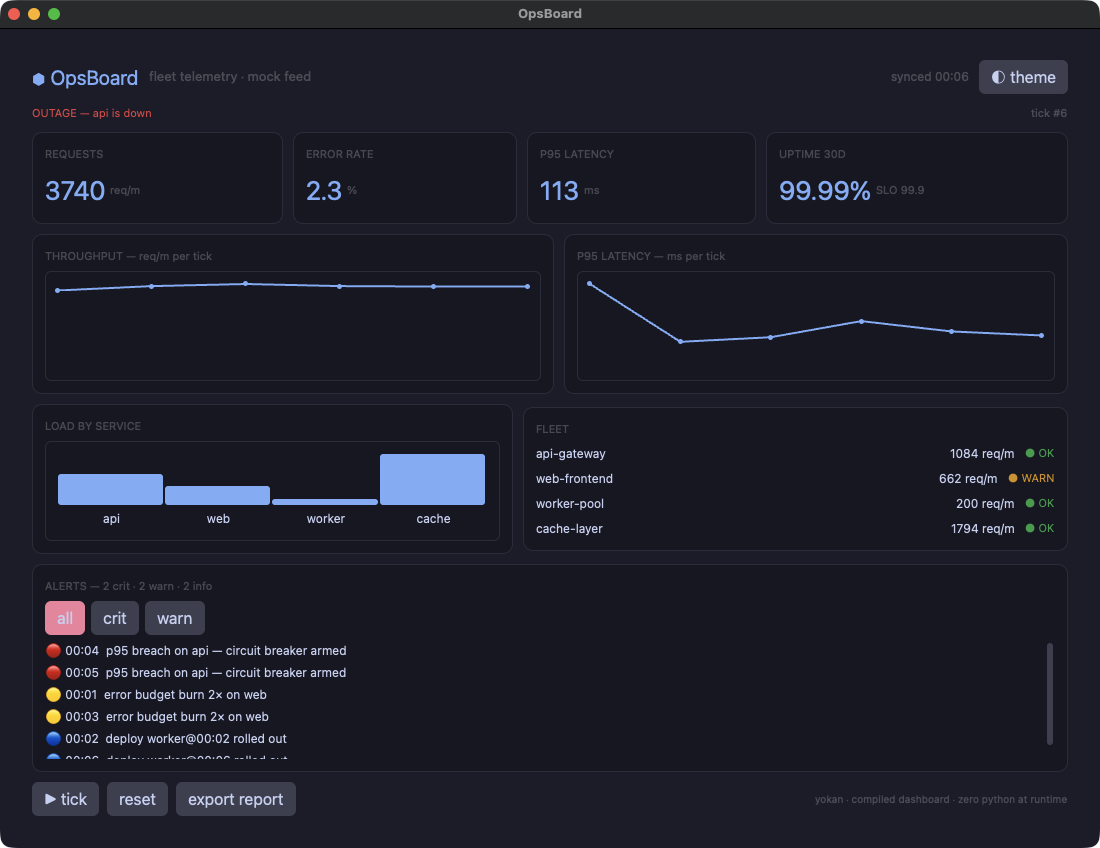
app.py
# /// script
# requires-python = ">=3.14"
# ///
"""OpsBoard — a fleet-operations dashboard, fully compiled.

Three modules, two stores, a sum-typed health model matched in the
view, seeded mock telemetry, charts, a virtualized alert feed with
severity filters, slotted cards, themed styling with a live palette
flip — and the shipped artifact is one native binary with no Python
in it. Every behavior below is gate-checked against CPython.

Run:   uv run demo/opsboard/app.py
Gate:  yokan gate demo/opsboard/app.py --script "click:reset,click:tick,..."
Ship:  yokan build demo/opsboard/app.py --release
"""
import os
import sys

sys.path.insert(0, os.path.join(os.path.dirname(os.path.abspath(__file__)), "..", ".."))
sys.path.insert(0, os.path.dirname(os.path.abspath(__file__)))

from yokan import (
    bar_chart,
    button,
    column,
    fs,
    line_chart,
    list_view,
    row,
    run,
    text,
)

from state import Alerts, Degraded, Healthy, Metrics, Outage, health, mode  # noqa: E402
from widgets import btn, btn_hot, card, h1, h2, kpi, panel, pill_crit, pill_ok, pill_warn, svc_row  # noqa: E402


def reset():
    Metrics.reset()
    Alerts.reset()
    health.set(Healthy())


def tick():
    Metrics.tick()
    Alerts.emit_tick(Metrics.ticks)
    if Alerts.crit_n > 1:
        health.set(Outage("api"))
    elif Alerts.crit_n > 0:
        health.set(Degraded(1))
    else:
        health.set(Healthy())


def boot():
    """Open onto history, not zeros: reset then replay six minutes
    of telemetry — deterministic, so both tiers boot identically."""
    Metrics.reset()
    Alerts.reset()
    for i in range(6):
        Metrics.tick()
        Alerts.emit_tick(Metrics.ticks)
    if Alerts.crit_n > 1:
        health.set(Outage("api"))
    elif Alerts.crit_n > 0:
        health.set(Degraded(1))
    else:
        health.set(Healthy())


def export():
    fs.write_text(
        "demo/.gate/opsboard-report.txt",
        f"OpsBoard report @ {Metrics.clock} — rps={Metrics.rps} p95={Metrics.p95}ms alerts={Alerts.crit_n}/{Alerts.warn_n}/{Alerts.info_n}",
    )


def flip_theme():
    if mode() == "dark":
        mode.set("light")
    else:
        mode.set("dark")


def alert_row(i):
    return text(Alerts.visible[i], size=12)


def view():
    with column(spacing=10, padding=16, background="windowBg", grow=1.0, theme=mode()):
        # ── header ────────────────────────────────────────────────
        with row(spacing=10):
            text("⬢ OpsBoard", **h1)
            text("fleet telemetry · mock feed", **h2)
            text(f"synced {Metrics.clock}", size=12, color="textDim", grow=1.0, align="right")
            button("◐ theme", on_click=flip_theme, **btn)
        # ── system health (sum type, matched live) ───────────────
        with row(spacing=8):
            match health():
                case Healthy():
                    text("ALL SYSTEMS NOMINAL", animate=140, easing="out", **pill_ok)
                case Degraded(services):
                    text(f"DEGRADED — {services} service(s) impacted", animate=140, easing="out", **pill_warn)
                case Outage(service):
                    text(f"OUTAGE — {service} is down", animate=140, easing="out", **pill_crit)
            text(f"tick #{Metrics.ticks}", size=11, color="textDim", grow=1.0, align="right")
        # ── KPI row ──────────────────────────────────────────────
        with row(spacing=10):
            kpi("REQUESTS", f"{Metrics.rps}", "req/m")
            kpi("ERROR RATE", f"{Metrics.err_pct:.1f}", "%")
            kpi("P95 LATENCY", f"{Metrics.p95}", "ms")
            kpi("UPTIME 30D", f"{Metrics.uptime}", "SLO 99.9")
        # ── charts ───────────────────────────────────────────────
        with row(spacing=10):
            with card("THROUGHPUT — req/m per tick"):
                line_chart(Metrics.rps_trend, height=110.0)
            with card("P95 LATENCY — ms per tick"):
                line_chart(Metrics.p95_trend, height=110.0)
        with row(spacing=10):
            with card("LOAD BY SERVICE"):
                bar_chart(Metrics.svc_reqs, labels=Metrics.svc_names, height=100.0)
            with card("FLEET"):
                svc_row("api-gateway", Metrics.api_r, Metrics.api_s)
                svc_row("web-frontend", Metrics.web_r, Metrics.web_s)
                svc_row("worker-pool", Metrics.worker_r, Metrics.worker_s)
                svc_row("cache-layer", Metrics.cache_r, Metrics.cache_s)
        # ── alert feed ───────────────────────────────────────────
        with card(f"ALERTS — {Alerts.crit_n} crit · {Alerts.warn_n} warn · {Alerts.info_n} info"):
            with row(spacing=6):
                # the highlight follows the ACTIVE filter
                if Alerts.filter == "all":
                    button("all", on_click=lambda: Alerts.set_filter("all"), **btn_hot)
                else:
                    button("all", on_click=lambda: Alerts.set_filter("all"), **btn)
                if Alerts.filter == "crit":
                    button("crit", on_click=lambda: Alerts.set_filter("crit"), **btn_hot)
                else:
                    button("crit", on_click=lambda: Alerts.set_filter("crit"), **btn)
                if Alerts.filter == "warn":
                    button("warn", on_click=lambda: Alerts.set_filter("warn"), **btn_hot)
                else:
                    button("warn", on_click=lambda: Alerts.set_filter("warn"), **btn)
            list_view(len(Alerts.visible), alert_row, item_height=22.0, grow=1.0)
        # ── footer ───────────────────────────────────────────────
        with row(spacing=8):
            button("▶ tick", on_click=tick, **btn)
            button("reset", on_click=reset, **btn)
            button("export report", on_click=export, **btn)
            text("yokan · compiled dashboard · zero python at runtime", size=10, color="textDim", grow=1.0, align="right")


if __name__ == "__main__":
    run(view, title="OpsBoard", width=1100, height=820, on_start=boot)
state.py
# /// script
# requires-python = ">=3.14"
# ///
"""OpsBoard state: the whole data model compiles — sum-typed fleet
health, two stores, seeded mock generation. No CPython at runtime.
"""
import random
from dataclasses import dataclass

from yokan import State, store  # noqa: E402
from yokan import clock

BASE_MS = 1767225600000  # 2026-01-01 00:00 UTC — the mock clock's epoch


@dataclass(frozen=True)
class Healthy:
    pass


@dataclass(frozen=True)
class Degraded:
    services: int


@dataclass(frozen=True)
class Outage:
    service: str


type Health = Healthy | Degraded | Outage

health: State[Health] = State(Healthy())
mode: State[str] = State("dark")


@store
class Metrics:
    ticks: int = 0
    clock: str = "--:--"
    rps: int = 0
    err_pct: float = 0.0
    p95: int = 0
    uptime: str = "99.99%"
    rps_trend: list[float] = []
    p95_trend: list[float] = []
    svc_reqs: list[int] = []
    svc_names: list[str] = ["api", "web", "worker", "cache"]
    api_r: int = 0
    api_s: str = "ok"
    web_r: int = 0
    web_s: str = "ok"
    worker_r: int = 0
    worker_s: str = "ok"
    cache_r: int = 0
    cache_s: str = "ok"

    def reset(self) -> None:
        random.seed(3)
        self.ticks = 0
        self.clock = "--:--"
        self.rps = 0
        self.err_pct = 0.0
        self.p95 = 0
        self.rps_trend = []
        self.p95_trend = []
        self.svc_reqs = []
        self.api_r = 0
        self.web_r = 0
        self.worker_r = 0
        self.cache_r = 0
        self.api_s = "ok"
        self.web_s = "ok"
        self.worker_s = "ok"
        self.cache_s = "ok"

    def tick(self) -> None:
        self.ticks += 1
        self.clock = clock.format_ms(1767225600000 + self.ticks * 60000, "%H:%M")
        self.api_r = 900 + random.randint(0, 300)
        self.web_r = 600 + random.randint(0, 250)
        self.worker_r = 200 + random.randint(0, 120)
        self.cache_r = 1500 + random.randint(0, 400)
        self.rps = self.api_r + self.web_r + self.worker_r + self.cache_r
        self.err_pct = 0.1 * random.randint(1, 28)
        self.p95 = 80 + random.randint(0, 220)
        self.rps_trend = self.rps_trend + [1.0 * self.rps]
        self.p95_trend = self.p95_trend + [1.0 * self.p95]
        self.svc_reqs = []
        self.svc_reqs = self.svc_reqs + [self.api_r]
        self.svc_reqs = self.svc_reqs + [self.web_r]
        self.svc_reqs = self.svc_reqs + [self.worker_r]
        self.svc_reqs = self.svc_reqs + [self.cache_r]
        if self.p95 > 260:
            self.api_s = "crit"
        elif self.p95 > 200:
            self.api_s = "warn"
        else:
            self.api_s = "ok"
        if self.err_pct > 2.0:
            self.web_s = "warn"
        else:
            self.web_s = "ok"


@store
class Alerts:
    crit_rows: list[str] = []
    warn_rows: list[str] = []
    info_rows: list[str] = []
    visible: list[str] = []
    filter: str = "all"
    crit_n: int = 0
    warn_n: int = 0
    info_n: int = 0

    def reset(self) -> None:
        self.crit_rows = []
        self.warn_rows = []
        self.info_rows = []
        self.visible = []
        self.filter = "all"
        self.crit_n = 0
        self.warn_n = 0
        self.info_n = 0

    def emit_tick(self, tick_no: int) -> None:
        stamp = clock.format_ms(1767225600000 + tick_no * 60000, "%H:%M")
        roll = random.randint(0, 9)
        if roll < 2:
            self.crit_rows = self.crit_rows + ["🔴 " + stamp + "  p95 breach on api — circuit breaker armed"]
            self.crit_n += 1
        elif roll < 5:
            self.warn_rows = self.warn_rows + ["🟡 " + stamp + "  error budget burn 2× on web"]
            self.warn_n += 1
        else:
            self.info_rows = self.info_rows + ["🔵 " + stamp + "  deploy worker@" + stamp + " rolled out"]
            self.info_n += 1
        self.rebuild()

    def set_filter(self, f: str) -> None:
        self.filter = f
        self.rebuild()

    def rebuild(self) -> None:
        self.visible = []
        if self.filter == "all":
            for r in self.crit_rows:
                self.visible = self.visible + [r]
            for r in self.warn_rows:
                self.visible = self.visible + [r]
            for r in self.info_rows:
                self.visible = self.visible + [r]
        elif self.filter == "crit":
            for r in self.crit_rows:
                self.visible = self.visible + [r]
        else:
            for r in self.warn_rows:
                self.visible = self.visible + [r]
widgets.py
# /// script
# requires-python = ">=3.14"
# ///
"""OpsBoard widgets: named styles and reusable components — the
slotted panel, KPI cards, status pills — all compiled to native
views with pixie's Slot{} splice.

Colors are theme TOKENS (panel/border/surface/textDim/accent…) so
the whole board re-skins on a palette flip; only the status colors
are fixed hex, picked to read on both palettes.
"""
from yokan import column, component, row, slot, style, text  # noqa: E402

panel = style(background="panel", border_radius=10, border_width=1.0, border_color="border", padding=12, spacing=6, grow=1.0)
kpi_label = style(size=11, color="textDim")
kpi_value = style(size=26, color="accent")
kpi_unit = style(size=11, color="textDim")
h1 = style(size=20, color="accent")
h2 = style(size=13, color="textDim")
pill_ok = style(size=11, color="#2fa84f")
pill_warn = style(size=11, color="#d99a1f")
pill_crit = style(size=11, color="#e5484d")
row_text = style(size=12)
btn = style(background="surface", hover_background="surfaceHover")
hot = style(background="#f38ba8", hover_background="#eba0ac")
btn_hot = btn | hot


@component(slots=True)
def card(title: str):
    with column(**panel):
        text(title, **kpi_label)
        slot()


@component
def kpi(label: str, value: str, unit: str):
    with column(**panel):
        text(label, **kpi_label)
        with row(spacing=4):
            text(value, **kpi_value)
            text(unit, **kpi_unit)


@component
def pill(status: str):
    with row():
        if status == "crit":
            text("● CRIT", **pill_crit)
        elif status == "warn":
            text("● WARN", **pill_warn)
        else:
            text("● OK", **pill_ok)


@component
def svc_row(name: str, reqs: int, status: str):
    with row(spacing=10):
        text(name, size=12, grow=1.0)
        text(f"{reqs} req/m", **row_text)
        pill(status)
forms — the full set of form controls: checkbox / switch / slider / select / radio_group / tab_bar; each handler receives the one new value
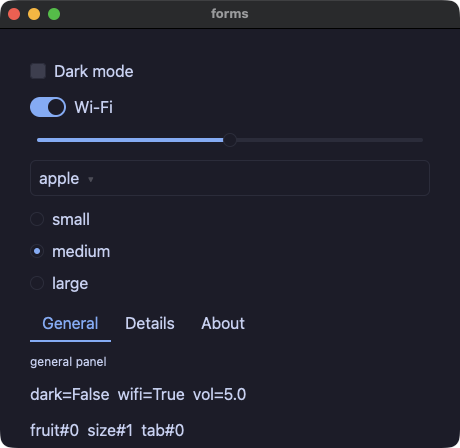
forms.py
# /// script
# requires-python = ">=3.14"
# ///
"""The form controls, gated: checkbox / switch (click by label
toggles), slider (`slide:` steps), select / radio_group / tab_bar
(`select:` steps) — every handler receives the new value as its one
argument. The last one is a text field that holds paragraphs:
`multiline=True` makes it wrap, `enter` writes a newline instead of
submitting, and `rows=` says how many lines are visible. Two of the
controls carry `tooltip=`, which every element takes: the window
shows it when the pointer rests there, and it is in the dump either
way, so a script sees it.
"""
import os
import sys

sys.path.insert(0, os.path.join(os.path.dirname(os.path.abspath(__file__)), ".."))

from yokan import (
    checkbox,
    column,
    text_field,
    radio_group,
    run,
    select,
    slider,
    State,
    store,
    switch,
    tab_bar,
    text,
)


@store
class Settings:
    dark: bool = False
    wifi: bool = True
    volume: float = 5.0
    fruits: list[str] = ["apple", "banana", "cherry"]
    fruit: int = 0
    sizes: list[str] = ["small", "medium", "large"]
    size: int = 1
    tabs: list[str] = ["General", "Details", "About"]
    tab: int = 0
    note: str = ""

    def set_dark(self, on: bool) -> None:
        self.dark = on

    def set_wifi(self, on: bool) -> None:
        self.wifi = on

    def set_volume(self, v: float) -> None:
        self.volume = v

    def pick_fruit(self, i: int) -> None:
        self.fruit = i

    def pick_size(self, i: int) -> None:
        self.size = i

    def pick_tab(self, i: int) -> None:
        self.tab = i

    def write(self, t: str) -> None:
        self.note = t


def view():
    with column(spacing=10, padding=14):
        checkbox(
            "Dark mode",
            checked=Settings.dark,
            on_change=Settings.set_dark,
            tooltip="the whole window follows this",
        )
        switch("Wi-Fi", checked=Settings.wifi, on_change=Settings.set_wifi)
        slider(
            value=Settings.volume,
            min=0.0,
            max=10.0,
            step=1.0,
            on_change=Settings.set_volume,
            tooltip="0 to 10, in whole steps",
        )
        select(options=Settings.fruits, selected=Settings.fruit, on_change=Settings.pick_fruit)
        radio_group(options=Settings.sizes, selected=Settings.size, on_change=Settings.pick_size)
        tab_bar(labels=Settings.tabs, active=Settings.tab, on_change=Settings.pick_tab)
        if Settings.tab == 0:
            text("general panel", size=12)
        elif Settings.tab == 1:
            text("details panel", size=12)
        else:
            text("about panel", size=12)
        text_field(
            Settings.note,
            placeholder="notes (enter writes a newline)",
            on_change=Settings.write,
            multiline=True,
            rows=3,
        )
        text(f"dark={Settings.dark}  wifi={Settings.wifi}  vol={Settings.volume:.1f}")
        text(f"fruit#{Settings.fruit}  size#{Settings.size}  tab#{Settings.tab}")


if __name__ == "__main__":
    run(view, title="forms", width=460, height=420)
calc — the classic keypad calculator: the layout is all grow (rows share the height, keys share each row, the zero key takes two shares), so resizing scales the pad with no dead space
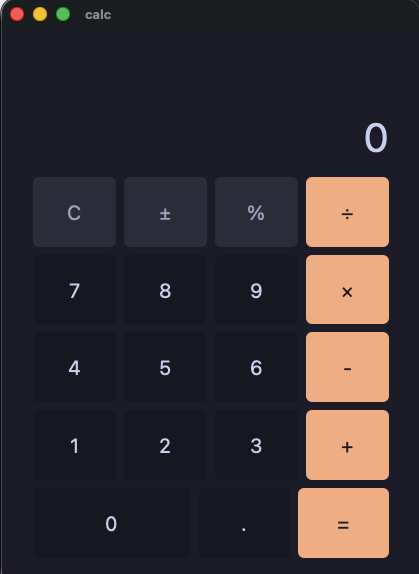
calc.py
# /// script
# requires-python = ">=3.14"
# ///
"""A calculator — the classic keypad, in the dialect. The layout is
all `grow`: the root column fills the window, every row shares the
height, keys share each row's width, and the zero key takes two
shares (`grow=2`), so resizing the window scales the whole pad with
no dead space. Styles are dicts merged with `|`.
`strings.to_float` is total (bad text parses as the default), so
the arithmetic needs no try."""
import os
import sys

sys.path.insert(0, os.path.join(os.path.dirname(os.path.abspath(__file__)), ".."))

from yokan import button, column, row, run, store, strings, style, text  # noqa: E402


@store
class Calc:
    display: str = "0"
    acc: float = 0.0
    op: str = ""
    fresh: bool = True
    has_dot: bool = False

    def press(self, d: str) -> None:
        if self.fresh:
            self.display = d
            self.fresh = False
            self.has_dot = False
        elif self.display == "0":
            self.display = d
        else:
            self.display = self.display + d

    def dot(self) -> None:
        if self.fresh:
            self.display = "0."
            self.fresh = False
            self.has_dot = True
        elif not self.has_dot:
            self.display = self.display + "."
            self.has_dot = True

    def negate(self) -> None:
        v = strings.to_float(self.display, 0.0)
        if v != 0.0:
            self.display = f"{0.0 - v}"
            self.fresh = False

    def percent(self) -> None:
        v = strings.to_float(self.display, 0.0)
        self.display = f"{v / 100.0}"
        self.fresh = True
        self.has_dot = False

    def apply(self, nxt: str) -> None:
        if self.fresh and self.op != "":
            self.op = nxt
            return
        cur = strings.to_float(self.display, 0.0)
        if self.op == "":
            self.acc = cur
        if self.op == "+":
            self.acc = self.acc + cur
        if self.op == "-":
            self.acc = self.acc - cur
        if self.op == "×":
            self.acc = self.acc * cur
        if self.op == "÷":
            if cur == 0.0:
                self.display = "Error"
                self.acc = 0.0
                self.op = ""
                self.fresh = True
                return
            self.acc = self.acc / cur
        self.display = f"{self.acc}"
        self.op = nxt
        self.fresh = True

    def do_op(self, o: str) -> None:
        Calc.apply(o)

    def equals(self) -> None:
        Calc.apply("")

    def clear(self) -> None:
        self.display = "0"
        self.acc = 0.0
        self.op = ""
        self.fresh = True
        self.has_dot = False


key = style(
    grow=1, size=20, background="panel",
    hover_background="#45475a", active_background="#585b70",
)
fun_tint = style(background="#313244", color="#a6adc8")
fun = key | fun_tint
op_tint = style(
    background="#fab387", color="#1e1e2e",
    hover_background="#f8c49b", active_background="#f5e0dc",
)
op = key | op_tint
wide_tint = style(grow=2, basis=8)
wide = key | wide_tint
readout = style(size=40, color="text", align="right", grow=1.4)
keys = style(spacing=8, grow=1)


def view():
    with column(spacing=8, padding=16, grow=1):
        text(f"{Calc.display}", **readout)
        with row(**keys):
            button("C", on_click=Calc.clear, **fun)
            button("±", on_click=Calc.negate, **fun)
            button("%", on_click=Calc.percent, **fun)
            button("÷", on_click=lambda: Calc.do_op("÷"), **op)
        with row(**keys):
            button("7", on_click=lambda: Calc.press("7"), **key)
            button("8", on_click=lambda: Calc.press("8"), **key)
            button("9", on_click=lambda: Calc.press("9"), **key)
            button("×", on_click=lambda: Calc.do_op("×"), **op)
        with row(**keys):
            button("4", on_click=lambda: Calc.press("4"), **key)
            button("5", on_click=lambda: Calc.press("5"), **key)
            button("6", on_click=lambda: Calc.press("6"), **key)
            button("-", on_click=lambda: Calc.do_op("-"), **op)
        with row(**keys):
            button("1", on_click=lambda: Calc.press("1"), **key)
            button("2", on_click=lambda: Calc.press("2"), **key)
            button("3", on_click=lambda: Calc.press("3"), **key)
            button("+", on_click=lambda: Calc.do_op("+"), **op)
        with row(**keys):
            button("0", on_click=lambda: Calc.press("0"), **wide)
            button(".", on_click=Calc.dot, **key)
            button("=", on_click=Calc.equals, **op)


if __name__ == "__main__":
    run(view, title="calc")
calcgrid — the same calculator on grid(columns=4, rows=5): equal tracks, one container instead of five rows, and the zero key spans two cells with col_span=2
calcgrid.py
# /// script
# requires-python = ">=3.14"
# ///
"""The calculator again, on a grid. `grid(columns=4, rows=5)`
lays equal tracks, every key fills its cell, and the zero key says
`col_span=2` — the whole keypad is one container instead of five
rows. Same store as demo/calc.py; only the view differs."""
import os
import sys

sys.path.insert(0, os.path.join(os.path.dirname(os.path.abspath(__file__)), ".."))

from yokan import button, column, grid, run, store, strings, style, text  # noqa: E402


@store
class Calc:
    display: str = "0"
    acc: float = 0.0
    op: str = ""
    fresh: bool = True
    has_dot: bool = False

    def press(self, d: str) -> None:
        if self.fresh:
            self.display = d
            self.fresh = False
            self.has_dot = False
        elif self.display == "0":
            self.display = d
        else:
            self.display = self.display + d

    def dot(self) -> None:
        if self.fresh:
            self.display = "0."
            self.fresh = False
            self.has_dot = True
        elif not self.has_dot:
            self.display = self.display + "."
            self.has_dot = True

    def negate(self) -> None:
        v = strings.to_float(self.display, 0.0)
        if v != 0.0:
            self.display = f"{0.0 - v}"
            self.fresh = False

    def percent(self) -> None:
        v = strings.to_float(self.display, 0.0)
        self.display = f"{v / 100.0}"
        self.fresh = True
        self.has_dot = False

    def apply(self, nxt: str) -> None:
        if self.fresh and self.op != "":
            self.op = nxt
            return
        cur = strings.to_float(self.display, 0.0)
        if self.op == "":
            self.acc = cur
        if self.op == "+":
            self.acc = self.acc + cur
        if self.op == "-":
            self.acc = self.acc - cur
        if self.op == "×":
            self.acc = self.acc * cur
        if self.op == "÷":
            if cur == 0.0:
                self.display = "Error"
                self.acc = 0.0
                self.op = ""
                self.fresh = True
                return
            self.acc = self.acc / cur
        self.display = f"{self.acc}"
        self.op = nxt
        self.fresh = True

    def do_op(self, o: str) -> None:
        Calc.apply(o)

    def equals(self) -> None:
        Calc.apply("")

    def clear(self) -> None:
        self.display = "0"
        self.acc = 0.0
        self.op = ""
        self.fresh = True
        self.has_dot = False


key = style(
    size=20, background="panel",
    hover_background="#45475a", active_background="#585b70",
)
fun_tint = style(background="#313244", color="#a6adc8")
fun = key | fun_tint
op_tint = style(
    background="#fab387", color="#1e1e2e",
    hover_background="#f8c49b", active_background="#f5e0dc",
)
op = key | op_tint
readout = style(size=40, color="text", align="right", grow=1.4)


def view():
    with column(spacing=8, padding=16, grow=1):
        text(f"{Calc.display}", **readout)
        with grid(columns=4, rows=5, spacing=8, grow=5):
            button("C", on_click=Calc.clear, **fun)
            button("±", on_click=Calc.negate, **fun)
            button("%", on_click=Calc.percent, **fun)
            button("÷", on_click=lambda: Calc.do_op("÷"), **op)
            button("7", on_click=lambda: Calc.press("7"), **key)
            button("8", on_click=lambda: Calc.press("8"), **key)
            button("9", on_click=lambda: Calc.press("9"), **key)
            button("×", on_click=lambda: Calc.do_op("×"), **op)
            button("4", on_click=lambda: Calc.press("4"), **key)
            button("5", on_click=lambda: Calc.press("5"), **key)
            button("6", on_click=lambda: Calc.press("6"), **key)
            button("-", on_click=lambda: Calc.do_op("-"), **op)
            button("1", on_click=lambda: Calc.press("1"), **key)
            button("2", on_click=lambda: Calc.press("2"), **key)
            button("3", on_click=lambda: Calc.press("3"), **key)
            button("+", on_click=lambda: Calc.do_op("+"), **op)
            button("0", on_click=lambda: Calc.press("0"), col_span=2, **key)
            button(".", on_click=Calc.dot, **key)
            button("=", on_click=Calc.equals, **op)


if __name__ == "__main__":
    run(view, title="calcgrid")
Holding state
stores — named stores: the class name IS the singleton, and stores call each other's methods
stores.py
# /// script
# requires-python = ">=3.14"
# ///
"""Named stores: `@store` is a process-lifetime singleton with
fields AND methods — the decorator returns the instance, so the
class name IS the store. Stores
call each other's methods; views read their fields reactively.
"""
import os
import sys

sys.path.insert(0, os.path.join(os.path.dirname(os.path.abspath(__file__)), ".."))

from yokan import button, column, row, run, store, text  # noqa: E402


@store
class Settings:
    factor: int = 2

    def double(self) -> None:
        self.factor *= 2


@store
class Cart:
    items: list[str] = []
    total: int = 0

    def add(self, name: str, price: int) -> None:
        self.items = self.items + [name]
        self.total += price * Settings.factor
        Settings.double()

    def clear(self) -> None:
        self.items = []
        self.total = 0


def view():
    with column(spacing=8, padding=12):
        text(f"n={len(Cart.items)} total={Cart.total} f={Settings.factor}")
        with row(spacing=6):
            button("add", on_click=lambda: Cart.add("apple", 10))
            button("clear", on_click=Cart.clear)


if __name__ == "__main__":
    run(view, title="stores")
models — @model and Protocol: observed objects, and statically dispatched interfaces
models.py
# /// script
# requires-python = ">=3.14"
# ///
"""class ↔ @model and trait ↔ Protocol. A model is an observed
object: Python objects and native handles are both references, so
identity agrees from the start. A Protocol base routes its methods
into a native `impl`, and a Protocol-typed helper compiles to a
bounded generic fn — static dispatch, no boxing.
"""
import os
import sys

sys.path.insert(0, os.path.join(os.path.dirname(os.path.abspath(__file__)), ".."))

from typing import Protocol  # noqa: E402

from yokan import button, column, model, run, State, text  # noqa: E402


class Shape(Protocol):
    def area(self) -> float: ...


@model
class Circle(Shape):
    r: float = 1.0
    hits: int = 0

    def grow(self, by: float) -> None:
        self.r += by
        self.hits += 1

    def area(self) -> float:
        return self.r * self.r * 3.0


left = Circle()
right = Circle()
total: State[float] = State(0.0)


def area_of(s: Shape) -> float:
    return s.area()


def bump():
    left.grow(0.5)
    right.grow(2.0)
    total.set(area_of(left) + area_of(right))


def view():
    with column(spacing=8, padding=12):
        text(f"L={left.hits} R={right.hits} total={total():.2f}")
        button("bump", on_click=bump)


if __name__ == "__main__":
    run(view, title="models")
links — models referencing models: owning Node | None, non-owning Weak[Node] back pointers (no cycles, so dropping the root frees the chain)
links.py
# /// script
# requires-python = ">=3.14"
# ///
"""Models referencing models, gated: `Node | None` fields wire an
ownership chain in handlers, `Weak[Node]` is the not-owning back
pointer (it breaks the cycle, so dropping the root frees the chain
in both tiers at the same statement), and views read through
walrus-narrowed bindings.
"""
import os
import sys

sys.path.insert(0, os.path.join(os.path.dirname(os.path.abspath(__file__)), ".."))

from yokan import button, column, model, row, run, State, store, text, Weak  # noqa: E402


@model
class Node:
    label: str = "n"
    kid: Node | None = None
    parent: Weak[Node] = None


@store
class Tree:
    root: Node | None = None
    keep: Node | None = None
    note: str = "-"

    def build(self) -> None:
        a = Node()
        a.label = "alpha"
        b = Node()
        b.label = "beta"
        a.kid = b
        b.parent = a
        self.root = a
        self.keep = b

    def drop_root(self) -> None:
        self.root = None

    def peek(self) -> None:
        if (r := Tree.root) is not None:
            if (k := r.kid) is not None:
                if (p := k.parent) is not None:
                    self.note = f"kid={k.label} parent={p.label}"
                else:
                    self.note = f"kid={k.label} parent=gone"
            else:
                self.note = "no kid"
        elif (k := Tree.keep) is not None:
            if (p := k.parent) is not None:
                self.note = f"kept {k.label}, parent={p.label}"
            else:
                self.note = f"kept {k.label}, parent=gone"
        else:
            self.note = "no root"


def view():
    with column(spacing=8, padding=12):
        text(f"note: {Tree.note}")
        if (r := Tree.root) is not None:
            text(f"root: {r.label}")
        else:
            text("root: (none)")
        with row(spacing=6):
            button("build", on_click=Tree.build)
            button("peek", on_click=Tree.peek)
            button("drop", on_click=Tree.drop_root)


if __name__ == "__main__":
    run(view, title="links")
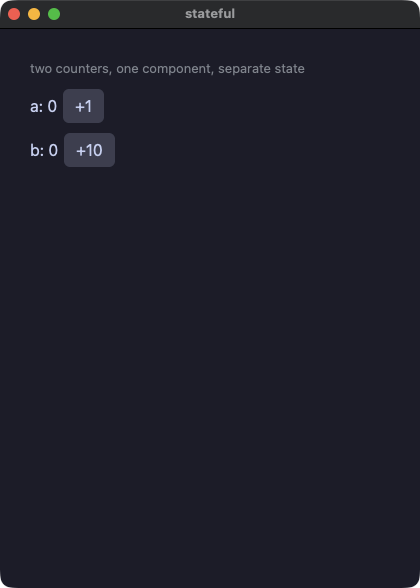
stateful — @component + local: a component with its own state per call site
stateful.py
# /// script
# requires-python = ">=3.14"
# ///
"""Per-instance state: @component + local. Each call site owns
its own `n`; identity is positional (the no-key rule), and the state
survives rebuilds and reloads.
"""
import os
import sys

sys.path.insert(0, os.path.join(os.path.dirname(os.path.abspath(__file__)), ".."))

from yokan import button, column, component, local, row, run, State, text  # noqa: E402


@component
def counter(label: str, step: int):
    n: State[int] = local(0)
    with row(spacing=6):
        text(f"{label}: {n()}")
        button(f"+{step}", on_click=lambda: n.set(n() + step))


def view():
    with column(spacing=10, padding=14):
        text("two counters, one component, separate state", size=13, color="#8a8f98")
        counter("a", 1)
        counter("b", 10)


if __name__ == "__main__":
    run(view, title="stateful")
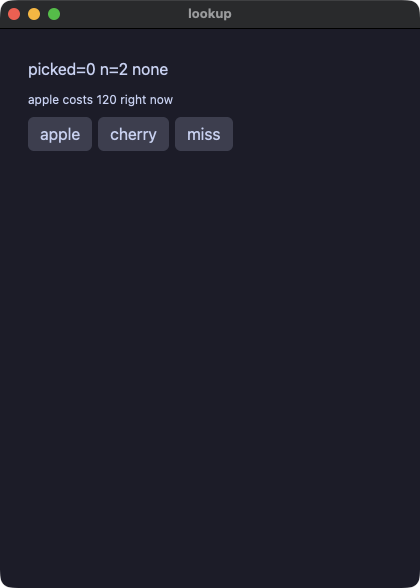
lookup — dict cells: reads via .get(key, default) and in, writes in place with cell[k] = v
lookup.py
# /// script
# requires-python = ">=3.14"
# ///
"""Dict cells. The order question is DECIDED: iteration stays out
(Python orders by insertion, native maps by key — admitting either
would lie), and everything order-free is in: per-key writes land in
place in both tiers (`prices["cherry"] = 200` is pixie's
`m[k] = v`), reads are total via .get(key, default), membership
guards conditions, len counts.
"""
import os
import sys

sys.path.insert(0, os.path.join(os.path.dirname(os.path.abspath(__file__)), ".."))

from yokan import button, column, row, run, State, text  # noqa: E402

prices: State[dict[str, int]] = State({"apple": 120, "banana": 80})
picked: State[int] = State(0)
label: State[str] = State("none")


def pick_apple():
    picked.set(prices().get("apple", -1))
    if "cherry" in prices():
        label.set("cherry known")
    else:
        label.set("no cherry")


def add_cherry():
    prices["cherry"] = 200
    picked.set(prices().get("cherry", -1))
    if "cherry" in prices():
        label.set("cherry known")


def miss():
    picked.set(prices().get("durian", -7))


def view():
    with column(spacing=8, padding=12):
        text(f"picked={picked()} n={len(prices())} {label()}")
        text(f"apple costs {prices().get('apple', -1)} right now", size=12)
        with row(spacing=6):
            button("apple", on_click=pick_apple)
            button("cherry", on_click=add_cherry)
            button("miss", on_click=miss)


if __name__ == "__main__":
    run(view, title="lookup")
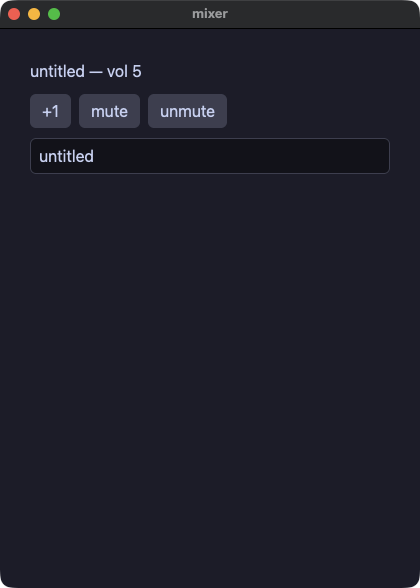
mixer — a fields-only @store: annotated fields, direct assignment, the screen follows
mixer.py
# /// script
# requires-python = ">=3.14"
# ///
"""Grouped state is a fields-only @store: annotated fields, direct
reads in views (`Mixer.volume`), writes through methods — no
separate instance line, and methods are there the day you need one.
"""
import os
import sys

sys.path.insert(0, os.path.join(os.path.dirname(os.path.abspath(__file__)), ".."))

from yokan import button, column, row, run, store, text, text_field  # noqa: E402


@store
class Mixer:
    volume: int = 5
    title: str = "untitled"
    muted: bool = False

    def louder(self) -> None:
        self.volume += 1

    def set_muted(self, on: bool) -> None:
        self.muted = on

    def rename(self, t: str) -> None:
        self.title = t


def view():
    with column(spacing=10, padding=14):
        text(f"{Mixer.title} — vol {Mixer.volume}", size=16)
        with row(spacing=8):
            button("+1", on_click=Mixer.louder)
            button("mute", on_click=lambda: Mixer.set_muted(True))
            button("unmute", on_click=lambda: Mixer.set_muted(False))
        if Mixer.muted:
            text("(muted)", size=12, color="#8a8f98")
        text_field(Mixer.title, placeholder="title", on_change=Mixer.rename)


if __name__ == "__main__":
    run(view, title="mixer")
Values and types
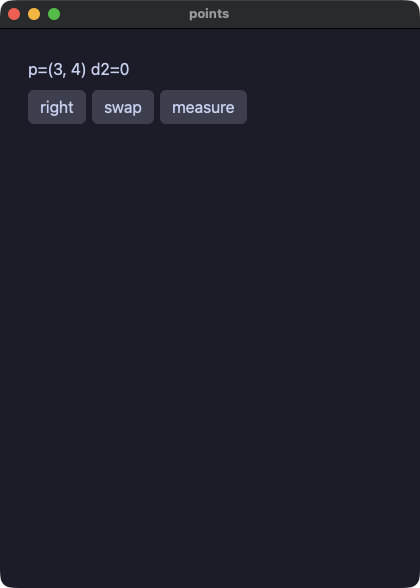
points — Value classes (frozen dataclasses): updates are functional, via replace
points.py
# /// script
# requires-python = ">=3.14"
# ///
"""struct ↔ frozen dataclass. `frozen=True` is the admission ticket:
an immutable value cannot expose Python's reference aliasing, so it
means the same thing as a native COW value by construction. Updates
are `dataclasses.replace` — a new value, both tiers.
"""
import os
import sys

sys.path.insert(0, os.path.join(os.path.dirname(os.path.abspath(__file__)), ".."))

from dataclasses import dataclass, replace  # noqa: E402

from yokan import button, column, row, run, State, text  # noqa: E402


@dataclass(frozen=True)
class Point:
    x: int
    y: int = 0


sel: State[Point] = State(Point(3, 4))
dist: State[int] = State(0)


def move_right():
    sel.set(replace(sel(), x=sel().x + 5))


def swap():
    sel.set(Point(sel().y, sel().x))


def measure():
    p = sel()
    dist.set(p.x * p.x + p.y * p.y)


def view():
    with column(spacing=8, padding=12):
        text(f"p=({sel().x}, {sel().y}) d2={dist()}")
        with row(spacing=6):
            button("right", on_click=move_right)
            button("swap", on_click=swap)
            button("measure", on_click=measure)


if __name__ == "__main__":
    run(view, title="points")
pkgapp — an app built from a package written in the dialect: py.yokan marks it, its modules compile in, and the Rust crate it declares rides along
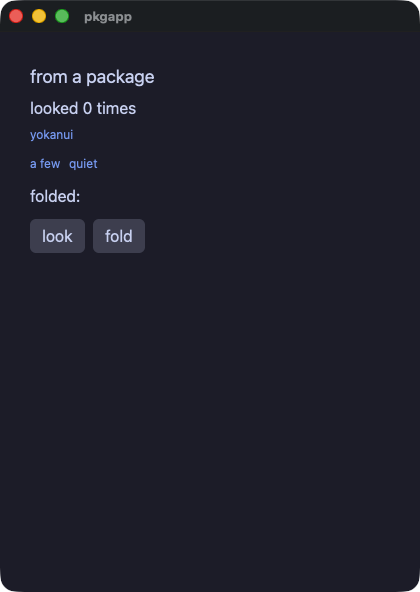
pkgapp.py
# /// script
# requires-python = ">=3.14"
# ///
"""An app built from a package written in the dialect.

`yokanui` is an ordinary installed Python package that carries a
`py.yokan` marker beside its `__init__.py`. The translator reads its
modules the way it reads the app's own files and compiles them into
the same binary, so there is no library at run time and nothing to
ship beside the app.

Its names are emitted under names derived from its modules, so the
package and the app can both have a `badge` and neither has to know
about the other. Here they do.
"""
import os
import sys

sys.path.insert(0, os.path.join(os.path.dirname(os.path.abspath(__file__)), ".."))

from yokan import State, button, column, row, run, text  # noqa: E402
from yokanui import badge, panel, pill, plain  # noqa: E402

seen: State[int] = State(0)
folded: State[str] = State("")


def badge_of(n: int) -> str:
    """The app's own `badge`-ish name, which the package's `badge`
    does not disturb."""
    return "many" if n > 2 else "a few"


def look() -> None:
    seen.set(seen() + 1)


def fold() -> None:
    # The package declares the Rust crate this calls, and the app
    # never mentions it: `[tool.yokan.crates]` beside the marker
    # merges into the app's.
    folded.set(plain("ようかん"))


def view() -> None:
    with column(spacing=10, padding=14):
        panel("from a package", f"looked {seen()} times")
        with row(spacing=8):
            badge(badge_of(seen()))
            pill("loud" if seen() > 2 else "quiet", seen() > 2)
        text(f"folded: {folded()}")
        with row(spacing=8):
            button("look", on_click=look)
            button("fold", on_click=fold)


if __name__ == "__main__":
    run(view, title="pkgapp")
points.py
# /// script
# requires-python = ">=3.14"
# ///
"""struct ↔ frozen dataclass. `frozen=True` is the admission ticket:
an immutable value cannot expose Python's reference aliasing, so it
means the same thing as a native COW value by construction. Updates
are `dataclasses.replace` — a new value, both tiers.
"""
import os
import sys

sys.path.insert(0, os.path.join(os.path.dirname(os.path.abspath(__file__)), ".."))

from dataclasses import dataclass, replace  # noqa: E402

from yokan import button, column, row, run, State, text  # noqa: E402


@dataclass(frozen=True)
class Point:
    x: int
    y: int = 0


sel: State[Point] = State(Point(3, 4))
dist: State[int] = State(0)


def move_right():
    sel.set(replace(sel(), x=sel().x + 5))


def swap():
    sel.set(Point(sel().y, sel().x))


def measure():
    p = sel()
    dist.set(p.x * p.x + p.y * p.y)


def view():
    with column(spacing=8, padding=12):
        text(f"p=({sel().x}, {sel().y}) d2={dist()}")
        with row(spacing=6):
            button("right", on_click=move_right)
            button("swap", on_click=swap)
            button("measure", on_click=measure)


if __name__ == "__main__":
    run(view, title="points")
vecops — operators on Value classes: define __add__ / __sub__ / __mul__ and + - * mean that
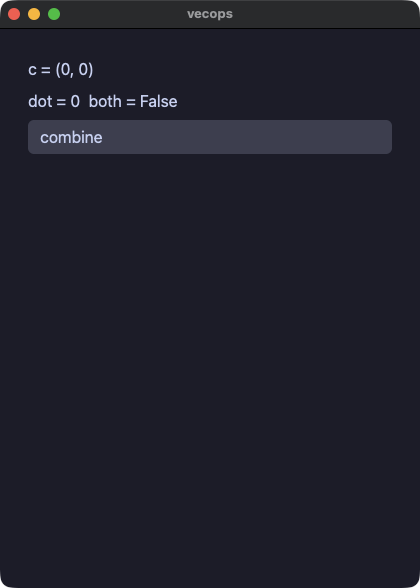
vecops.py
# /// script
# requires-python = ">=3.14"
# ///
"""Operator overloading on value classes, gated: __add__ / __sub__ /
__mul__ become the operator's meaning in both tiers, and plain value
methods are handler-callable. Bool logic as a VALUE (and / or / not
over bools) rides along.
"""
import os
import sys

sys.path.insert(0, os.path.join(os.path.dirname(os.path.abspath(__file__)), ".."))

from yokan import button, column, run, State, text, value  # noqa: E402


@value
class V2:
    x: int
    y: int

    def __add__(self, o: "V2") -> "V2":
        return V2(self.x + o.x, self.y + o.y)

    def __sub__(self, o: "V2") -> "V2":
        return V2(self.x - o.x, self.y - o.y)

    def __mul__(self, k: int) -> "V2":
        return V2(self.x * k, self.y * k)

    def dot(self, o: "V2") -> int:
        return self.x * o.x + self.y * o.y


a: State[V2] = State(V2(1, 2))
b: State[V2] = State(V2(10, 20))
c: State[V2] = State(V2(0, 0))
d: State[int] = State(0)
both: State[bool] = State(False)
hot: State[bool] = State(True)
cold: State[bool] = State(False)


def combine():
    c.set(a() + b() * 2 - V2(1, 1))
    d.set(a().dot(b()))
    both.set(hot() and not cold())


def view():
    with column(spacing=6, padding=12):
        text(f"c = ({c().x}, {c().y})")
        text(f"dot = {d()}  both = {both()}")
        button("combine", on_click=combine)


if __name__ == "__main__":
    run(view, title="vecops")
geometry — static dispatch through Protocol: the trait story, compiled
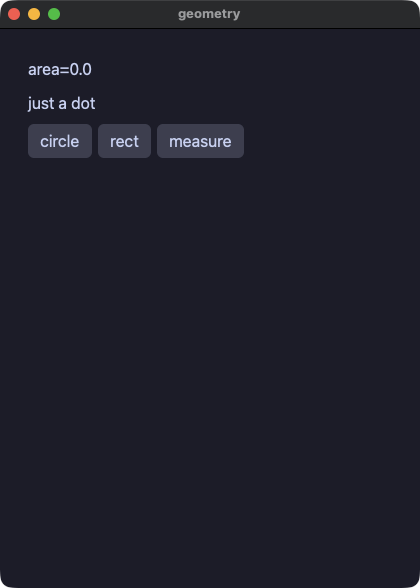
geometry.py
# /// script
# requires-python = ">=3.14"
# ///
"""Sum types: frozen dataclasses joined by a `type` alias compile to
a native payload enum, and `match` destructures in handlers AND view
bodies — this required fixing a real substrate contradiction (the
checker demanded view patterns the emitter refused; both tiers can
bind them now).
"""
import os
import sys

sys.path.insert(0, os.path.join(os.path.dirname(os.path.abspath(__file__)), ".."))

from dataclasses import dataclass  # noqa: E402

from yokan import button, column, row, run, State, text  # noqa: E402


@dataclass(frozen=True)
class Circle:
    r: float


@dataclass(frozen=True)
class Rect:
    w: float
    h: float


@dataclass(frozen=True)
class Dot:
    pass


type Shape = Circle | Rect | Dot

sel: State[Shape] = State(Dot())
area: State[float] = State(0.0)


def mk_circle():
    sel.set(Circle(2.0))


def mk_rect():
    sel.set(Rect(3.0, 4.0))


def measure():
    match sel():
        case Circle(r):
            area.set(r * r * 3.0)
        case Rect(w, h):
            area.set(w * h)
        case Dot():
            area.set(0.0)


def view():
    with column(spacing=8, padding=12):
        text(f"area={area():.1f}")
        match sel():
            case Circle(r):
                text(f"circle r={r:.1f}")
            case Rect(w, h):
                text(f"rect {w:.1f} x {h:.1f}")
            case Dot():
                text("just a dot")
        with row(spacing=6):
            button("circle", on_click=mk_circle)
            button("rect", on_click=mk_rect)
            button("measure", on_click=measure)


if __name__ == "__main__":
    run(view, title="geometry")
moods — Enum, Optional and animation
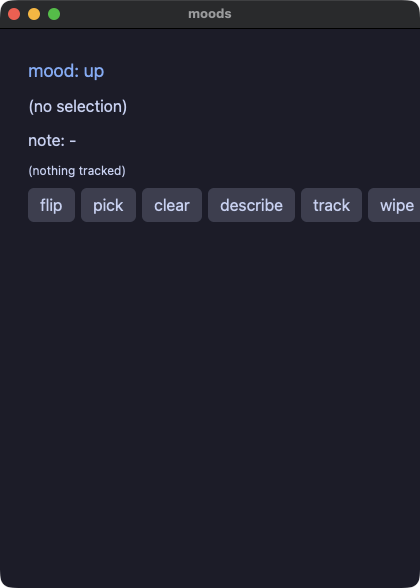
moods.py
# /// script
# requires-python = ">=3.14"
# ///
"""Enum, Optional and animation. `match` IS pixie's `case` (exhaustiveness checked
natively), the walrus IS `if let some(v)` (Python's own spelling of
narrowing), and `animate=`/`easing=` ride the kernel's animation clock, so
`advance:` frames dump identically in both tiers.
"""
import os
import sys

sys.path.insert(0, os.path.join(os.path.dirname(os.path.abspath(__file__)), ".."))

from enum import Enum, auto  # noqa: E402

from yokan import button, column, row, run, State, store, text  # noqa: E402


class Mood(Enum):
    HAPPY = auto()
    SAD = auto()


@store
class Tracker:
    last: int | None = None
    trend: Mood = Mood.HAPPY

    def note(self, v: int) -> None:
        self.last = v
        match self.trend:
            case Mood.HAPPY:
                self.trend = Mood.SAD
            case Mood.SAD:
                self.trend = Mood.HAPPY

    def wipe(self) -> None:
        self.last = None


mood: State[Mood] = State(Mood.HAPPY)
sel: State[int | None] = State(None)
note: State[str] = State("-")


def flip():
    match mood():
        case Mood.HAPPY:
            mood.set(Mood.SAD)
        case Mood.SAD:
            mood.set(Mood.HAPPY)


def describe():
    if (v := sel()) is not None:
        note.set(f"picked {v}")
    else:
        note.set("nothing picked")


def view():
    with column(spacing=8, padding=12):
        match mood():
            case Mood.HAPPY:
                text("mood: up", size=18, color="accent", animate=120, easing="out")
            case Mood.SAD:
                text("mood: down", size=18, color="#f38ba8", animate=120, easing="out")
        if (v := sel()) is not None:
            text(f"selection: {v}")
        else:
            text("(no selection)")
        text(f"note: {note()}")
        if (t := Tracker.last) is not None:
            text(f"tracked: {t}", size=12)
        else:
            text("(nothing tracked)", size=12)
        with row(spacing=6):
            button("flip", on_click=flip)
            button("pick", on_click=lambda: sel.set(7))
            button("clear", on_click=lambda: sel.set(None))
            button("describe", on_click=describe)
            button("track", on_click=lambda: Tracker.note(9), animate=100, easing="inOut")
            button("wipe", on_click=Tracker.wipe)


if __name__ == "__main__":
    run(view, title="moods")
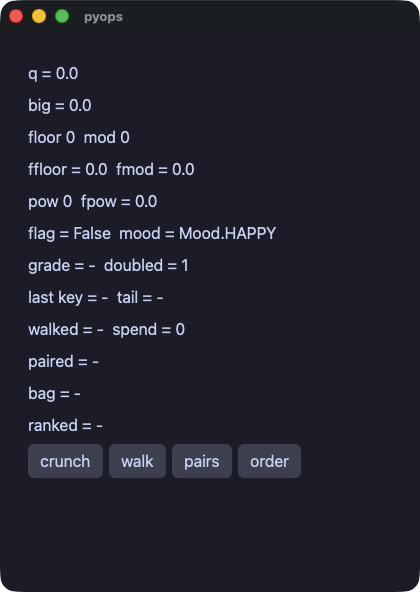
pyops — CPython's own arithmetic: / // % **, negative indexing, ordering by a key — byte-identical in both runs
pyops.py
# /// script
# requires-python = ">=3.14"
# ///
"""Python-semantics operations, gated: `/` `//` `%` `**`, bare
float/bool/enum text, negative indexing, dict iteration (the keys
in the order they went in, the values, `.items()`, and sorted()),
tuples (a literal, a part, unpacking, a pair loop, a tuple return),
ordering by a key (`sorted`/`min`/`max` with `key=`, `reverse=`),
comprehensions and `[::-1]` over a value class, if/else locals that
outlive the branch, @value, list-typed store method parameters.
The interpreted run uses the real operators and str(); the compiled
run reproduces CPython's results exactly — the gate proves they print
the same bytes.
"""
import os
import sys
from enum import Enum

sys.path.insert(0, os.path.join(os.path.dirname(os.path.abspath(__file__)), ".."))

from yokan import button, column, row, run, State, store, text, value  # noqa: E402


@value
class Point:
    x: int
    y: int = 0


class Mood(Enum):
    HAPPY = 1
    GRUMPY = 2


q: State[float] = State(0.0)
big: State[float] = State(0.0)
fd: State[int] = State(0)
md: State[int] = State(0)
ffd: State[float] = State(0.0)
fmd: State[float] = State(0.0)
p2: State[int] = State(0)
pf: State[float] = State(0.0)
flag: State[bool] = State(False)
mood: State[Mood] = State(Mood.HAPPY)
grade: State[str] = State("-")
last_key: State[str] = State("-")
walked: State[str] = State("-")
paired: State[str] = State("-")
sized: State[tuple[str, int]] = State(("-", 0))
spend: State[int] = State(0)
tail: State[str] = State("-")
pt: State[Point] = State(Point(3, 4))
prices: State[dict[str, int]] = State({"cherry": 300, "apple": 120, "banana": 80})
names: State[list[str]] = State(["ada", "erik", "momo"])
people: State[list[Point]] = State([Point(3, 1), Point(1, 5), Point(2, 5)])
ranked: State[str] = State("-")


@store
class Bag:
    joined: str = "-"

    def take(self, xs: list[str]) -> None:
        self.joined = ""
        for x in xs:
            self.joined = self.joined + x

    def spot(self, p: Point) -> None:
        self.joined = f"({p.x}, {p.y})"


def crunch():
    q.set(1 / 3)
    big.set(9007199254740993 / 3)
    fd.set(-7 // 2)
    md.set(7 % -2)
    ffd.set(-7.5 // 2.0)
    fmd.set(-1.0 % 0.3)
    p2.set(2 ** 10)
    pf.set(2.0 ** -2)
    flag.set(True)
    mood.set(Mood.GRUMPY)
    n = 25
    if n > 20:
        verdict = "high"
    else:
        verdict = "low"
    grade.set(verdict)


def measure(word: str) -> tuple[str, int]:
    return (word.upper(), len(word))


def pairs():
    # A dict walks as pairs, a tuple comes back from a helper, and
    # `divmod` answers the two numbers Python says it does.
    s = ""
    for k, v in prices().items():
        s = s + f"{k[0]}{v}"
    label, n = measure("momo")
    whole, rest = divmod(len(s), 3)
    sized.set((label, n))
    paired.set(f"{s} {label}{n} {whole}r{rest} {sized()[1]}")


def walk():
    for k in sorted(prices()):
        last_key.set(k)
    # A dict walks in the order its keys went in, which is not the
    # sorted order above — cherry, apple, banana.
    order = ""
    for k in prices():
        order = order + k[0]
    walked.set(order)
    n = 0
    for v in prices().values():
        n = n + v
    spend.set(n)
    r = names()
    tail.set(r[-1])
    Bag.take(names())
    Bag.spot(pt())


def rank(p: Point) -> int:
    return p.y


def order():
    # A key says which part to compare, so an order works for a value
    # class as much as for a number, and the key can be a lambda or a
    # helper. Sorting is stable: the two points with y=5 keep the
    # order they came in, and `reverse=True` keeps it as well — it
    # turns the comparison around, not the answer.
    by_y = sorted(people(), key=lambda p: p.y)
    down = sorted(people(), key=rank, reverse=True)
    lo = min(people(), key=lambda p: p.x)
    hi = max(people(), key=lambda p: p.x)
    xs = [p.x for p in people()]
    back = people()[::-1]
    high = sorted(xs, reverse=True)
    ranked.set(
        f"{by_y[0].x}{by_y[1].x}{by_y[2].x} {down[0].x}{down[1].x} "
        f"{lo.x}{hi.x} {xs[0]} {back[0].x} {high[0]}"
    )


def view():
    with column(spacing=6, padding=12):
        text(f"q = {q()}")
        text(f"big = {big()}")
        text(f"floor {fd()}  mod {md()}")
        text(f"ffloor = {ffd()}  fmod = {fmd()}")
        text(f"pow {p2()}  fpow = {pf()}")
        text(f"flag = {flag()}  mood = {mood()}")
        text(f"grade = {grade()}  doubled = {p2() * 2 + 1}")
        text(f"last key = {last_key()}  tail = {tail()}")
        text(f"walked = {walked()}  spend = {spend()}")
        text(f"paired = {paired()}")
        text(f"bag = {Bag.joined}")
        text(f"ranked = {ranked()}")
        with row(spacing=6):
            button("crunch", on_click=crunch)
            button("walk", on_click=walk)
            button("pairs", on_click=pairs)
            button("order", on_click=order)


if __name__ == "__main__":
    run(view, title="pyops")
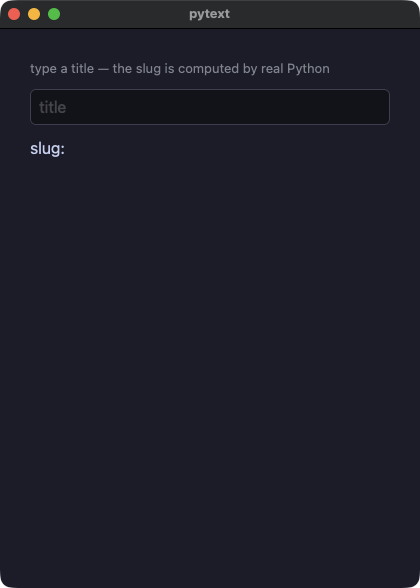
pytext — bare float / bool / Enum text renders exactly as Python's str()
pytext.py
# /// script
# requires-python = ">=3.14"
# ///
"""@py — a CPython escape compiled INTO the native app.

`slug` stays real Python (stdlib `re`) in both tiers: interpreted on
CPython, and run on an EMBEDDED CPython inside the pixie binary,
bridged through pixie's own [crates] binding machinery. The gate
proves both tiers agree.
"""
import os
import sys

sys.path.insert(0, os.path.join(os.path.dirname(os.path.abspath(__file__)), ".."))

from yokan import column, py, run, State, text, text_field  # noqa: E402


@py
def slug(t: str) -> str:
    import re

    return re.sub(r"[^a-z0-9]+", "-", t.lower()).strip("-")


title: State[str] = State("")
slugged: State[str] = State("")


def retitle(t: str):
    title.set(t)
    slugged.set(slug(t))


def view():
    with column(spacing=10, padding=14):
        text("type a title — the slug is computed by real Python", size=13, color="#8a8f98")
        text_field(title(), placeholder="title", on_change=retitle)
        text(f"slug: {slugged()}", size=16)


if __name__ == "__main__":
    run(view, title="pytext")
Control flow and errors
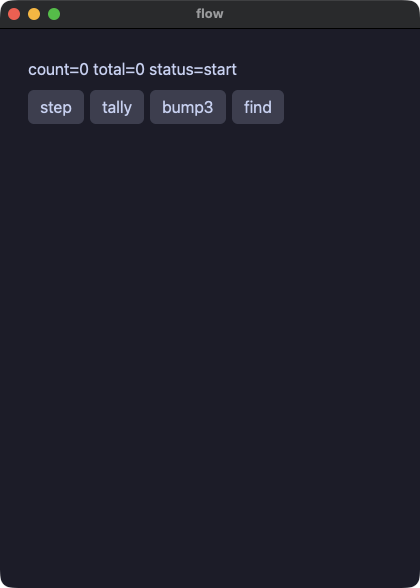
flow — real control flow in handlers: if / elif / while / for / break / continue
flow.py
# /// script
# requires-python = ">=3.14"
# ///
"""Handler control flow, natively compiled: if/elif/else, while,
for-over-range and for-over-list with break/continue, and a pure
helper fn that lowers to a native free fn (not an escape — the
computation itself compiles). Locals are block-scoped natively, so
the translator refuses reads that Python would leak.

A decorator compiles too: decoration happens at import and the
compiled app never runs the module, so the wrapper is folded into
the handler it decorates. Both runs then do the same thing — which
is what the gate compares.
"""
import os
import sys

sys.path.insert(0, os.path.join(os.path.dirname(os.path.abspath(__file__)), ".."))

from yokan import button, column, row, run, State, text  # noqa: E402

count: State[int] = State(0)
total: State[int] = State(0)
status: State[str] = State("start")


def double(v: int) -> int:
    return v * 2


def announced(f):
    """A wrapper around the handler: it says what it is doing, runs
    the handler, and says it is done."""

    def wrapper():
        status.set("working")
        f()
        status.set("done")

    return wrapper


def step():
    count.set(count() + 1)
    if count() > 3 and count() < 100:
        status.set("big")
    elif count() == 3:
        status.set("three")
    else:
        status.set("small")


def tally():
    total.set(0)
    for i in range(1, 6):
        if i == 3:
            continue
        total.set(total() + double(i))


@announced
def bump3():
    while count() < 3:
        count.set(count() + 1)


def find():
    for i in range(0, 10):
        if i * i > 10:
            count.set(i)
            break


def view():
    with column(spacing=8, padding=12):
        text(f"count={count()} total={total()} status={status()}")
        with row(spacing=6):
            button("step", on_click=step)
            button("tally", on_click=tally)
            button("bump3", on_click=bump3)
            button("find", on_click=find)


if __name__ == "__main__":
    run(view, title="flow")
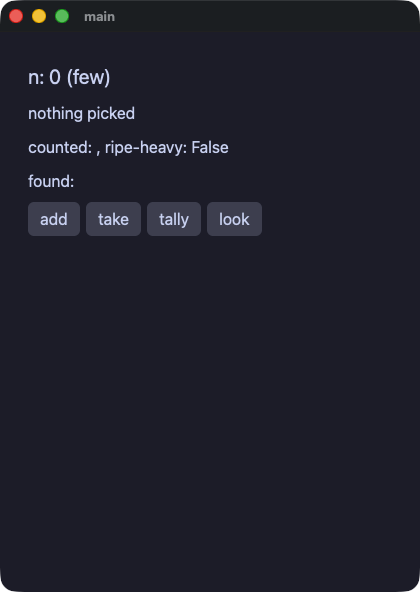
dialect — the everyday Python that used to be refused: a method answering int | None, a local dict, a conditional expression in a view, d[k] caught as a KeyError, print as a second compared channel, an early return
dialect.py
# /// script
# requires-python = ">=3.14"
# ///
"""The everyday Python the dialect used to refuse, gated: a method
that answers `int | None`, a local dict counted up and read back, a
conditional expression inside a view, `d[k]` caught as a KeyError,
`print` as a checked output, an early `return` inside a branch, and a
comparison used as a value.

`print` writes to stdout and the screens go to the file `PIXIE_DUMP`
names, so the gate compares both: the dumps and what the app printed.
"""
import os
import sys

sys.path.insert(0, os.path.join(os.path.dirname(os.path.abspath(__file__)), ".."))

from yokan import State, button, column, row, run, store, text  # noqa: E402

words: State[list[str]] = State(["ripe", "green", "ripe", "gold", "ripe", "green"])
counted: State[str] = State("")
found: State[str] = State("")
flagged: State[bool] = State(False)


@store
class Basket:
    n: int = 0
    # An optional field, and a method that answers one.
    picked: int | None = None

    def pick(self) -> int | None:
        if self.n > 2:
            return self.n
        return None

    # A conditional expression, nested, read by the view as a
    # property.
    @property
    def grade(self) -> str:
        return "many" if self.n > 4 else ("some" if self.n > 2 else "few")

    # An early return inside a branch, and an `if` / `else` where both
    # sides answer.
    def rung(self) -> int:
        if self.n > 4:
            return 2
        elif self.n > 2:
            return 1
        else:
            return 0

    def add(self) -> None:
        self.n = self.n + 1


def take() -> None:
    print("rung", Basket.rung())
    v = Basket.pick()
    if v is not None:
        Basket.picked = v
        print("picked", v)
    else:
        print("nothing to pick")


def tally() -> None:
    # A local dict: counted up, read with `.get`, asked with `in`,
    # walked in sorted order.
    counts: dict[str, int] = {}
    for w in words():
        counts[w] = counts.get(w, 0) + 1
    best = ""
    most = 0
    for k in sorted(counts):
        if counts.get(k, 0) > most:
            most = counts.get(k, 0)
            best = k
    counted.set(f"{best}={most} of {len(counts)}")
    # A comparison as a value.
    flagged.set(most > 2 and "ripe" in counts)
    print("tallied", len(counts), "kinds", sep=" ", end="\n")


def look() -> None:
    counts: dict[str, int] = {}
    for w in words():
        counts[w] = counts.get(w, 0) + 1
    # `d[k]` is the read Python answers with a KeyError, and what a
    # `try` catches is the read itself, bound to a name.
    try:
        gold = counts["gold"]
        found.set(f"gold {gold}")
    except KeyError as e:
        found.set(f"no {e}")
    try:
        plum = counts["plum"]
        found.set(f"{found()}, plum {plum}")
    except KeyError as e:
        found.set(f"{found()}, no {e}")


def view() -> None:
    with column(spacing=8, padding=12):
        # A conditional expression, where a view used to have none.
        text(f"n: {Basket.n} ({Basket.grade})", size=20)
        if (v := Basket.picked) is not None:
            text(f"picked: {v}")
        else:
            text("nothing picked")
        text(f"counted: {counted()}, ripe-heavy: {flagged()}")
        text(f"found: {found()}")
        with row(spacing=6):
            button("add", on_click=Basket.add)
            button("take", on_click=take)
            button("tally", on_click=tally)
            button("look", on_click=look)


if __name__ == "__main__":
    run(view)
closures — functions as values: a lambda in a local, a nested def that captures, a callback field armed and swapped, a closure handed to a method, and map over one
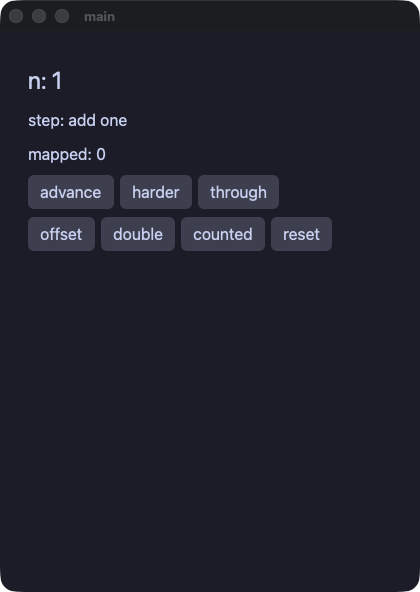
closures.py
# /// script
# requires-python = ">=3.14"
# ///
"""Functions as values, gated: a lambda held in an annotated local, a
nested def that captures a local, a `Callable` field a store is armed
with and swapped later, a closure handed to a method that declares
one, `map` over a function value and a function value as a sort key.

Captures are by value, taken where the closure is made, and the two
places Python's variable capture would disagree are refused by name:
writing to a captured local, and letting a closure that took a loop
variable outlive the iteration.
"""
import os
import sys
from typing import Callable

sys.path.insert(0, os.path.join(os.path.dirname(os.path.abspath(__file__)), ".."))

from yokan import State, button, column, row, run, store, text  # noqa: E402

xs: State[list[int]] = State([1, 2, 3])
mapped: State[int] = State(0)


@store
class Pipeline:
    n: int = 1
    # A callback field: the store is armed with one and can be armed
    # with another while the app runs.
    step: Callable[[int], int] = lambda x: x + 1
    label: str = "add one"

    def advance(self) -> None:
        f = self.step
        self.n = f(self.n)

    def harder(self) -> None:
        self.step = lambda x: x * x
        self.label = "squares"

    def reset(self) -> None:
        self.n = 1
        self.step = lambda x: x + 1
        self.label = "add one"

    # A method that takes a function value, and one that hands it one.
    def apply(self, g: Callable[[int], int]) -> None:
        self.n = g(self.n)

    def through(self) -> None:
        self.apply(lambda x: x * 10)


def double_all() -> None:
    twice: Callable[[int], int] = lambda x: x * 2
    doubled = list(map(twice, xs()))
    mapped.set(sum(doubled))


def offset() -> None:
    # A nested def, capturing a local by value: `base` is the number
    # that was there when the closure was made.
    base = Pipeline.n

    def add(x: int) -> int:
        return x + base

    Pipeline.n = add(10)


def ordered() -> None:
    # A function value as a sort key: the keys are built once, and the
    # list comes back in their order.
    down: Callable[[int], int] = lambda x: -x
    xs.set(sorted(xs(), key=down))
    mapped.set(xs()[0])


def counted() -> None:
    # A closure made inside a loop and called there: both runs read
    # the same value, so it is allowed.
    total = 0
    for i in xs():
        scale: Callable[[int], int] = lambda x: x * i
        total = total + scale(2)
    mapped.set(total)


def view() -> None:
    with column(spacing=8, padding=12):
        text(f"n: {Pipeline.n}", size=24)
        text(f"step: {Pipeline.label}")
        text(f"mapped: {mapped()}")
        with row(spacing=6):
            button("advance", on_click=Pipeline.advance)
            button("harder", on_click=Pipeline.harder)
            button("through", on_click=Pipeline.through)
        with row(spacing=6):
            button("offset", on_click=offset)
            button("double", on_click=double_all)
            button("counted", on_click=counted)
            button("ordered", on_click=ordered)
            button("reset", on_click=Pipeline.reset)


if __name__ == "__main__":
    run(view)
bytes — a byte literal, a digest, base64, and a binary file written and read back, its mark compared against the literal
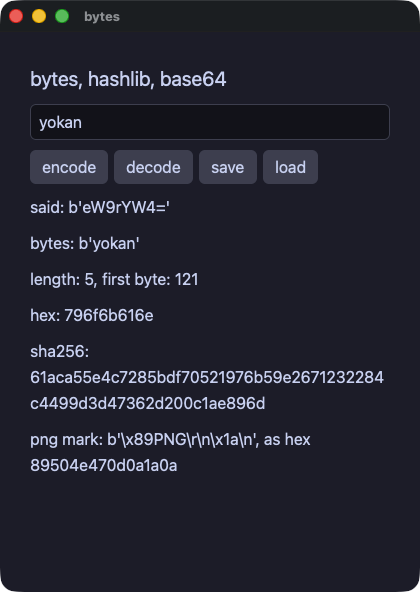
bytes.py
# /// script
# requires-python = ">=3.14"
# ///
"""`bytes` in the dialect, and the two modules that wait on it.

A `bytes` value is what a file, a response or a digest is made of.
The literal is Python's (`b"..."` with its escapes), and so are the
operations: `len`, indexing to a number, slicing, `+`, `.hex()`,
`bytes.fromhex`, `str.encode()` and `bytes.decode()`. A hole renders
one the way Python's `str(b)` does, `b'...'` and all.

`hashlib` and `base64` are Python's own modules over those bytes:
`hashlib.sha256(b).hexdigest()` and `base64.b64encode(b)`. A digest
is a function of its input alone, so the compiled run answers it
without CPython, and a table CPython printed holds it to CPython.

`fs.read_bytes` and `fs.write_bytes` are Yokan's own: one
implementation, both runs, for the file the text pair cannot carry.
"""
import base64
import hashlib
import os
import sys

sys.path.insert(0, os.path.join(os.path.dirname(os.path.abspath(__file__)), ".."))

from yokan import State, button, column, row, run, store, text, text_field  # noqa: E402
from yokan import fs  # noqa: E402

# The eight bytes every PNG starts with, written as a literal.
PNG = b"\x89PNG\r\n\x1a\n"
FILE = "demo/.gate/bytes_demo/mark.bin"

phrase: State[str] = State("yokan")
said: State[str] = State("")


@store
class Note:
    # A bytes field starts empty and is filled while the app runs.
    body: bytes = b""
    digest: str = ""
    size: int = 0

    def take(self, text: str) -> None:
        self.body = text.encode()
        self.size = len(self.body)
        self.digest = hashlib.sha256(self.body).hexdigest()

    def save(self) -> None:
        Note.take(phrase())
        n = fs.write_bytes(FILE, PNG + self.body)
        said.set(f"wrote {n} bytes")

    def load(self) -> None:
        try:
            raw = fs.read_bytes(FILE)
        except RuntimeError:
            said.set("nothing saved yet")
            return
        head = raw[0:8]
        rest = raw[8:len(raw)]
        self.body = rest
        self.size = len(rest)
        self.digest = hashlib.sha256(rest).hexdigest()
        if head == PNG:
            said.set(f"read {len(raw)} bytes, mark {head} is the one")
        else:
            said.set(f"read {len(raw)} bytes, mark {head} is not the one")


def encode() -> None:
    Note.take(phrase())
    said.set(f"{base64.b64encode(Note.body)}")


def decode() -> None:
    # Back the way it came: base64 answers bytes, and bytes decode to
    # the text they were made from.
    packed = base64.b64encode(phrase().encode())
    said.set(base64.b64decode(packed).decode())


def view() -> None:
    with column(spacing=10, padding=14):
        text("bytes, hashlib, base64", size=20)
        text_field(phrase(), placeholder="text to encode", on_change=phrase.set)
        with row(spacing=6):
            button("encode", on_click=encode)
            button("decode", on_click=decode)
            button("save", on_click=Note.save)
            button("load", on_click=Note.load)
        text(f"said: {said()}")
        text(f"bytes: {Note.body}")
        text(f"length: {Note.size}, first byte: {Note.body[0] if Note.size > 0 else 0}")
        text(f"hex: {Note.body.hex()}")
        text(f"sha256: {Note.digest}")
        text(f"png mark: {PNG}, as hex {PNG.hex()}")


if __name__ == "__main__":
    run(view, title="bytes", on_start=encode)
edges — containment, demonstrated: out-of-bounds and overflow stop the same statement the same way in both runs, and the app keeps running
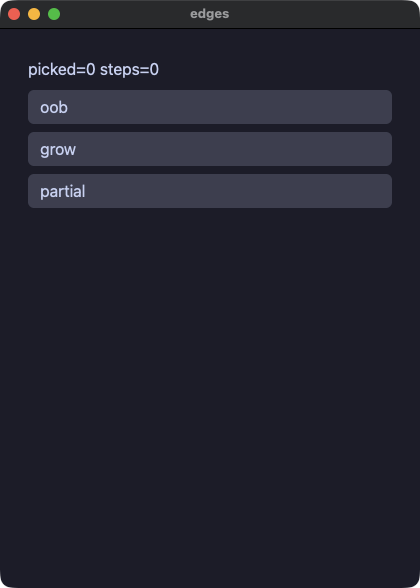
edges.py
# /// script
# requires-python = ">=3.14"
# ///
"""Containment, proven by the gate: every predictable failure an
admitted program can reach fails the SAME way interpreted and
compiled — the statement aborts before writing, earlier statements'
effects stay, the app keeps running.

  oob     — a local subscript past the end
  grow    — i64 overflow (the write is refused before it happens,
            in both runs)
  partial — first statement lands, second fails: ordering agrees
"""
import os
import sys

sys.path.insert(0, os.path.join(os.path.dirname(os.path.abspath(__file__)), ".."))

from yokan import button, column, run, State, text  # noqa: E402

xs: State[list[int]] = State([7])
picked: State[int] = State(0)
big: State[int] = State(4611686018427387904)
steps: State[int] = State(0)


def oob():
    r = xs()
    picked.set(r[5])


def grow():
    big.set(big() * 4)


def partial():
    steps.set(steps() + 1)
    r = xs()
    picked.set(r[9])


def view():
    with column(spacing=8, padding=12):
        text(f"picked={picked()} steps={steps()}")
        button("oob", on_click=oob)
        button("grow", on_click=grow)
        button("partial", on_click=partial)


if __name__ == "__main__":
    run(view, title="edges")
tryfetch — the full try/except form: catch a failing http call, with f"{e}" identical in both runs
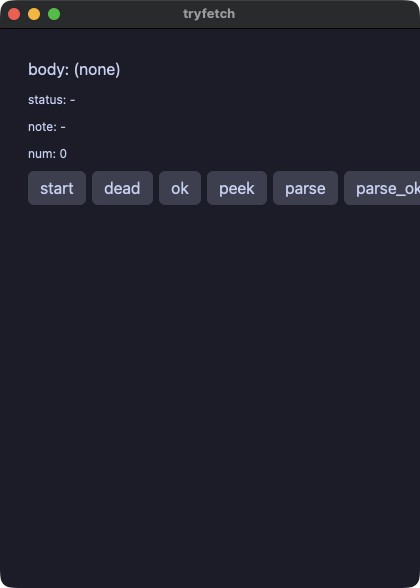
tryfetch.py
# /// script
# requires-python = ">=3.14"
# ///
"""try/except over the standard library: a failing http.get_text
raises, a Python `try` around it catches, and `f"{e}"` renders the
same message whether the app runs interpreted or compiled. An
uncaught failure aborts just the handler that raised — the app
keeps running.
"""
import os
import sys

sys.path.insert(0, os.path.join(os.path.dirname(os.path.abspath(__file__)), ".."))

from yokan import button, column, py, row, run, State, text  # noqa: E402
from yokan import fs, http  # noqa: E402


@py
def serve() -> int:
    import http.server
    import threading

    body = b"hello from fixture"

    class H(http.server.BaseHTTPRequestHandler):
        def do_GET(self):
            self.send_response(200)
            self.send_header("Content-Length", str(len(body)))
            self.end_headers()
            self.wfile.write(body)

        def log_message(self, format: str, *args: object) -> None:
            pass

    srv = http.server.HTTPServer(("127.0.0.1", 0), H)
    threading.Thread(target=srv.serve_forever, daemon=True).start()
    return srv.server_address[1]


@py
def parse_num(s: str) -> int:
    return int(s)


@py
def risky(mode: str) -> int:
    if mode == "value":
        raise ValueError("bad value here")
    if mode == "key":
        raise KeyError("missing-key")
    return 7


port: State[int] = State(0)
num: State[int] = State(0)
body: State[str] = State("(none)")
status: State[str] = State("-")
note: State[str] = State("-")


def start():
    port.set(serve())


def fetch_dead():
    try:
        body.set(http.get_text("http://127.0.0.1:9/nothing"))
    except Exception as e:
        status.set(f"offline: {e}")


def fetch_ok():
    try:
        body.set(http.get_text(f"http://127.0.0.1:{port()}/"))
    except Exception:
        status.set("unreachable")


def peek():
    try:
        note.set(fs.read_text("demo/.gate/absent.txt"))
    except Exception as e:
        note.set(f"no file: {e}")


def parse():
    try:
        num.set(parse_num("41x"))
    except Exception as e:
        note.set(f"bad: {e}")


def parse_ok():
    try:
        num.set(parse_num("41"))
    except Exception:
        note.set("unexpected")


def multi_v():
    try:
        num.set(risky("value"))
    except ValueError as e:
        note.set(f"VE: {e}")
    except KeyError as e:
        note.set(f"KE: {e}")
    except Exception:
        note.set("other")


def multi_k():
    try:
        num.set(risky("key"))
    except ValueError as e:
        note.set(f"VE: {e}")
    except KeyError as e:
        note.set(f"KE: {e}")
    except Exception:
        note.set("other")


def full():
    try:
        a = risky("fine")
        note.set(f"got {a}")
        b = risky("value")
        num.set(a + b)
    except (ValueError, KeyError) as e:
        status.set(f"caught: {e}")
    except Exception:
        status.set("other")
    else:
        status.set("clean run")
    finally:
        body.set("finally ran")


def full_ok():
    try:
        a = risky("fine")
        b = risky("fine")
        num.set(a + b)
    except Exception as e:
        status.set(f"caught: {e}")
    else:
        status.set("clean run")
    finally:
        body.set("finally ran")


def mixed():
    try:
        note.set(fs.read_text("demo/.gate/absent.txt"))
    except (KeyError, RuntimeError) as e:
        status.set(f"io: {e}")
    except Exception:
        status.set("other")


def multi_ok():
    try:
        num.set(risky("fine"))
    except ValueError:
        note.set("VE")
    except Exception:
        note.set("other")


def view():
    with column(spacing=8, padding=12):
        text(f"body: {body()}")
        text(f"status: {status()}", size=12)
        text(f"note: {note()}", size=12)
        text(f"num: {num()}", size=12)
        with row(spacing=6):
            button("start", on_click=start)
            button("dead", on_click=fetch_dead)
            button("ok", on_click=fetch_ok)
            button("peek", on_click=peek)
            button("parse", on_click=parse)
            button("parse_ok", on_click=parse_ok)
            button("mv", on_click=multi_v)
            button("mk", on_click=multi_k)
            button("mo", on_click=multi_ok)
            button("full", on_click=full)
            button("full_ok", on_click=full_ok)
            button("mixed", on_click=mixed)


if __name__ == "__main__":
    run(view, title="tryfetch")
UI elements
widgets — every element in one app: nine pages behind a picked list, from the arrangers to the canvas, with the riders every element takes on a page of their own
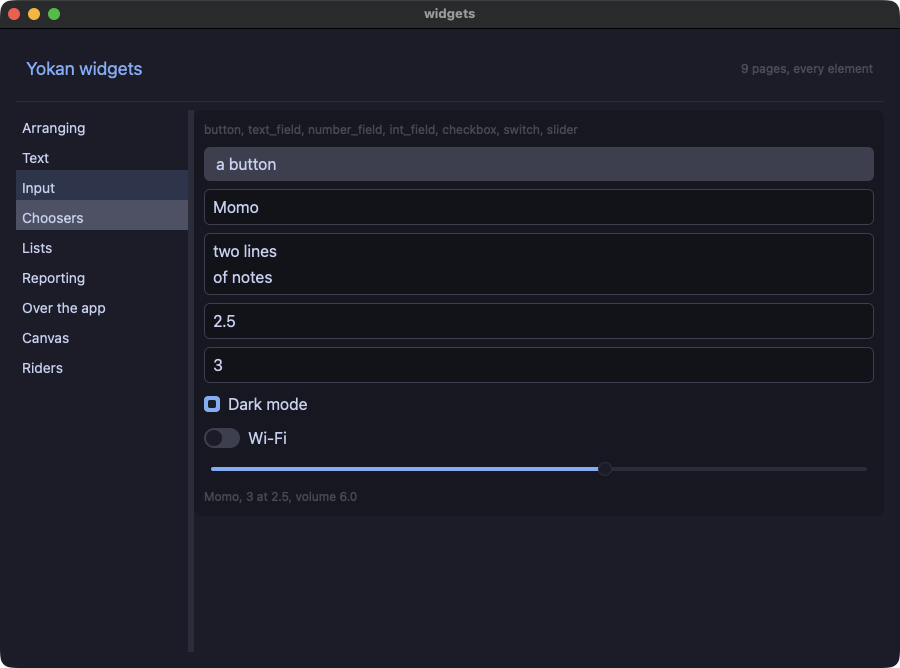
widgets.py
# /// script
# requires-python = ">=3.14"
# ///
"""Every element in the catalog, in one app.

The chrome is three of them. A `split` holds the pages beside the
page, its left pane is a `list_view` you pick from, and the right one
is a `scroll_view`. So the first three widgets are the ones you use
to look at the rest.

A verification script walks the pages by name — `select:Input` picks
from the app's FIRST chooser, which is that list — and everything a
page puts on the screen is numbered after it (`select@1:` and up).
"""
import os
import sys

sys.path.insert(0, os.path.join(os.path.dirname(os.path.abspath(__file__)), ".."))

from yokan import (  # noqa: E402
    bar_chart,
    component,
    button,
    canvas,
    checkbox,
    circle,
    column,
    context_menu,
    data_table,
    divider,
    grid,
    h_scroll_view,
    image,
    int_field,
    line,
    line_chart,
    link,
    list_view,
    menu_button,
    modal,
    number_field,
    pixel,
    pixel_text,
    progress,
    radio_group,
    rect,
    row,
    run,
    scroll_view,
    segmented,
    select,
    slider,
    spacer,
    spinner,
    split,
    stack,
    store,
    style,
    svg,
    switch,
    tab_bar,
    table,
    text,
    text_field,
    toast,
)

heading = style(size=18, color="accent")
faint = style(size=12, color="#8a8f98")
panel = style(padding=10, background="#1f2027", border_radius=8.0)
cell = style(size=12, background="#313244", padding=6, border_radius=6.0, align="center")


@store
class Gallery:
    pages: list[str] = [
        "Arranging",
        "Text",
        "Input",
        "Choosers",
        "Lists",
        "Reporting",
        "Over the app",
        "Canvas",
        "Riders",
    ]
    page: int = 0
    ratio: float = 0.28

    # What the input page binds. Every control shows a value the app
    # holds and hands the new one back — the same contract nine times.
    name: str = "Momo"
    note: str = "two lines\nof notes"
    price: float = 2.5
    qty: int = 3
    dark: bool = True
    wifi: bool = False
    volume: float = 6.0

    # The choosers: one list of options, four spellings, one index.
    fruits: list[str] = ["apple", "banana", "cherry"]
    fruit: int = 1
    tab: int = 0
    size: int = 2
    chosen: str = "nothing yet"

    # Lists and tables.
    rows: list[str] = ["ada", "bo", "cy", "dee", "eve", "fay"]
    kbs: list[int] = [12, 7, 31, 4, 19, 55]
    picked: int = -1
    sort_col: int = -1
    desc: bool = False

    # Reporting.
    pct: float = 0.62
    bars: list[float] = [3.0, 7.0, 5.0, 9.0, 4.0]
    trend: list[float] = [2.0, 4.0, 3.5, 6.0, 5.5, 8.0]

    # What is open over the app.
    asking: bool = False
    saved: bool = False

    # The canvas palette; a command's color is an index into it.
    palette: list[str] = ["#11111b", "#89b4fa", "#f38ba8", "#eeeeee"]

    def go(self, i: int) -> None:
        self.page = i

    def widen(self, r: float) -> None:
        self.ratio = min(0.5, max(0.15, r))

    def set_name(self, s: str) -> None:
        self.name = s

    def set_note(self, s: str) -> None:
        self.note = s

    def set_price(self, v: float) -> None:
        self.price = v

    def set_qty(self, n: int) -> None:
        self.qty = n

    def set_dark(self, on: bool) -> None:
        self.dark = on

    def set_wifi(self, on: bool) -> None:
        self.wifi = on

    def set_volume(self, v: float) -> None:
        self.volume = v

    def pick_fruit(self, i: int) -> None:
        self.fruit = i

    def pick_tab(self, i: int) -> None:
        self.tab = i

    def pick_size(self, i: int) -> None:
        self.size = i

    def act(self, i: int) -> None:
        self.chosen = self.fruits[i]

    def pick_row(self, i: int) -> None:
        self.picked = i

    def sort_by(self, i: int) -> None:
        self.sort_col = i
        self.desc = not self.desc

    def ask(self) -> None:
        self.asking = True

    def close(self) -> None:
        self.asking = False

    def save(self) -> None:
        self.saved = True

    def saved_shown(self) -> None:
        self.saved = False
        self.chosen = "the toast closed itself"


def page_row(i: int):
    """A row of the page list: the text a script picks it by."""
    with row(spacing=6, padding=6):
        text(Gallery.pages[i], size=14)


def file_row(i: int):
    # The padding keeps the right-hand number clear of the scrollbar
    # the viewport paints over its edge.
    with row(spacing=8, padding=6):
        text(Gallery.rows[i], size=14, grow=1.0)
        text(f"{Gallery.kbs[i]} kb", size=12, color="#7aa2f7")


def file_cells(i: int):
    return row(
        text(Gallery.rows[i]),
        text(f"{Gallery.kbs[i]}"),
    )


@component
def arranging():
    with column(spacing=10, **panel):
        text("column, row, grid, stack, spacer, divider, split, h_scroll_view", **faint)
        with row(spacing=8):
            text("a row")
            spacer()
            text("pushed to the edge", **faint)
        divider()
        # A grid lays equal tracks; `col_span=` is a rider, so it works
        # on any element rather than on a special cell.
        with grid(columns=3, spacing=6):
            text("one", **cell)
            text("two", **cell)
            text("three", **cell)
            text("spans two tracks", col_span=2, **cell)
            text("four", **cell)
        divider(color="accent", thickness=2.0)
        with stack():
            text("stacked under", size=28, color="#3b3f4a")
            text("and over", size=14)
        split(
            column(text("a pane"), padding=10, background="#313244", grow=1.0),
            column(text("and the other"), padding=10, background="#45475a", grow=1.0),
            ratio=Gallery.ratio,
            on_change=Gallery.widen,
            height=70.0,
        )
        with h_scroll_view():
            with row(spacing=8):
                text("one")
                text("two")
                text("three")
                text("four")
                text("five")
                text("and it scrolls sideways", **faint)


@component
def texts():
    with column(spacing=8, **panel):
        text("text, link, image, svg", **faint)
        text("bold", bold=True)
        text("italic", italic=True)
        text("mono 0x1f", mono=True)
        text("underlined", underline=True)
        text("a pill", size=12, background="#313244", padding=4, border_radius=6.0)
        text("one line, clipped with an ellipsis when it does not fit", wrap="ellipsis", width=180.0)
        link("yokan on GitHub", "https://github.com/i2y/yokan")
        with row(spacing=12):
            image("demo/assets/postcard.png", width=120.0, height=75.0)
            svg("demo/assets/yokan.svg", width=48.0, height=48.0)


@component
def inputs():
    with column(spacing=8, **panel):
        text("button, text_field, number_field, int_field, checkbox, switch, slider", **faint)
        button("a button", on_click=Gallery.save)
        text_field(Gallery.name, placeholder="name", on_change=Gallery.set_name)
        text_field(Gallery.note, multiline=True, rows=2, on_change=Gallery.set_note)
        number_field(Gallery.price, min=0.0, max=100.0, step=0.5, placeholder="price",
                     on_change=Gallery.set_price)
        int_field(Gallery.qty, min=1, max=99, placeholder="qty", on_change=Gallery.set_qty)
        checkbox("Dark mode", checked=Gallery.dark, on_change=Gallery.set_dark)
        switch("Wi-Fi", checked=Gallery.wifi, on_change=Gallery.set_wifi)
        slider(value=Gallery.volume, min=0.0, max=10.0, step=1.0, on_change=Gallery.set_volume)
        text(f"{Gallery.name}, {Gallery.qty} at {Gallery.price}, volume {Gallery.volume}", **faint)


@component
def choosers():
    with column(spacing=8, **panel):
        text("select, radio_group, tab_bar, segmented, menu_button", **faint)
        # A column stretches its children across it, so the two that
        # look wrong at full width sit in a row instead.
        with row(spacing=8):
            select(options=Gallery.fruits, selected=Gallery.fruit, on_change=Gallery.pick_fruit)
            menu_button("Actions", Gallery.fruits, on_select=Gallery.act)
        radio_group(options=Gallery.fruits, selected=Gallery.fruit, on_change=Gallery.pick_fruit)
        tab_bar(labels=Gallery.fruits, active=Gallery.tab, on_change=Gallery.pick_tab)
        with row(spacing=8):
            segmented(options=["S", "M", "L"], selected=Gallery.size, on_change=Gallery.pick_size)
        text(f"fruit {Gallery.fruit}, tab {Gallery.tab}, size {Gallery.size}", **faint)


@component
def lists():
    with column(spacing=8, **panel):
        text("list_view, table, data_table", **faint)
        list_view(
            len(Gallery.rows),
            file_row,
            item_height=26.0,
            height=78.0,
            selected=Gallery.picked,
            on_select=Gallery.pick_row,
            scroll_to=Gallery.picked,
        )
        table(
            ["name", "kb"],
            len(Gallery.rows),
            file_cells,
            widths=[2.0, 1.0],
            height=104.0,
            selected=Gallery.picked,
            on_select=Gallery.pick_row,
            sort=Gallery.sort_col,
            descending=Gallery.desc,
            on_sort=Gallery.sort_by,
        )
        with data_table():
            with row(spacing=8):
                text("kind", grow=1.0)
                text("what it is for", grow=2.0)
            with row(spacing=8):
                text("list_view", grow=1.0)
                text("rows of any shape, virtualized", grow=2.0)
            with row(spacing=8):
                text("table", grow=1.0)
                text("rows on column tracks, with a header", grow=2.0)


@component
def reporting():
    with column(spacing=8, **panel):
        text("progress, spinner, bar_chart, line_chart", **faint)
        progress(Gallery.pct, label="downloading", height=8.0)
        progress(0.0, indeterminate=True, height=8.0)
        with row(spacing=8):
            spinner()
            text("working", **faint)
        bar_chart(Gallery.bars, labels=["mon", "tue", "wed", "thu", "fri"], height=90.0, axis=True)
        line_chart(Gallery.trend, height=90.0, axis=True, color="#a6e3a1")


@component
def over_the_app():
    with column(spacing=8, **panel):
        text("modal, toast, context_menu", **faint)
        with row(spacing=8):
            button("show modal", on_click=Gallery.ask)
            button("show toast", on_click=Gallery.save)
        with context_menu(options=Gallery.fruits, on_select=Gallery.act):
            with column(padding=14, background="#313244", border_radius=8.0):
                text("right-click this card", size=14)
        text(f"chosen: {Gallery.chosen}", **faint)


@component
def riders():
    with column(spacing=8, **panel):
        text("the properties every element takes, whatever it is", **faint)
        text("a tooltip is in the dump either way", tooltip="so a script sees it")
        button("disabled", on_click=Gallery.save, disabled=True)
        text_field(Gallery.name, placeholder="also disabled", on_change=Gallery.set_name,
                   disabled=True)
        with column(spacing=6, theme="light", padding=8, background="surface",
                    border_radius=8.0):
            text("a scope with the other palette", size=13)
            button("in the light", on_click=Gallery.save)
        text("wider than it needs", width=220.0, background="#313244", padding=6)
        text("read as a heading", role="heading", size=15)
        image("demo/assets/yokan.svg", width=40.0, height=40.0,
              a11y_label="the Yokan mark")
        text("fades in when it appears", animate=200.0, enter=True, **faint)


@component
def painting():
    with column(spacing=8, **panel):
        text("canvas: virtual pixels, and every color an index", **faint)
        with canvas(64, 32, scale=4, background=0, palette=Gallery.palette):
            rect(2, 2, 14, 8, 1)
            circle(30, 10, 5, 2)
            line(2, 20, 61, 20, 3)
            pixel(40, 6, 3)
            pixel_text(2, 24, "PIXELS", 1)


def view() -> None:
    with column(grow=1.0):
        with row(spacing=8, padding=10):
            text("Yokan widgets", **heading)
            spacer()
            text(f"{len(Gallery.pages)} pages, every element", **faint)
        divider()
        with row(grow=1.0):
            list_view(
                len(Gallery.pages),
                page_row,
                item_height=30.0,
                height=430.0,
                width=150.0,
                selected=Gallery.page,
                on_select=Gallery.go,
            )
            divider()
            # A scroll_view takes a height rather than a share of the
            # row, so the column around it takes the width that is left
            # and the two panes are given the same height.
            # A row centres what it holds, so the pane is given the same
            # height as the list beside it and its page stacks from the
            # top of it.
            with column(grow=1.0, padding=10, height=450.0):
                with scroll_view(height=430.0):
                    if Gallery.page == 0:
                        arranging()
                    elif Gallery.page == 1:
                        texts()
                    elif Gallery.page == 2:
                        inputs()
                    elif Gallery.page == 3:
                        choosers()
                    elif Gallery.page == 4:
                        lists()
                    elif Gallery.page == 5:
                        reporting()
                    elif Gallery.page == 6:
                        over_the_app()
                    elif Gallery.page == 7:
                        painting()
                    else:
                        riders()
        if Gallery.asking:
            with modal():
                text("a modal takes the clicks behind it", size=14)
                button("close", on_click=Gallery.close)
        if Gallery.saved:
            toast("Saved", duration_ms=1500.0, on_close=Gallery.saved_shown)


if __name__ == "__main__":
    # A catalog wants room: the window asks for a size, and the
    # two panes take the height they were given.
    run(view, title="widgets", width=900.0, height=640.0)
todo — the classic todo list
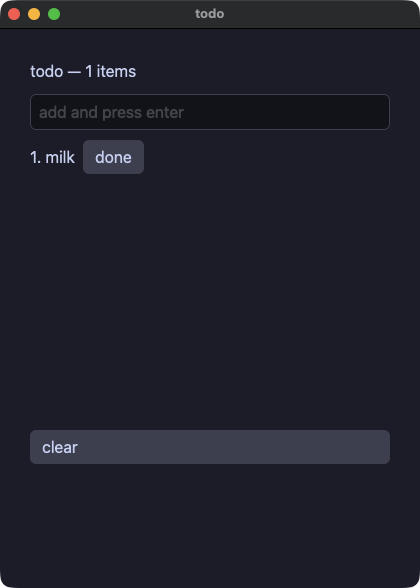
todo.py
# /// script
# requires-python = ">=3.14"
# ///
"""List state: a todo app with a virtualized list, fully in the dialect.

items: State[list[str]] — the annotation is what makes `[]`-style
list state translatable at all. The row builder becomes a `.pix`
`for` repeater, and the row index is an ordinary int inside it: the
number, the marker on the row that is done, and that row's own
button all read the same `i`.
"""
import os
import sys

sys.path.insert(0, os.path.join(os.path.dirname(os.path.abspath(__file__)), ".."))

from yokan import button, column, list_view, row, run, State, text, text_field  # noqa: E402

items: State[list[str]] = State(["milk"])
draft: State[str] = State("")
done: State[int] = State(-1)


def add(t: str):
    items.set(items() + [t])
    draft.set("")


def line(i: int):
    with row(spacing=8):
        text(f"{i + 1}. {items()[i]}")
        if i == done():
            text("done", color="accent")
        button("done", on_click=lambda: done.set(i))


def view():
    with column(spacing=10, padding=14):
        text(f"todo — {len(items())} items", size=16)
        text_field(
            draft(),
            placeholder="add and press enter",
            on_change=draft.set,
            on_submit=add,
        )
        list_view(len(items()), line, item_height=26.0, height=280.0)
        button("clear", on_click=lambda: items.set([]))


if __name__ == "__main__":
    run(view, title="todo")
table — data_table: the first row is the header, later rows are data rows shaded in alternation, and the frame comes with the element
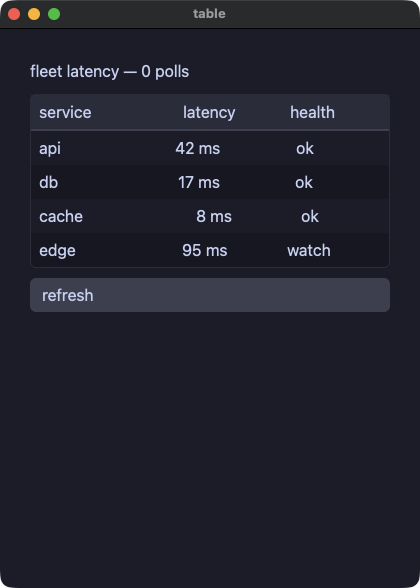
table.py
# /// script
# requires-python = ">=3.14"
# ///
"""data_table draws the table itself: the first `row` inside it is
the header, every later `row` is a data row shaded in alternation,
and the frame around them comes with the element. Columns line up
because the cells of one column carry the same `grow` share.
"""
import os
import sys

sys.path.insert(0, os.path.join(os.path.dirname(os.path.abspath(__file__)), ".."))

from yokan import button, column, data_table, row, run, store, text  # noqa: E402


@store
class Fleet:
    api: int = 42
    db: int = 17
    cache: int = 8
    edge: int = 95
    polls: int = 0

    def refresh(self) -> None:
        self.polls += 1
        self.api = (self.api * 3 + 29) % 140
        self.db = (self.db * 5 + 11) % 140
        self.cache = (self.cache * 7 + 3) % 140
        self.edge = (self.edge * 2 + 47) % 140


def health(ms: int) -> str:
    label = "ok"
    if ms > 60:
        label = "watch"
    if ms > 100:
        label = "slow"
    return label


def view():
    with column(spacing=10, padding=14):
        text(f"fleet latency — {Fleet.polls} polls", size=16)
        with data_table():
            with row(spacing=8):
                text("service", grow=2.0)
                text("latency", grow=1.0, align="right")
                text("health", grow=1.0, align="center")
            with row(spacing=8):
                text("api", grow=2.0)
                text(f"{Fleet.api} ms", grow=1.0, align="right")
                text(f"{health(Fleet.api)}", grow=1.0, align="center")
            with row(spacing=8):
                text("db", grow=2.0)
                text(f"{Fleet.db} ms", grow=1.0, align="right")
                text(f"{health(Fleet.db)}", grow=1.0, align="center")
            with row(spacing=8):
                text("cache", grow=2.0)
                text(f"{Fleet.cache} ms", grow=1.0, align="right")
                text(f"{health(Fleet.cache)}", grow=1.0, align="center")
            with row(spacing=8):
                text("edge", grow=2.0)
                text(f"{Fleet.edge} ms", grow=1.0, align="right")
                text(f"{health(Fleet.edge)}", grow=1.0, align="center")
        button("refresh", on_click=Fleet.refresh)


if __name__ == "__main__":
    run(view, title="table")
transcript — a conversation with a coding agent, read top to bottom: turns of unequal height (a pill, wrapped prose, a mono code block on a panel, a dim tool line) in a scroll_view over a column, which is the shape for rows that do not share one height; copy code puts a block on the clipboard
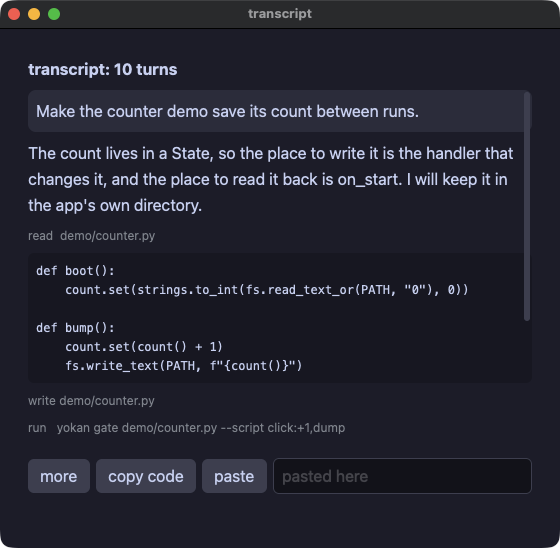
transcript.py
# /// script
# requires-python = ">=3.14"
# ///
"""A transcript, read top to bottom: the turns of a conversation with
a coding agent, prose and code, in a `scroll_view` over a `column`.
The rows are not one height — a turn is a paragraph or a block of
code — so this is the shape for them, not the virtualized
`list_view`, whose rows share one `item_height`. A session is
hundreds of turns, and a column of hundreds of texts scrolls fine.

Each turn is a value class; the view walks the list and picks the
shape by its kind: a person's turn as a pill, the agent's prose
wrapped, a code block in `mono` on a panel, and a tool call as one
dim line. `copy` puts a block on the clipboard, which a script
checks with a paste into the field.
"""
import os
import sys

sys.path.insert(0, os.path.join(os.path.dirname(os.path.abspath(__file__)), ".."))

from yokan import (  # noqa: E402
    State,
    button,
    clipboard,
    column,
    row,
    run,
    scroll_view,
    store,
    style,
    text,
    text_field,
    value,
)

dim = style(size=12, color="#8a8f98")


@value
class Turn:
    kind: str  # "user", "agent", "code" or "tool"
    body: str


@store
class Session:
    turns: list[Turn] = [
        Turn("user", "Make the counter demo save its count between runs."),
        Turn(
            "agent",
            "The count lives in a State, so the place to write it is the "
            "handler that changes it, and the place to read it back is "
            "on_start. I will keep it in the app's own directory.",
        ),
        Turn("tool", "read  demo/counter.py"),
        Turn(
            "code",
            "def boot():\n"
            "    count.set(strings.to_int(fs.read_text_or(PATH, \"0\"), 0))\n"
            "\n"
            "def bump():\n"
            "    count.set(count() + 1)\n"
            "    fs.write_text(PATH, f\"{count()}\")",
        ),
        Turn("tool", "write demo/counter.py"),
        Turn("tool", "run   yokan gate demo/counter.py --script click:+1,dump"),
        Turn("agent", "The gate is green: the count is written on every click and read back at start."),
        Turn("user", "Where does the file go?"),
        Turn(
            "agent",
            "fs.app_dir names the directory the platform keeps for an app, "
            "so it is Application Support on macOS and XDG_DATA_HOME on Linux.",
        ),
        Turn("code", "PATH = fs.app_dir(\"counter\") + \"/count.txt\""),
    ]
    extra: int = 0

    def more(self) -> None:
        # A longer session: the same turns again, numbered, so a
        # script can scroll a screen that is taller than the window.
        self.extra = self.extra + 1
        self.turns = self.turns + [
            Turn("user", f"And one more thing ({self.extra})."),
            Turn("agent", f"Done, as turn {self.extra}: the change is in, and the gate still passes."),
        ]


pasted: State[str] = State("")


def copy_code():
    for t in Session.turns:
        if t.kind == "code":
            clipboard.set_text(t.body)


def paste():
    pasted.set(clipboard.get_text())


def view():
    with column(spacing=8, padding=12):
        text(f"transcript: {len(Session.turns)} turns", size=16, bold=True)
        with scroll_view(height=360.0):
            with column(spacing=8):
                for t in Session.turns:
                    if t.kind == "user":
                        text(t.body, background="#313244", padding=8.0, border_radius=8.0)
                    if t.kind == "agent":
                        text(t.body)
                    if t.kind == "code":
                        text(t.body, mono=True, size=12, background="#181825", padding=8.0, border_radius=6.0)
                    if t.kind == "tool":
                        text(t.body, **dim)
        with row(spacing=6):
            button("more", on_click=Session.more)
            button("copy code", on_click=copy_code)
            button("paste", on_click=paste)
            text_field(pasted(), placeholder="pasted here", on_change=pasted.set)


if __name__ == "__main__":
    run(view, title="transcript", width=560, height=520)
dialog — the modal: existing IS being open, so wrap it in if
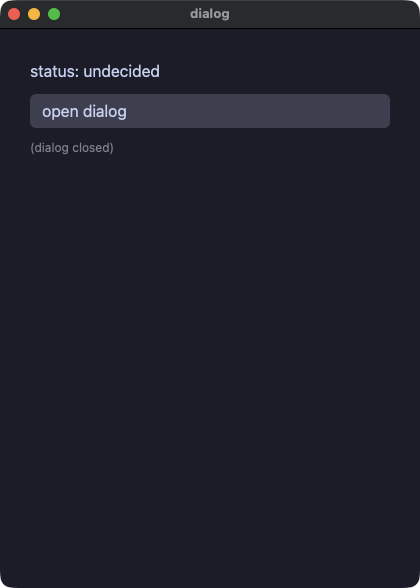
dialog.py
# /// script
# requires-python = ">=3.14"
# ///
"""Conditional rendering: a modal behind `if show():`.

bool cells follow the same split as floats: bool TEXT is out of the
dialect, bool CONDITIONS are in. The Python `if` becomes .pix's view
`if/else`; the modal needs no open= — presence IS openness.
"""
import os
import sys

sys.path.insert(0, os.path.join(os.path.dirname(os.path.abspath(__file__)), ".."))

from yokan import button, column, modal, row, run, State, text  # noqa: E402

show: State[bool] = State(False)
status: State[str] = State("undecided")


def accept():
    status.set("accepted")
    show.set(False)


def decline():
    status.set("declined")
    show.set(False)


def view():
    with column(spacing=10, padding=14):
        text(f"status: {status()}", size=16)
        button("open dialog", on_click=lambda: show.set(True))
        if show():
            with modal():
                text("accept the terms?", size=18)
                with row(spacing=8):
                    button("accept", on_click=accept)
                    button("decline", on_click=decline)
        else:
            text("(dialog closed)", size=12, color="#8a8f98")


if __name__ == "__main__":
    run(view, title="dialog")
toast — a message over the app that closes itself: duration_ms counts on the framework's own clock (a script says advance:), and on_close clears the flag the if reads
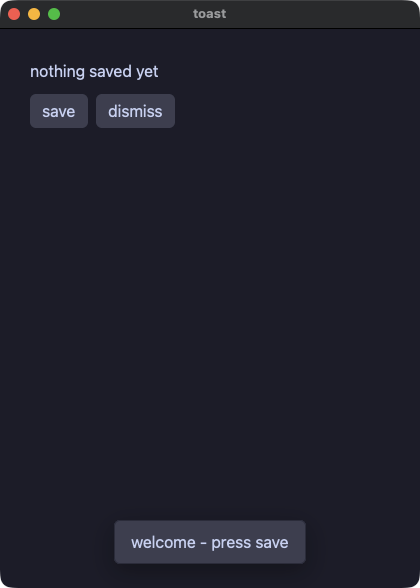
toast.py
# /// script
# requires-python = ">=3.14"
# ///
"""A message that appears over the app and goes away on its own.

A toast is open by existing, the way a modal is: put it behind
`if showing():` rather than passing a flag. Give it `duration_ms` and
it closes itself that many milliseconds later by calling `on_close` —
which is where the app clears what the `if` reads. The countdown runs
on the framework's own clock, so a headless script says `advance:1500`
and sees the same thing a person waiting would.
"""
import os
import sys

sys.path.insert(0, os.path.join(os.path.dirname(os.path.abspath(__file__)), ".."))

from yokan import button, column, row, run, State, text, toast  # noqa: E402

note: State[str] = State("nothing saved yet")
saved: State[bool] = State(False)
hint: State[bool] = State(True)


def save():
    note.set("saved")
    saved.set(True)


def done():
    saved.set(False)
    note.set("the toast closed itself")


def dismiss():
    hint.set(False)


def view():
    with column(spacing=10, padding=14):
        text(f"{note()}", size=16)
        with row(spacing=8):
            button("save", on_click=save)
            button("dismiss", on_click=dismiss)
        if hint():
            toast("welcome - press save")
        if saved():
            toast("Saved", duration_ms=1500, on_close=done)


if __name__ == "__main__":
    run(view, title="toast")
trend — line and bar charts
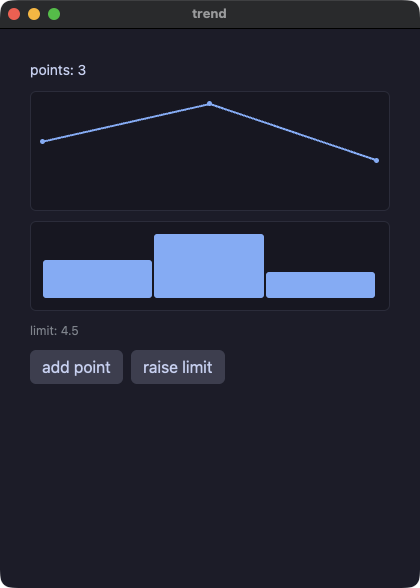
trend.py
# /// script
# requires-python = ">=3.14"
# ///
"""Chart data from a list[float] cell — the float rule in action:

float TEXT is out of the dialect (str(2.0) diverges across tiers),
but float DATA is fine: both tiers dump chart values through the
same kernel renderer, and the gate proves it.
"""
import os
import sys

sys.path.insert(0, os.path.join(os.path.dirname(os.path.abspath(__file__)), ".."))

from yokan import (
    bar_chart,
    button,
    column,
    line_chart,
    row,
    run,
    State,
    text,
)

values: State[list[float]] = State([3.0, 5.0, 2.0])
limit: State[float] = State(4.5)


def bump():
    values.set(values() + [8.0])


def raise_limit():
    limit.set(limit() + 0.5)


def view():
    with column(spacing=10, padding=14):
        text(f"points: {len(values())}", size=14)
        line_chart(values(), height=120.0)
        bar_chart(values(), height=90.0)
        text(f"limit: {limit():.1f}", size=12, color="#8a8f98")
        with row(spacing=8):
            button("add point", on_click=bump)
            button("raise limit", on_click=raise_limit)


if __name__ == "__main__":
    run(view, title="trend")
styled — named styles (style + ** splat + | merge) and theme scopes
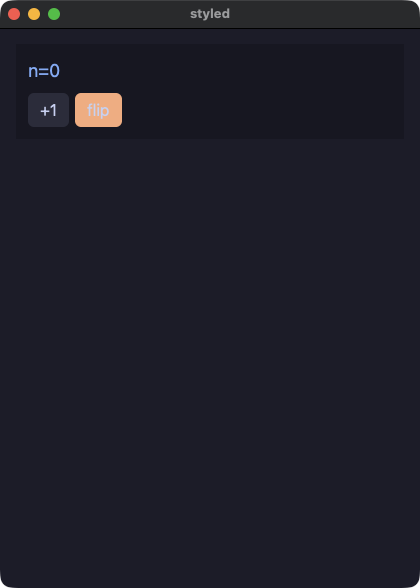
styled.py
# /// script
# requires-python = ">=3.14"
# ///
"""Named styles and the theme scope. A style is a plain dict of
element kwargs (`style`), applied with `**` — plain Python when
interpreted, a native style block when compiled; `|` merges styles
and `theme=` scopes a palette over a subtree. Tokens like "accent"
resolve in one shared place, so a palette flip re-colors the
interpreted and the compiled app identically.
"""
import os
import sys

sys.path.insert(0, os.path.join(os.path.dirname(os.path.abspath(__file__)), ".."))

from yokan import button, column, row, run, State, style, text  # noqa: E402

chip = style(size=18, color="accent")
key = style(background="#313244", hover_background="#45475a")
hot = style(background="#fab387")
key_hot = key | hot

mode: State[str] = State("dark")
n: State[int] = State(0)


def flip():
    if mode() == "dark":
        mode.set("light")
    else:
        mode.set("dark")


def view():
    with column(spacing=8, padding=12, background="panel", theme=mode()):
        text(f"n={n()}", **chip)
        with row(spacing=6):
            button("+1", on_click=lambda: n.set(n() + 1), **key)
            button("flip", on_click=flip, **key_hot)


if __name__ == "__main__":
    run(view, title="styled")
cards — components with slots (components that take children)
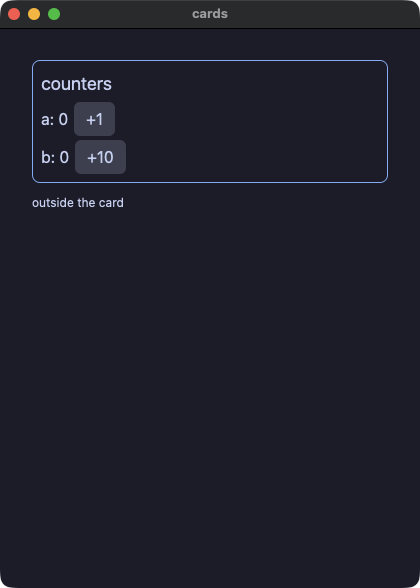
cards.py
# /// script
# requires-python = ">=3.14"
# ///
"""Slots: a component that takes CHILDREN. Declare it
@component(slots=True), place them with slot(), pass them by
`with card(...):` — the native twin is pixie's `Slot { }` splice,
and the children keep use-site identity, so stateful components
inside a slot hold independent per-instance state.
"""
import os
import sys

sys.path.insert(0, os.path.join(os.path.dirname(os.path.abspath(__file__)), ".."))

from yokan import (
    button,
    column,
    component,
    local,
    row,
    run,
    slot,
    State,
    text,
)


@component(slots=True)
def card(title: str):
    with column(spacing=4, padding=8, border_width=1.0, border_color="accent", border_radius=8):
        text(title, size=18)
        slot()


@component
def counter(label: str, step: int):
    n: State[int] = local(0)
    with row(spacing=6):
        text(f"{label}: {n()}")
        button(f"+{step}", on_click=lambda: n.set(n() + step))


def view():
    with column(spacing=10, padding=16):
        with card("counters"):
            counter("a", 1)
            counter("b", 10)
        text("outside the card", size=12)


if __name__ == "__main__":
    run(view, title="cards")
layout — spacer and divider: a spacer pushes the button to the row's edge, a divider draws a rule (thicker and accent-colored between the sections)
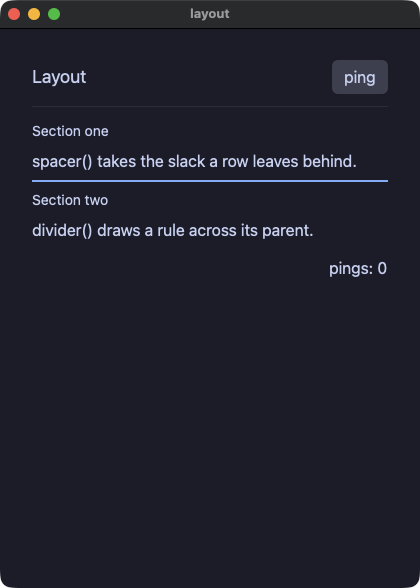
layout.py
# /// script
# requires-python = ">=3.14"
# ///
"""spacer and divider: a flex filler and a rule. The header row's
spacer pushes "ping" to the row's far edge; the footer row's spacer
does the same for the ping count. divider() draws the rules —
default weight between the header and the body, a heavier
theme-colored one between the body's two sections.

Develop:  uv run demo/layout.py
Ship:     python3 yokan_gate.py gate demo/layout.py --script "click:ping"
"""
import os
import sys

sys.path.insert(0, os.path.join(os.path.dirname(os.path.abspath(__file__)), ".."))

from yokan import button, column, divider, row, run, spacer, State, text  # noqa: E402


pings: State[int] = State(0)


def view():
    return column(
        row(
            text("Layout", size=18),
            spacer(),
            button("ping", on_click=lambda: pings.set(pings() + 1)),
        ),
        divider(),
        column(
            text("Section one", size=14),
            text("spacer() takes the slack a row leaves behind."),
            divider(thickness=2.0, color="accent"),
            text("Section two", size=14),
            text("divider() draws a rule across its parent."),
            spacing=6,
        ),
        row(
            spacer(),
            text(f"pings: {pings()}"),
        ),
        spacing=12,
        padding=16,
    )


if __name__ == "__main__":
    run(view, title="layout")
split — two panes and a divider you drag: the ratio is the app's own number, so the handler writes it back and clamps it there (the element has no min / max)
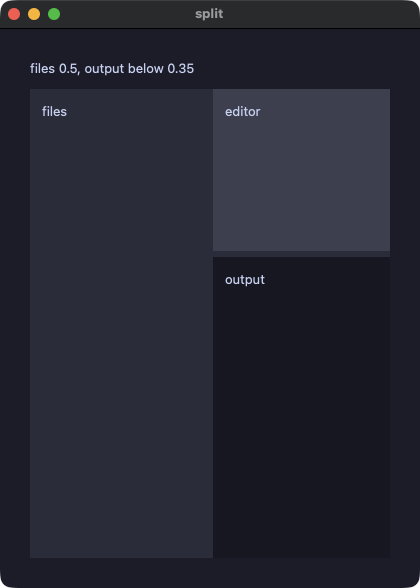
split.py
# /// script
# requires-python = ">=3.14"
# ///
"""A split is two panes and a divider you drag.

`ratio` is the share the first pane takes, and it is the app's own
number: the handler receives the new one and writes it back, which is
what moves the divider. That is the slider's contract with a different
gesture, so `slide:` drives it headless with no verb of its own — and
because a ratio is a fraction, the widget has no min= / max=: a pane
that may not vanish says so once, in the handler.
"""
import os
import sys

sys.path.insert(0, os.path.join(os.path.dirname(os.path.abspath(__file__)), ".."))

from yokan import column, run, split, store, text  # noqa: E402


@store
class Panes:
    ratio: float = 0.5
    rows: float = 0.35

    def widen(self, r: float) -> None:
        # The floor under each pane, kept where the app keeps the
        # number rather than on the widget: one owner, not two.
        self.ratio = min(0.8, max(0.2, r))

    def lower(self, r: float) -> None:
        self.rows = min(0.85, max(0.15, r))


def view():
    with column(spacing=10, padding=14, grow=1.0):
        text(f"files {Panes.ratio}, output below {Panes.rows}", size=13)
        split(
            column(
                text("files", size=13),
                padding=12,
                background="#313244",
                grow=1.0,
            ),
            split(
                column(
                    text("editor", size=13),
                    padding=12,
                    background="#45475a",
                    grow=1.0,
                ),
                column(
                    text("output", size=13),
                    padding=12,
                    background="#181825",
                    grow=1.0,
                ),
                ratio=Panes.rows,
                vertical=True,
                on_change=Panes.lower,
            ),
            ratio=Panes.ratio,
            on_change=Panes.widen,
        )


if __name__ == "__main__":
    run(view, title="split")
about — link: text that opens a URL, beside a button that copies one to the clipboard
about.py
# /// script
# requires-python = ">=3.14"
# ///
"""The About panel: the app's identity, and three Links out to the
project. A Link is a line of text that opens its `url` in the
browser when clicked (accent-colored, underlined, a pointer cursor);
a headless run accepts the click and does nothing, since opening a
browser is not app state — `dump` never moves because of one. The
button copies the source URL to the clipboard with `clipboard.set_text`
and flips the status line to confirm it.
"""
import os
import sys

sys.path.insert(0, os.path.join(os.path.dirname(os.path.abspath(__file__)), ".."))

from yokan import button, column, link, run, store, text  # noqa: E402
from yokan import clipboard  # noqa: E402


@store
class About:
    status: str = ""

    def copy_link(self) -> None:
        clipboard.set_text("https://github.com/i2y/yokan")
        self.status = "copied"


def view():
    with column(spacing=8, padding=14):
        text("Yokan", size=28)
        text("version 0.2.0")
        link("Website", "https://i2y.github.io/yokan/")
        link("Source", "https://github.com/i2y/yokan")
        link("Docs", "https://i2y.github.io/yokan/tour/")
        button("copy link", on_click=About.copy_link)
        text(f"status: {About.status}")


if __name__ == "__main__":
    run(view, title="about")
badges — text with a box of its own: status pills, a monospaced hash, an underlined note, an ellipsis and a two-line clamp
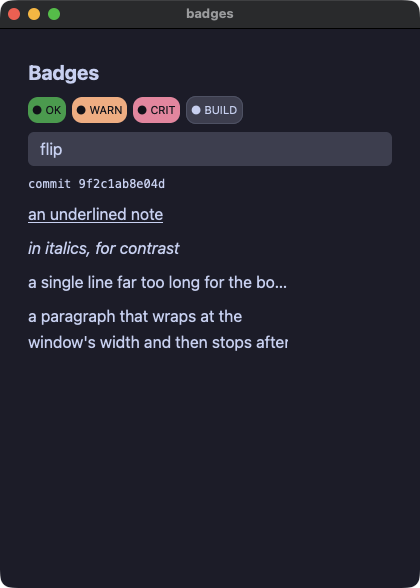
badges.py
# /// script
# requires-python = ">=3.14"
# ///
"""Typography, wrapping and the box a label draws behind itself.
A text can be bold, italic, monospaced or underlined; it can stop
wrapping (`wrap="nowrap"`), clip with an ellipsis (`wrap="ellipsis"`
plus a `width`), or clamp to `max_lines`; and `background`,
`padding` and the border props turn it into a status pill. The pill
colors are named once as styles and composed with `|`, and the last
one follows state — a style value is a value, so `flip` re-colors it
without a second element.
"""
import os
import sys

sys.path.insert(0, os.path.join(os.path.dirname(os.path.abspath(__file__)), ".."))

from yokan import button, column, row, run, State, style, text  # noqa: E402

pill = style(size=11, color="#11111b", padding=4, border_radius=10)
ok = style(background="#2fa84f")
warn = style(background="#fab387")
crit = style(background="#f38ba8")

pill_ok = pill | ok
pill_warn = pill | warn
pill_crit = pill | crit

tint: State[str] = State("#45475a")
hot: State[bool] = State(False)


def flip():
    hot.set(not hot())
    if hot():
        tint.set("#f38ba8")
    else:
        tint.set("#45475a")


def view():
    with column(spacing=8, padding=12):
        text("Badges", size=20, bold=True)
        with row(spacing=6):
            text("● OK", **pill_ok)
            text("● WARN", **pill_warn)
            text("● CRIT", **pill_crit)
            text(
                "● BUILD",
                size=11,
                color="#cdd6f4",
                background=tint(),
                padding=4,
                border_radius=10,
                border_width=1,
                border_color="#585b70",
            )
        button("flip", on_click=flip)
        text("commit 9f2c1ab8e04d", mono=True, size=12)
        text("an underlined note", underline=True)
        text("in italics, for contrast", italic=True)
        # An ellipsis needs a bounded box to clip against.
        text(
            "a single line far too long for the box it was given, so it ends in an ellipsis",
            wrap="ellipsis",
            width=260,
        )
        # The clamp is the other half: this one wraps, then stops.
        text(
            "a paragraph that wraps at the window's width and then stops after two lines, "
            "because a clamped label is what a card summary wants",
            max_lines=2,
            width=260,
        )


if __name__ == "__main__":
    run(view, title="badges")
filter — segmented: the toggle-button chooser over a filtered list
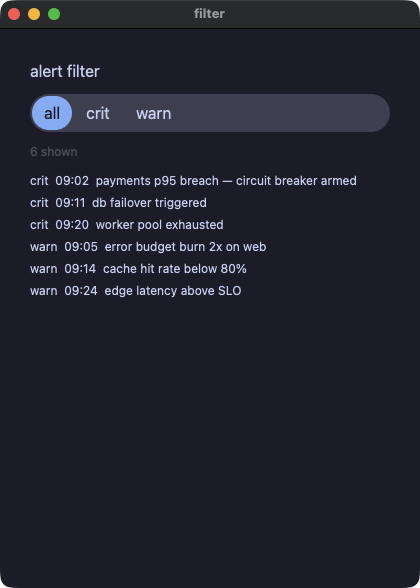
filter.py
# /// script
# requires-python = ">=3.14"
# ///
"""segmented replaces a row of if/else-styled buttons with one bound
chooser: the accent-filled segment IS the current filter, and
picking another segment reruns `on_change` with its 0-based index.
Compare `demo/opsboard/app.py`'s `Alerts.filter` row, which needs
three buttons and an if/else per button to do the same job.

Develop:  uv run demo/filter.py
Ship:     python3 yokan_gate.py gate demo/filter.py --script "select:crit,dump,select:all"
"""
import os
import sys

sys.path.insert(0, os.path.join(os.path.dirname(os.path.abspath(__file__)), ".."))

from yokan import column, list_view, run, segmented, store, text  # noqa: E402


@store
class Alerts:
    # `self.levels[i]` (a list indexed by an arbitrary Int) is not in
    # the dialect yet — only a row builder's OWN driving list may be
    # indexed by its row number — and a plain method call (like
    # `.startswith()`) is not a valid `if` condition either, only a
    # bool cell/field or a comparison is. So the split mirrors
    # opsboard's `Alerts.rebuild()`: one list per severity, `pick`
    # branches on the INDEX (an Int comparison) instead of a String
    # field, and appends whichever lists the chosen segment covers.
    levels: list[str] = ["all", "crit", "warn"]
    level: int = 0
    crit_rows: list[str] = [
        "crit  09:02  payments p95 breach — circuit breaker armed",
        "crit  09:11  db failover triggered",
        "crit  09:20  worker pool exhausted",
    ]
    warn_rows: list[str] = [
        "warn  09:05  error budget burn 2x on web",
        "warn  09:14  cache hit rate below 80%",
        "warn  09:24  edge latency above SLO",
    ]
    visible: list[str] = [
        "crit  09:02  payments p95 breach — circuit breaker armed",
        "crit  09:11  db failover triggered",
        "crit  09:20  worker pool exhausted",
        "warn  09:05  error budget burn 2x on web",
        "warn  09:14  cache hit rate below 80%",
        "warn  09:24  edge latency above SLO",
    ]

    def pick(self, i: int) -> None:
        self.level = i
        self.visible = []
        if i == 0:
            for r in self.crit_rows:
                self.visible = self.visible + [r]
            for r in self.warn_rows:
                self.visible = self.visible + [r]
        elif i == 1:
            for r in self.crit_rows:
                self.visible = self.visible + [r]
        else:
            for r in self.warn_rows:
                self.visible = self.visible + [r]


def alert_row(i):
    return text(Alerts.visible[i], size=12)


def view():
    with column(spacing=10, padding=14):
        text("alert filter", size=16)
        segmented(options=Alerts.levels, selected=Alerts.level, on_change=Alerts.pick)
        text(f"{len(Alerts.visible)} shown", size=12, color="textDim")
        list_view(len(Alerts.visible), alert_row, item_height=22.0, height=150.0)


if __name__ == "__main__":
    run(view, title="filter")
contextmenu — the menu a right-click opens on what it wraps: the items are the app's data, so they are in a dump open or not, and a script picks one with select:
contextmenu.py
# /// script
# requires-python = ">=3.14"
# ///
"""A menu the right button opens.

`context_menu` wraps one element with the items it offers. The items
are the app's own data, so they are in a dump whether the menu is
open or not, and a verification script picks from them with the step
every chooser takes — `select:<item>` — without the click that opens
the panel. Where that panel goes is the window's business, the way a
`select`'s open list is.
"""
import os
import sys

sys.path.insert(0, os.path.join(os.path.dirname(os.path.abspath(__file__)), ".."))

from yokan import column, context_menu, run, store, text  # noqa: E402


@store
class Board:
    items: list[str] = ["Rename", "Duplicate", "Delete"]
    note: str = "right-click the card"

    def pick(self, i: int) -> None:
        self.note = f"chose {self.items[i]}"


def view() -> None:
    with column(spacing=10, padding=14):
        text("a menu the right button opens", size=20)
        with context_menu(options=Board.items, on_select=Board.pick):
            with column(padding=16, background="#313244", border_radius=8.0):
                text("a card", size=14)
        text(f"{Board.note}")


if __name__ == "__main__":
    run(view, title="contextmenu")
menubutton — a button that opens a short menu: no current value, so the label stays put and the handler receives the chosen index; a script picks from it with select:
menubutton.py
# /// script
# requires-python = ">=3.14"
# ///
"""A button that opens a short menu.

`menu_button` is a `select` with no current value: the label stays
put, the options are data, and choosing one calls the handler with
its index. Nothing new is needed to verify it — `select:<option>`
picks from a menu the way it picks from a select, and the options
are in the dump whether the menu is open or not, because what the
app offers is not engine state.
"""
import os
import sys

sys.path.insert(0, os.path.join(os.path.dirname(os.path.abspath(__file__)), ".."))

from yokan import column, menu_button, row, run, store, text  # noqa: E402


@store
class Doc:
    actions: list[str] = ["Rename", "Duplicate", "Delete"]
    exports: list[str] = ["CSV", "JSON"]
    note: str = "nothing chosen"

    def act(self, i: int) -> None:
        self.note = f"chose {self.actions[i]}"

    def export(self, i: int) -> None:
        self.note = f"exported as {self.exports[i]}"


def view() -> None:
    with column(spacing=10, padding=14):
        text("a button that opens a menu", size=20)
        with row(spacing=8):
            menu_button("Actions", Doc.actions, on_select=Doc.act)
            menu_button("Export", Doc.exports, on_select=Doc.export)
        text(f"{Doc.note}")


if __name__ == "__main__":
    run(view, title="menubutton")
quantities — number_field and int_field: typed numeric inputs that commit on enter, clamp into the range and snap to the step
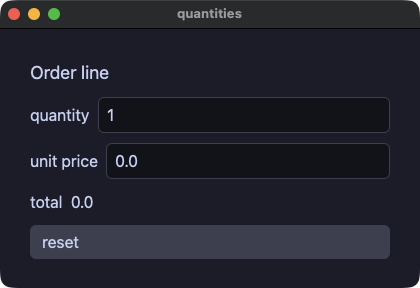
quantities.py
# /// script
# requires-python = ">=3.14"
# ///
"""An order line with typed numeric inputs: int_field for the
quantity (1..99) and number_field for the unit price (0..1000, in
half-yen steps). Both commit on `enter` or when the field loses
focus — in a script, `input:` commits — so text that is not a number
never reaches the store, and the total is computed in the view.
"""
import os
import sys

sys.path.insert(0, os.path.join(os.path.dirname(os.path.abspath(__file__)), ".."))

from yokan import button, column, int_field, number_field, row, run, store, text


@store
class Order:
    qty: int = 1
    price: float = 0.0

    def set_qty(self, n: int) -> None:
        self.qty = n

    def set_price(self, p: float) -> None:
        self.price = p

    def reset(self) -> None:
        self.qty = 1
        self.price = 0.0


def view():
    with column(spacing=10, padding=14):
        text("Order line", size=18)
        with row(spacing=8):
            text("quantity")
            int_field(Order.qty, min=1, max=99, placeholder="qty", on_change=Order.set_qty)
        with row(spacing=8):
            text("unit price")
            number_field(
                Order.price,
                min=0.0,
                max=1000.0,
                step=0.5,
                placeholder="price",
                on_change=Order.set_price,
            )
        text(f"total  {Order.qty * Order.price}")
        button("reset", on_click=Order.reset)


if __name__ == "__main__":
    run(view, title="quantities", width=420, height=260)
loading — progress with a label, a size, and an indeterminate sweep for work with no known length
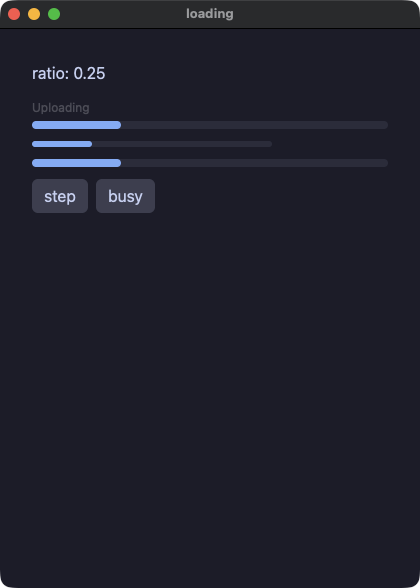
loading.py
# /// script
# requires-python = ">=3.14"
# ///
"""progress: `value` stays the only required prop — `width`/`height`
size the track, `label` draws a dim line above it, and
`indeterminate` ignores `value` and sweeps a segment instead, for
work with no known length.

Develop:  uv run demo/loading.py
Ship:     python3 yokan_gate.py gate demo/loading.py --script "click:step,click:step,dump,click:busy"
"""
import os
import sys

sys.path.insert(0, os.path.join(os.path.dirname(os.path.abspath(__file__)), ".."))

from yokan import button, column, progress, row, run, State, text  # noqa: E402


ratio: State[float] = State(0.25)
busy: State[bool] = State(False)


def step():
    if ratio() >= 1.0:
        ratio.set(0.0)
    else:
        ratio.set(ratio() + 0.25)


def toggle_busy():
    busy.set(not busy())


def view():
    return column(
        text(f"ratio: {ratio()}"),
        progress(ratio(), label="Uploading"),
        progress(ratio(), width=240, height=6),
        progress(ratio(), indeterminate=busy()),
        row(
            button("step", on_click=step),
            button("busy", on_click=toggle_busy),
            spacing=8,
        ),
        spacing=12,
        padding=16,
    )


if __name__ == "__main__":
    run(view, title="loading")
canvas — the drawing surface: a grid of virtual pixels painted command by command, colors by palette index, a for inside the canvas, and the keyboard read as a device from the tick
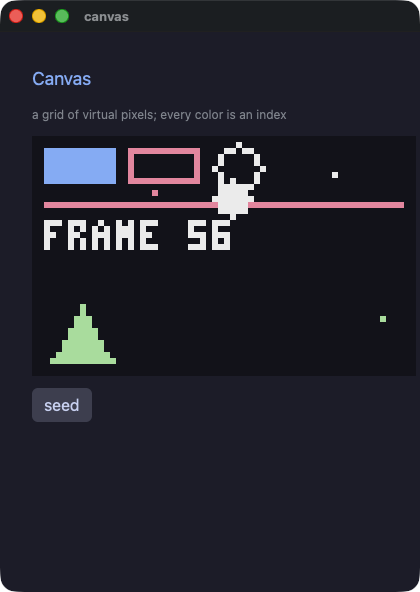
canvas.py
# /// script
# requires-python = ">=3.14"
# ///
"""A canvas: a grid of virtual pixels you paint command by command.

`canvas(width, height, scale=…, background=…, palette=…)` opens the
grid, and inside it the commands paint — `pixel`, `line`, `rect`,
`rect_outline`, `circle`, `circle_outline`, `triangle`,
`triangle_outline`, `sprite` and `pixel_text`. `scale` says how many
logical pixels each virtual one takes, so a 64x40 canvas at six is
384x240 on screen.

Every color is a NUMBER: the index of a color in `palette`. That is
how tools for pixel art work, so drawing code written for one moves
here with its numbers unchanged.

The commands are not elements. Nothing here can be clicked, themed,
sized or animated, and a `for` inside the canvas is the ordinary
loop — what its body paints joins the frame where it stands.
"""
import os
import sys

sys.path.insert(0, os.path.join(os.path.dirname(os.path.abspath(__file__)), ".."))

from yokan import (  # noqa: E402
    button,
    canvas,
    circle,
    circle_outline,
    column,
    every,
    keys,
    line,
    pixel,
    pixel_text,
    rect,
    rect_outline,
    row,
    run,
    store,
    style,
    text,
    triangle,
    value,
)

heading = style(size=18, color="accent")
faint = style(size=12, color="#8a8f98")


@value
class Blip:
    x: int
    y: int
    c: int


@store
class Sky:
    frame: int = 0
    ball_x: int = 30
    ball_y: int = 18
    dx: int = 1
    dy: int = 1
    blips: list[Blip] = []
    # Five colors are enough to show that the index IS the color.
    palette: list[str] = ["#11111b", "#89b4fa", "#f38ba8", "#eeeeee", "#a6e3a1"]

    def seed(self) -> None:
        self.blips = [Blip(6, 4, 1), Blip(20, 9, 2), Blip(50, 6, 3), Blip(58, 30, 4)]

    def tick(self) -> None:
        self.frame = self.frame + 1
        # The keyboard is read here, in the tick — never in a view.
        # `down` is "held right now", so holding an arrow steers.
        if keys.down("left"):
            self.dx = -1
        if keys.down("right"):
            self.dx = 1
        if keys.pressed("space"):
            self.dy = -self.dy
        x = self.ball_x + self.dx
        y = self.ball_y + self.dy
        if x < 4:
            x = 4
            self.dx = 1
        if x > 59:
            x = 59
            self.dx = -1
        if y < 4:
            y = 4
            self.dy = 1
        if y > 35:
            y = 35
            self.dy = -1
        self.ball_x = x
        self.ball_y = y


every(0.05, Sky.tick)


def seed():
    Sky.seed()


def view():
    with column(spacing=12, padding=16):
        text("Canvas", **heading)
        text("a grid of virtual pixels; every color is an index", **faint)
        with canvas(64, 40, scale=6, background=0, palette=Sky.palette):
            rect(2, 2, 12, 6, 1)
            rect_outline(16, 2, 12, 6, 2)
            circle_outline(34, 5, 4, 3)
            line(2, 11, 61, 11, 2)
            triangle(3, 37, 8, 28, 13, 37, 4)
            for b in Sky.blips:
                pixel(b.x, b.y, b.c)
            circle(Sky.ball_x, Sky.ball_y, 3, 3)
            pixel_text(2, 14, f"FRAME {Sky.frame}", 3)
        with row(spacing=8):
            button("seed", on_click=seed)


if __name__ == "__main__":
    run(view, title="canvas", on_start=seed)
shooter — Pyxel's shoot-'em-up example, ported: three scenes, a hundred parallax stars, enemies that sway as they fall, rectangle collisions and expanding blasts, all on the canvas
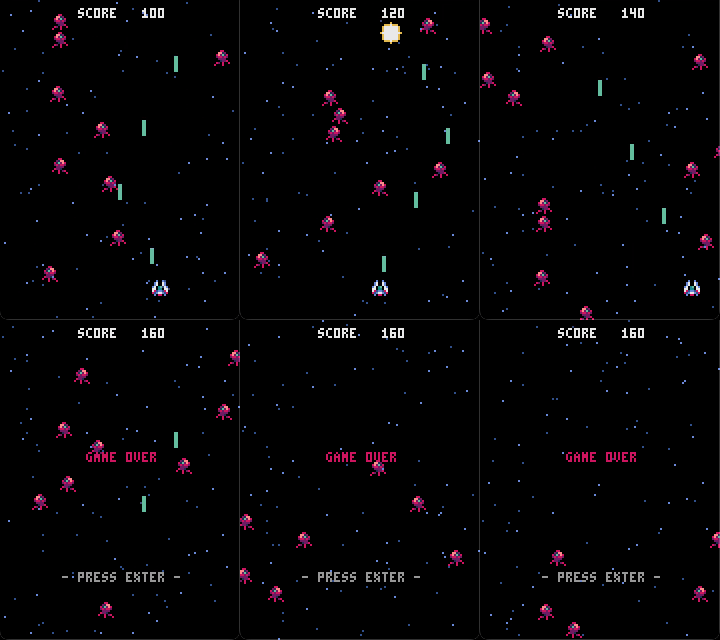
shooter.py
# /// script
# requires-python = ">=3.14"
# ///
"""Pyxel Shooter, ported to Yokan.

The original is `09_shooter.py` from Pyxel's examples (Takashi Kitao,
MIT, https://github.com/kitao/pyxel), and the sprite sheet in
`assets/shooter.png` is that example's own two 8x8 sprites, written out
with Pyxel's palette. The port follows it line by line: `pyxel.rect`
becomes `rect`, `pyxel.btn` becomes `keys.down`, `pyxel.blt` becomes
`sprite`, and the color numbers are the same numbers, because inside a
canvas a color is an index into the palette this file declares.

What is different, and why. Speeds that were fractional (1.5 px a
frame) are carried in tenths of a pixel and drawn whole, because a
pixel grid has no half pixels. The music is gone, and the two sound
effects are ours rather than Pyxel's: its sounds are written as MML
for a chip it emulates, and `audio.play` takes a file, so
`assets/shot.wav` and `assets/blast.wav` were made for this port. So
is the gamepad.
Everything else — three scenes, a hundred parallax stars, the enemy
that sways as it falls, rectangle collisions, expanding blasts — is
the game.

Arrow keys move, space fires, enter starts and restarts, q quits.
"""
import os
import random
import sys

sys.path.insert(0, os.path.join(os.path.dirname(os.path.abspath(__file__)), ".."))

from yokan import (  # noqa: E402
    audio,
    canvas,
    circle,
    circle_outline,
    column,
    every,
    keys,
    pixel,
    pixel_text,
    quit,
    rect,
    run,
    sprite,
    store,
    value,
)

WIDTH = 120
HEIGHT = 160

SCENE_TITLE = 0
SCENE_PLAY = 1
SCENE_GAMEOVER = 2

NUM_STARS = 100
STAR_COLOR_HIGH = 12
STAR_COLOR_LOW = 5

PLAYER_WIDTH = 8
PLAYER_HEIGHT = 8
PLAYER_SPEED = 2

BULLET_WIDTH = 2
BULLET_HEIGHT = 8
BULLET_COLOR = 11
BULLET_SPEED = 4

ENEMY_WIDTH = 8
ENEMY_HEIGHT = 8
# Pyxel's 1.5 px a frame, in tenths.
ENEMY_SPEED = 15

BLAST_START_RADIUS = 1
BLAST_END_RADIUS = 8
BLAST_COLOR_IN = 7
BLAST_COLOR_OUT = 10

SHEET = "demo/assets/shooter.png"
SHOT = "demo/assets/shot.wav"
BLAST = "demo/assets/blast.wav"


@value
class Star:
    x: int
    # `y` is what the canvas draws; `y10` is where the star really is.
    y: int
    y10: int
    speed10: int
    col: int


@value
class Bullet:
    x: int
    y: int


@value
class Enemy:
    x: int
    y: int
    x10: int
    y10: int
    flip: bool
    offset: int


@value
class Blast:
    x: int
    y: int
    radius: int


@store
class Game:
    scene: int = 0
    score: int = 0
    frame: int = 0
    title_col: int = 0
    px: int = 56
    py: int = 140
    stars: list[Star] = []
    bullets: list[Bullet] = []
    enemies: list[Enemy] = []
    blasts: list[Blast] = []
    # Pyxel's own sixteen colors, which is what makes the numbers in
    # this file mean what they mean in the original.
    palette: list[str] = [
        "#000000", "#2b335f", "#7e2072", "#19959c",
        "#8b4852", "#395c98", "#a9c1ff", "#eeeeee",
        "#d4186c", "#d38441", "#e9c35b", "#70c6a9",
        "#7696de", "#a3a3a3", "#ff9798", "#edc7b0",
    ]

    def boot(self) -> None:
        random.seed(7)
        out: list[Star] = []
        for i in range(NUM_STARS):
            x = random.randint(0, WIDTH - 1)
            y = random.randint(0, HEIGHT - 1)
            speed10 = random.randint(10, 25)
            col = STAR_COLOR_LOW
            if speed10 > 18:
                col = STAR_COLOR_HIGH
            out = out + [Star(x, y, y * 10, speed10, col)]
        self.stars = out

    def tick(self) -> None:
        if keys.pressed("q"):
            quit()
        self.frame = self.frame + 1
        self.title_col = self.frame % 16
        Game.move_stars()
        if self.scene == SCENE_TITLE:
            if keys.pressed("enter"):
                self.scene = SCENE_PLAY
        elif self.scene == SCENE_PLAY:
            Game.play()
        else:
            Game.over()

    def move_stars(self) -> None:
        out: list[Star] = []
        for s in self.stars:
            y10 = s.y10 + s.speed10
            if y10 >= HEIGHT * 10:
                y10 = y10 - HEIGHT * 10
            out = out + [Star(s.x, y10 // 10, y10, s.speed10, s.col)]
        self.stars = out

    def play(self) -> None:
        if self.frame % 6 == 0:
            x = random.randint(0, WIDTH - ENEMY_WIDTH)
            self.enemies = self.enemies + [
                Enemy(x, 0, x * 10, 0, False, random.randint(0, 59))
            ]
        Game.collide()
        Game.move_player()
        Game.move_bullets()
        Game.move_enemies()
        Game.move_blasts()

    def over(self) -> None:
        Game.move_bullets()
        Game.move_enemies()
        Game.move_blasts()
        if keys.pressed("enter"):
            self.scene = SCENE_PLAY
            self.px = 56
            self.py = 140
            self.score = 0
            self.enemies = []
            self.bullets = []
            self.blasts = []

    def move_player(self) -> None:
        x = self.px
        y = self.py
        if keys.down("left"):
            x = x - PLAYER_SPEED
        if keys.down("right"):
            x = x + PLAYER_SPEED
        if keys.down("up"):
            y = y - PLAYER_SPEED
        if keys.down("down"):
            y = y + PLAYER_SPEED
        self.px = min(max(x, 0), WIDTH - PLAYER_WIDTH)
        self.py = min(max(y, 0), HEIGHT - PLAYER_HEIGHT)
        if keys.pressed("space"):
            self.bullets = self.bullets + [
                Bullet(self.px + 3, self.py - 4)
            ]
            audio.play(SHOT, 0.5)

    def move_bullets(self) -> None:
        out: list[Bullet] = []
        for b in self.bullets:
            y = b.y - BULLET_SPEED
            if y + BULLET_HEIGHT - 1 >= 0:
                out = out + [Bullet(b.x, y)]
        self.bullets = out

    def move_enemies(self) -> None:
        out: list[Enemy] = []
        for e in self.enemies:
            x10 = e.x10
            flip = True
            if (self.frame + e.offset) % 60 < 30:
                x10 = x10 + ENEMY_SPEED
                flip = False
            else:
                x10 = x10 - ENEMY_SPEED
            y10 = e.y10 + ENEMY_SPEED
            if y10 <= (HEIGHT - 1) * 10:
                out = out + [
                    Enemy(x10 // 10, y10 // 10, x10, y10, flip, e.offset)
                ]
        self.enemies = out

    def move_blasts(self) -> None:
        out: list[Blast] = []
        for b in self.blasts:
            r = b.radius + 1
            if r <= BLAST_END_RADIUS:
                out = out + [Blast(b.x, b.y, r)]
        self.blasts = out

    def collide(self) -> None:
        """The two rectangle tests, resolved into new lists.

        A value is not edited in place, so where the original sets
        `is_alive = False` and filters afterwards, this keeps the ones
        that live."""
        live_enemies: list[Enemy] = []
        hit: list[int] = []
        blasts_ = self.blasts
        score_ = self.score
        struck_player = False
        for e in self.enemies:
            struck = False
            for i in range(len(self.bullets)):
                b = self.bullets[i]
                if (
                    e.x + ENEMY_WIDTH > b.x
                    and b.x + BULLET_WIDTH > e.x
                    and e.y + ENEMY_HEIGHT > b.y
                    and b.y + BULLET_HEIGHT > e.y
                ):
                    struck = True
                    hit = hit + [i]
            if struck:
                blasts_ = blasts_ + [
                    Blast(e.x + 4, e.y + 4, BLAST_START_RADIUS)
                ]
                score_ = score_ + 10
                audio.play(BLAST, 0.7)
            elif (
                self.px + PLAYER_WIDTH > e.x
                and e.x + ENEMY_WIDTH > self.px
                and self.py + PLAYER_HEIGHT > e.y
                and e.y + ENEMY_HEIGHT > self.py
            ):
                blasts_ = blasts_ + [
                    Blast(self.px + 4, self.py + 4, BLAST_START_RADIUS)
                ]
                struck_player = True
                audio.play(BLAST, 0.7)
            else:
                live_enemies = live_enemies + [e]
        live_bullets: list[Bullet] = []
        for i in range(len(self.bullets)):
            if i in hit:
                continue
            live_bullets = live_bullets + [self.bullets[i]]
        self.enemies = live_enemies
        self.bullets = live_bullets
        self.blasts = blasts_
        self.score = score_
        if struck_player:
            self.scene = SCENE_GAMEOVER


every(0.033, Game.tick)


def view():
    with column(spacing=0, padding=0):
        with canvas(WIDTH, HEIGHT, scale=4, background=0, palette=Game.palette):
            for s in Game.stars:
                pixel(s.x, s.y, s.col)
            if Game.scene == SCENE_TITLE:
                pixel_text(35, 66, "Pyxel Shooter", Game.title_col)
                pixel_text(31, 126, "- PRESS ENTER -", 13)
            elif Game.scene == SCENE_PLAY:
                sprite(Game.px, Game.py, SHEET, 0, 0, PLAYER_WIDTH, PLAYER_HEIGHT, colkey=0)
            else:
                pixel_text(43, 66, "GAME OVER", 8)
                pixel_text(31, 126, "- PRESS ENTER -", 13)
            for b in Game.bullets:
                rect(b.x, b.y, BULLET_WIDTH, BULLET_HEIGHT, BULLET_COLOR)
            for e in Game.enemies:
                sprite(e.x, e.y, SHEET, 8, 0, ENEMY_WIDTH, ENEMY_HEIGHT, colkey=0, flip_x=e.flip)
            for bl in Game.blasts:
                circle(bl.x, bl.y, bl.radius, BLAST_COLOR_IN)
                circle_outline(bl.x, bl.y, bl.radius, BLAST_COLOR_OUT)
            pixel_text(39, 4, f"SCORE {Game.score:5}", 7)


if __name__ == "__main__":
    # `padding=0.0`: the canvas IS the app, so it paints to the
    # window's edge rather than sitting inside the engine's ring.
    run(
        view,
        title="Pyxel Shooter",
        width=480.0,
        height=640.0,
        padding=0.0,
        on_start=Game.boot,
    )
jump — Pyxel's jump game, ported: gravity, floors that drop away when you land on them, fruit, and a mountain, trees and two cloud layers scrolling at their own speeds
jump.py
# /// script
# requires-python = ">=3.14"
# ///
"""Pyxel Jump, ported to Yokan.

The original is `02_jump_game.py` from Pyxel's examples (Takashi
Kitao, MIT, https://github.com/kitao/pyxel), and `assets/jump.png` is
that example's own image bank (`jump_game.pyxres`) written out with
Pyxel's palette. The port follows it line by line: `pyxel.blt` becomes
`sprite`, `pyxel.btn` becomes `keys.down`, `pyxel.cls(12)` becomes the
canvas background, and 12 still means the same color, because inside a
canvas a color is an index into the palette this file declares.

What is different, and why. The music is gone, and the three sound
effects are ours rather than Pyxel's: its sounds are written as MML
for a chip it emulates, and `audio.play` takes a file, so the three
WAVs in `assets/` were made for this port. So is the gamepad. Everything else — the falling player, the floors
that drop away when you land on them, the fruit, the scrolling
mountain, trees and two layers of cloud — is the game.

Left and right move; the rest is gravity.
"""
import os
import random
import sys

sys.path.insert(0, os.path.join(os.path.dirname(os.path.abspath(__file__)), ".."))

from yokan import (  # noqa: E402
    audio,
    canvas,
    column,
    every,
    keys,
    pixel_text,
    run,
    sprite,
    store,
    value,
)

WIDTH = 160
HEIGHT = 120
SKY = 12
SHEET = "demo/assets/jump.png"
LAND = "demo/assets/land.wav"
FRUIT = "demo/assets/fruit.wav"
FALL = "demo/assets/fall.wav"


@value
class Cloud:
    x: int
    y: int


@value
class Floor:
    x: int
    y: int
    alive: bool


@value
class Fruit:
    x: int
    y: int
    kind: int
    alive: bool


@store
class Game:
    score: int = 0
    px: int = 72
    py: int = -16
    dy: int = 0
    alive: bool = True
    frame: int = 0
    far: list[Cloud] = []
    near: list[Cloud] = []
    floors: list[Floor] = []
    fruits: list[Fruit] = []
    # What the view needs whole: the parallax offsets and which of the
    # two player sprites to cut out.
    tree_off: int = 0
    far_off: int = 0
    near_off: int = 0
    player_u: int = 0
    palette: list[str] = [
        "#000000", "#2b335f", "#7e2072", "#19959c",
        "#8b4852", "#395c98", "#a9c1ff", "#eeeeee",
        "#d4186c", "#d38441", "#e9c35b", "#70c6a9",
        "#7696de", "#a3a3a3", "#ff9798", "#edc7b0",
    ]

    def boot(self) -> None:
        random.seed(11)
        self.far = [Cloud(-10, 75), Cloud(40, 65), Cloud(90, 60)]
        self.near = [Cloud(10, 25), Cloud(70, 35), Cloud(120, 15)]
        floors_: list[Floor] = []
        fruits_: list[Fruit] = []
        for i in range(4):
            floors_ = floors_ + [Floor(i * 60, random.randint(8, 104), True)]
            fruits_ = fruits_ + [
                Fruit(i * 60, random.randint(0, 104), random.randint(0, 2), True)
            ]
        self.floors = floors_
        self.fruits = fruits_

    def tick(self) -> None:
        self.frame = self.frame + 1
        self.tree_off = self.frame % 160
        self.far_off = (self.frame // 16) % 160
        self.near_off = (self.frame // 8) % 160
        Game.update_player()
        Game.update_floors()
        Game.update_fruits()

    def update_player(self) -> None:
        if keys.down("left"):
            self.px = max(self.px - 2, 0)
        if keys.down("right"):
            self.px = min(self.px + 2, WIDTH - 16)
        self.py = self.py + self.dy
        self.dy = min(self.dy + 1, 8)
        self.player_u = 0
        if self.dy > 0:
            self.player_u = 16
        if self.py > HEIGHT:
            if self.alive:
                audio.play(FALL)
            self.alive = False
            if self.py > 600:
                self.score = 0
                self.px = 72
                self.py = -16
                self.dy = 0
                self.alive = True

    def update_floors(self) -> None:
        """A floor the player lands on drops away and bounces them.

        The original edits the tuple in the list; a value is not edited
        in place, so this builds the next list — and `dy` is carried in
        a local because the bounce it writes is what the floors after
        this one see."""
        out: list[Floor] = []
        score_ = self.score
        dy_ = self.dy
        for f in self.floors:
            x = f.x
            y = f.y
            alive_ = f.alive
            if alive_:
                if (
                    self.px + 16 >= x
                    and self.px <= x + 40
                    and self.py + 16 >= y
                    and self.py <= y + 8
                    and dy_ > 0
                ):
                    alive_ = False
                    score_ = score_ + 10
                    dy_ = -12
                    audio.play(LAND)
            else:
                y = y + 6
            x = x - 4
            if x < -40:
                x = x + 240
                y = random.randint(8, 104)
                alive_ = True
            out = out + [Floor(x, y, alive_)]
        self.floors = out
        self.score = score_
        self.dy = dy_

    def update_fruits(self) -> None:
        out: list[Fruit] = []
        score_ = self.score
        dy_ = self.dy
        for f in self.fruits:
            x = f.x
            y = f.y
            kind = f.kind
            alive_ = f.alive
            if alive_ and abs(x - self.px) < 12 and abs(y - self.py) < 12:
                alive_ = False
                score_ = score_ + (kind + 1) * 100
                dy_ = min(dy_, -8)
                audio.play(FRUIT)
            x = x - 2
            if x < -40:
                x = x + 240
                y = random.randint(0, 104)
                kind = random.randint(0, 2)
                alive_ = True
            out = out + [Fruit(x, y, kind, alive_)]
        self.fruits = out
        self.score = score_
        self.dy = dy_


every(0.033, Game.tick)


def view():
    with column(spacing=0, padding=0):
        with canvas(WIDTH, HEIGHT, scale=4, background=SKY, palette=Game.palette):
            # sky, mountain, and the trees that scroll fastest
            sprite(0, 88, SHEET, 0, 88, 160, 32)
            sprite(0, 88, SHEET, 0, 64, 160, 24, colkey=SKY)
            for i in range(2):
                sprite(i * 160 - Game.tree_off, 104, SHEET, 0, 48, 160, 16, colkey=SKY)
            # two layers of cloud, each strip drawn twice so it wraps
            for i in range(2):
                for c in Game.far:
                    sprite(c.x + i * 160 - Game.far_off, c.y, SHEET, 64, 32, 32, 8, colkey=SKY)
            for i in range(2):
                for c in Game.near:
                    sprite(c.x + i * 160 - Game.near_off, c.y, SHEET, 0, 32, 56, 8, colkey=SKY)
            for f in Game.floors:
                sprite(f.x, f.y, SHEET, 0, 16, 40, 8, colkey=SKY)
            for fr in Game.fruits:
                if fr.alive:
                    sprite(fr.x, fr.y, SHEET, 32 + fr.kind * 16, 0, 16, 16, colkey=SKY)
            sprite(Game.px, Game.py, SHEET, Game.player_u, 0, 16, 16, colkey=SKY)
            pixel_text(5, 4, f"SCORE {Game.score:>4}", 1)
            pixel_text(4, 4, f"SCORE {Game.score:>4}", 7)


if __name__ == "__main__":
    run(
        view,
        title="Pyxel Jump",
        width=640.0,
        height=480.0,
        padding=0.0,
        on_start=Game.boot,
    )
charts — negative values below the zero line, a pinned range, an axis with gridlines, and two series with their own colors
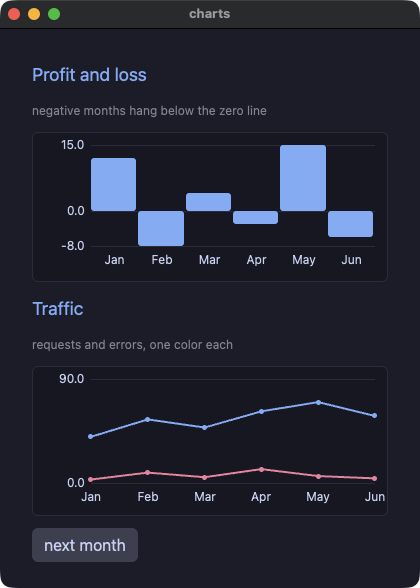
charts.py
# /// script
# requires-python = ">=3.14"
# ///
"""Charts that can say what they mean: a profit-and-loss bar chart
whose losing months hang below the zero line, and a two-series line
chart of requests against errors.

`axis=True` puts the range's ends and the zero line in the margin
with a faint gridline across the plot at each; `series=` takes one
`list[list[float]]` field, one inner list per line, and `colors=`
names them.
"""
import os
import sys

sys.path.insert(0, os.path.join(os.path.dirname(os.path.abspath(__file__)), ".."))

from yokan import (
    bar_chart,
    button,
    column,
    line_chart,
    row,
    run,
    store,
    style,
    text,
)

heading = style(size=18, color="accent")
faint = style(size=12, color="#8a8f98")


@store
class Book:
    months: list[str] = ["Jan", "Feb", "Mar", "Apr", "May", "Jun"]
    profit: list[float] = [12.0, -8.0, 4.0, -3.0, 15.0, -6.0]
    requests: list[float] = [40.0, 55.0, 48.0, 62.0, 70.0, 58.0]
    errors: list[float] = [3.0, 9.0, 5.0, 12.0, 6.0, 4.0]
    traffic: list[list[float]] = [
        [40.0, 55.0, 48.0, 62.0, 70.0, 58.0],
        [3.0, 9.0, 5.0, 12.0, 6.0, 4.0],
    ]
    n: int = 6

    def next_month(self) -> None:
        self.n = self.n + 1
        # A deterministic next month, so both runs read the same
        # numbers and the gate can byte-compare them.
        p = 1.0 * (self.n * 7 % 41) - 18.0
        self.profit = self.profit + [p]
        self.months = self.months + [f"M{self.n}"]
        self.requests = self.requests + [1.0 * (self.n * 13 % 50) + 30.0]
        self.errors = self.errors + [1.0 * (self.n * 5 % 14)]
        # `series=` reads ONE list[list[float]], so the two flat
        # series are collected into it after each shift.
        self.traffic = []
        self.traffic = self.traffic + [self.requests]
        self.traffic = self.traffic + [self.errors]


def advance():
    Book.next_month()


def view():
    with column(spacing=12, padding=16):
        text("Profit and loss", **heading)
        text("negative months hang below the zero line", **faint)
        bar_chart(Book.profit, labels=Book.months, axis=True, height=150.0)
        text("Traffic", **heading)
        text("requests and errors, one color each", **faint)
        line_chart(
            series=Book.traffic,
            labels=Book.months,
            colors=["accent", "#f38ba8"],
            axis=True,
            max=90.0,
            height=150.0,
        )
        with row(spacing=8):
            button("next month", on_click=advance)


if __name__ == "__main__":
    run(view, title="charts")
roster — table: a virtualized table with column tracks, row selection and header sort (the app re-sorts its own lists)
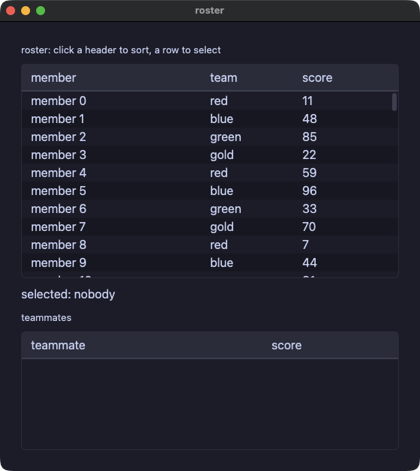
roster.py
# /// script
# requires-python = ">=3.14"
# ///
"""A roster of 200 members in a `table`: the columns are tracks the
cells line up on, a click on a row selects it, and a click on a header
sorts. The widget only reports which column was clicked; the store
owns the order and re-sorts its own parallel lists, so the selection
is tracked by member and follows its row through a sort. A second
table lists the selected member's teammates, with a selection of its
own.
"""
import os
import sys

sys.path.insert(0, os.path.join(os.path.dirname(os.path.abspath(__file__)), ".."))

from yokan import column, row, run, store, table, text  # noqa: E402


@store
class Roster:
    team_names: list[str] = ["red", "blue", "green", "gold"]
    names: list[str] = []
    ids: list[int] = []
    teams: list[str] = []
    team_ix: list[int] = []
    scores: list[int] = []
    keys: list[int] = []
    sel: int = -1
    sel_id: int = -1
    sel_line: str = ""
    sort_col: int = -1
    desc: bool = False
    mates: list[str] = []
    mate_scores: list[int] = []
    mate_sel: int = -1
    mate_name: str = ""

    def seed(self) -> None:
        for i in range(200):
            self.names = self.names + [f"member {i}"]
            self.ids = self.ids + [i]
            self.team_ix = self.team_ix + [i % 4]
            self.teams = self.teams + [self.team_names[i % 4]]
            self.scores = self.scores + [(i * 37 + 11) % 100]

    def pick(self, i: int) -> None:
        self.sel = i
        self.sel_id = self.ids[i]
        self.sel_line = f"{self.names[i]} ({self.teams[i]}, {self.scores[i]})"
        self.mates = []
        self.mate_scores = []
        for k in range(len(self.names)):
            if self.team_ix[k] == self.team_ix[i] and k != i:
                self.mates = self.mates + [self.names[k]]
                self.mate_scores = self.mate_scores + [self.scores[k]]
        self.mate_sel = -1

    def pick_mate(self, i: int) -> None:
        self.mate_sel = i
        self.mate_name = self.mates[i]

    def swap(self, a: int, b: int) -> None:
        n = self.names[a]
        self.names[a] = self.names[b]
        self.names[b] = n
        d = self.ids[a]
        self.ids[a] = self.ids[b]
        self.ids[b] = d
        t = self.teams[a]
        self.teams[a] = self.teams[b]
        self.teams[b] = t
        x = self.team_ix[a]
        self.team_ix[a] = self.team_ix[b]
        self.team_ix[b] = x
        s = self.scores[a]
        self.scores[a] = self.scores[b]
        self.scores[b] = s
        k = self.keys[a]
        self.keys[a] = self.keys[b]
        self.keys[b] = k

    # The sort key is an int per column: the member number for the
    # name column (the names are seeded in order), the team's index,
    # the score. An insertion sort swaps every parallel list in step,
    # then the selection finds its member again.
    def sort_by(self, j: int) -> None:
        if j == self.sort_col:
            self.desc = not self.desc
        else:
            self.sort_col = j
            self.desc = False
        if j == 0:
            self.keys = [k for k in self.ids]
        elif j == 1:
            self.keys = [k for k in self.team_ix]
        else:
            self.keys = [k for k in self.scores]
        i = 1
        while i < len(self.names):
            k = i
            while k > 0:
                a = self.keys[k]
                b = self.keys[k - 1]
                if (self.desc and a > b) or (not self.desc and a < b):
                    Roster.swap(k, k - 1)
                    k = k - 1
                else:
                    break
            i = i + 1
        if self.sel_id >= 0:
            for k in range(len(self.names)):
                if self.ids[k] == self.sel_id:
                    self.sel = k


def cells(i: int):
    return row(text(Roster.names[i]), text(Roster.teams[i]), text(f"{Roster.scores[i]}"))


def mate_cells(i: int):
    return row(text(Roster.mates[i]), text(f"{Roster.mate_scores[i]}"))


def view():
    with column(spacing=8, padding=12, grow=1.0):
        text("roster: click a header to sort, a row to select", size=13)
        table(
            ["member", "team", "score"],
            len(Roster.names),
            cells,
            widths=[2.0, 1.0, 1.0],
            selected=Roster.sel,
            sort=Roster.sort_col,
            descending=Roster.desc,
            on_select=Roster.pick,
            on_sort=Roster.sort_by,
            grow=1.0,
        )
        if Roster.sel >= 0:
            text(f"selected: {Roster.sel_line}")
        else:
            text("selected: nobody")
        text("teammates", size=13)
        table(
            ["teammate", "score"],
            len(Roster.mates),
            mate_cells,
            widths=[2.0, 1.0],
            selected=Roster.mate_sel,
            on_select=Roster.pick_mate,
            height=120.0,
        )
        if Roster.mate_sel >= 0:
            text(f"teammate: {Roster.mate_name}")


if __name__ == "__main__":
    run(view, title="roster", width=560, height=600, on_start=Roster.seed)
picklist — list_view with a marked row: selected= / on_select, the pair a table takes, a script picking a row by what it says, and scroll_to bringing the picked row into view
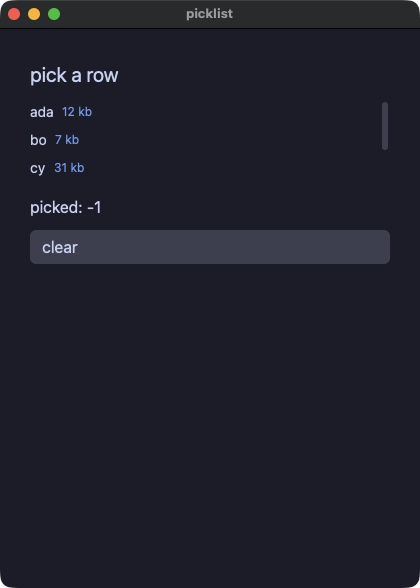
picklist.py
# /// script
# requires-python = ">=3.14"
# ///
"""A list you can pick a row from.

`list_view` takes `selected` and `on_select` the way `table` does:
the marked row is data the app owns, and clicking a row asks the app
to move the mark rather than moving it behind the app's back. The
rows are whatever the builder returns, so a verification script picks
one by what it says — the first text anywhere in the row.

The viewport is three rows tall, so `scroll_to` has something to do:
it is the row the app asks to have in view, and the list obeys it
when the number changes — a scroll position belongs to whoever is
scrolling, and this is the one sentence an app can say about it.
"""
import os
import sys

sys.path.insert(0, os.path.join(os.path.dirname(os.path.abspath(__file__)), ".."))

from yokan import State, button, column, list_view, row, run, text  # noqa: E402

names: State[list[str]] = State(["ada", "bo", "cy", "dee", "eve"])
sizes: State[list[int]] = State([12, 7, 31, 4, 19])
picked: State[int] = State(-1)


def choose(i: int) -> None:
    picked.set(i)


def clear() -> None:
    picked.set(-1)


def line(i: int):
    with row(spacing=8):
        text(names()[i], size=14)
        text(f"{sizes()[i]} kb", size=12, color="#7aa2f7")


def view() -> None:
    with column(spacing=10, padding=14):
        text("pick a row", size=20)
        list_view(
            len(names()),
            line,
            item_height=28.0,
            height=84.0,
            selected=picked(),
            on_select=choose,
            scroll_to=picked(),
        )
        text(f"picked: {picked()}")
        button("clear", on_click=clear)


if __name__ == "__main__":
    run(view, title="picklist")
labels — the accessibility properties role= and a11y_label=, printed by a script's a11y step
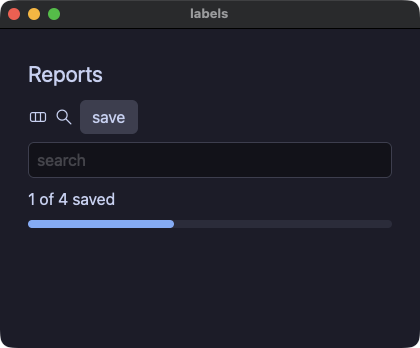
labels.py
# /// script
# requires-python = ">=3.14"
# ///
"""Accessibility riders, gated: `role=` overrides the role an element
derives, `a11y_label=` is the name assistive technology reads instead
of what the element would otherwise derive. Mirrors
examples/labels/labels.pix — the `a11y` headless step prints the
resulting tree, the same one a platform adapter would be handed.

Develop:  uv run demo/labels.py
Ship:     python3 yokan_gate.py gate demo/labels.py --script "a11y,click:save,a11y"
"""
import os
import sys

sys.path.insert(0, os.path.join(os.path.dirname(os.path.abspath(__file__)), ".."))

from yokan import button, column, progress, row, run, State, svg, text, text_field  # noqa: E402


title: State[str] = State("Reports")
query: State[str] = State("")
# `role=` takes a value: the summary line is a heading until there is
# a result under it, and then it is not (mirrors labels.pix).
summary_role: State[str] = State("heading")


def save():
    summary_role.set("label")


def find(q: str):
    query.set(q)


def view():
    with column(spacing=8, padding=12):
        text(title(), size=22, role="heading")
        with row(spacing=6, role="group", a11y_label="toolbar"):
            svg("demo/assets/yokan.svg", width=20, height=20, a11y_label="Yokan")
            svg("demo/assets/search.svg", width=20, height=20, a11y_label="Search")
            # The one element carrying tooltip=, role=, a11y_label=
            # AND animate= together — proving the wrapper nesting
            # (Semantics, then Tooltip, then Anim) matches pixie's
            # own codegen byte for byte.
            button(
                "save",
                on_click=save,
                animate=150,
                easing="out",
                role="button",
                a11y_label="Save the report",
                tooltip="Save this report",
            )
        text_field(query(), placeholder="search", on_change=find, a11y_label="search")
        text("1 of 4 saved", role=summary_role())
        progress(0.4)


if __name__ == "__main__":
    run(view, title="labels", width=420, height=320)
shared — the shared properties, one on each kind of element: a themed spacer, an animated segmented, a field spanning two grid tracks, a link with a role, a divider with a tooltip, a disabled button and field, a sized column
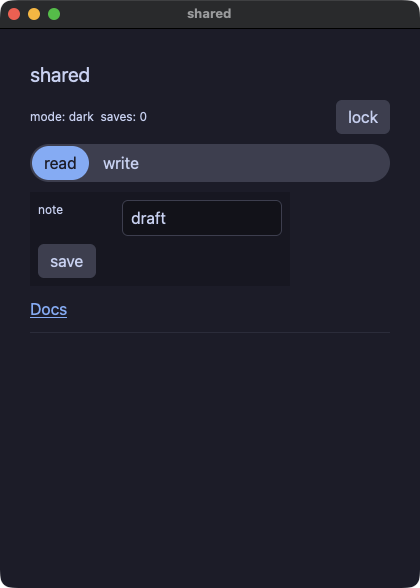
shared.py
# /// script
# requires-python = ">=3.14"
# ///
"""The shared properties: the keyword arguments EVERY element takes,
under the same names and with the same meaning. `width=`/`min_width=`
size an element, `disabled=` dims it and stops taking its clicks,
`theme=` scopes a palette over a subtree, `animate=`/`easing=` tween
what changes, `col_span=` places an element on a grid's tracks,
`role=` names it for assistive technology and `tooltip=` is the line
the window shows under the pointer. None of them belongs to any one
element, so the same spelling works on a spacer, a segmented chooser,
a field, a link or a rule — and both runs build the same tree, which
is what the gate compares. Locking proves it: while `locked` is true
the save button and the field are inert, in the window and in a
script alike.

Develop:  uv run demo/shared.py
Ship:     python3 yokan_gate.py gate demo/shared.py --script "click:lock,click:save,input:typed,dump,click:lock,click:save,dump"
"""
import os
import sys

sys.path.insert(0, os.path.join(os.path.dirname(os.path.abspath(__file__)), ".."))

from yokan import (  # noqa: E402
    button,
    column,
    divider,
    grid,
    link,
    row,
    run,
    segmented,
    spacer,
    store,
    text,
    text_field,
)


@store
class Locks:
    locked: bool = False
    saves: int = 0
    # The palette the spacer's subtree resolves its tokens in — a
    # property takes a read, not just a literal, so the lock switches it.
    mode: str = "dark"
    tab: int = 0
    note: str = "draft"

    def flip(self) -> None:
        self.locked = not self.locked
        if self.locked:
            self.mode = "light"
        else:
            self.mode = "dark"

    def save(self) -> None:
        self.saves = self.saves + 1

    def pick(self, i: int) -> None:
        self.tab = i

    def edit(self, t: str) -> None:
        self.note = t


def view():
    with column(spacing=10, padding=14):
        text("shared", size=20, role="heading")
        with row(spacing=8):
            text(f"mode: {Locks.mode}  saves: {Locks.saves}", size=12)
            # A theme scope on a spacer: the property is the element's,
            # whichever element it is.
            spacer(grow=1.0, theme=Locks.mode)
            button("lock", on_click=Locks.flip, tooltip="flip the lock")
        segmented(
            options=["read", "write"],
            selected=Locks.tab,
            on_change=Locks.pick,
            animate=120,
            easing="out",
        )
        # A box around the section: 260 wide, never under 200.
        with column(width=260.0, min_width=200.0, spacing=8, padding=8, background="panel"):
            # The field takes two of the grid's three tracks, and goes
            # inert with the lock.
            with grid(columns=3, spacing=8):
                text("note", size=12)
                text_field(
                    Locks.note,
                    on_change=Locks.edit,
                    col_span=2,
                    disabled=Locks.locked,
                )
            button("save", on_click=Locks.save, disabled=Locks.locked, tooltip="count a save")
        link("Docs", "https://i2y.github.io/yokan/", role="button")
        divider(tooltip="the end of the shared properties")


if __name__ == "__main__":
    run(view, title="shared")
The standard library
picker — file dialogs and dropped files: fs.open_dialog / save_dialog inside a task, on_file_drop; a script answers with file:<path> and drops with drop:<path>
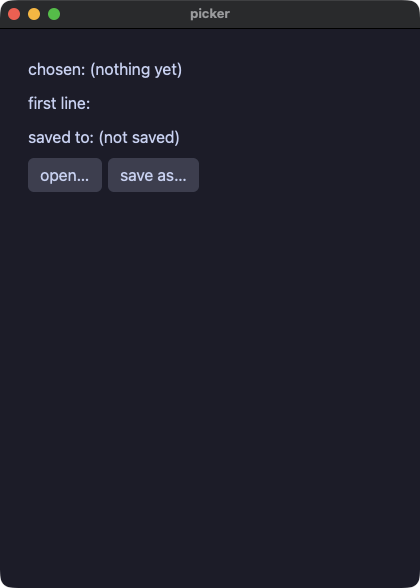
picker.py
# /// script
# requires-python = ">=3.14"
# ///
"""File dialogs. A dialog waits for a person, so it runs inside a
`task`: the call blocks on the worker while the window keeps drawing,
and the answer arrives in `on_done`. A headless run has no person, so
the script is the person — a `file:<path>` step is the answer the
next dialog gets, which is what makes a flow that opens a file
replayable and comparable across both runs.

A file dragged onto the window arrives the same way: `on_file_drop`
declares what happens to the path, and a script drops one with
`drop:<path>`.
"""
import os
import sys

sys.path.insert(0, os.path.join(os.path.dirname(os.path.abspath(__file__)), ".."))

from yokan import (  # noqa: E402
    button,
    column,
    on_file_drop,
    row,
    run,
    State,
    task,
    text,
)
from yokan import fs  # noqa: E402

chosen: State[str] = State("(nothing yet)")
body: State[str] = State("")
saved: State[str] = State("(not saved)")


def pick_file() -> str:
    return fs.open_dialog("Choose a file")


def took(path: str):
    chosen.set(path)
    if path != "":
        body.set(fs.read_text_or(path, "(unreadable)"))


def open_one():
    task(pick_file, on_done=took)


def pick_target() -> str:
    return fs.save_dialog("notes.txt")


def wrote(path: str):
    if path != "":
        fs.write_text(path, body())
        saved.set(path)


def save_as():
    task(pick_target, on_done=wrote)


def dropped(path: str):
    chosen.set(path)
    body.set(fs.read_text_or(path, "(unreadable)"))


on_file_drop(dropped)


def view():
    with column(spacing=8, padding=12):
        text(f"chosen: {chosen()}")
        text(f"first line: {body()[:40]}")
        text(f"saved to: {saved()}")
        with row(spacing=6):
            button("open…", on_click=open_one, tooltip="the platform's own panel")
            button("save as…", on_click=save_as)


if __name__ == "__main__":
    run(view, title="picker")
keys — shortcuts, keys, the clipboard and the menu bar: shortcut("cmd+s", save), on_key(typed), clipboard.set_text / get_text, menu_item("Count", "Save", save) — driven in a script with key:cmd+s and menu:Save
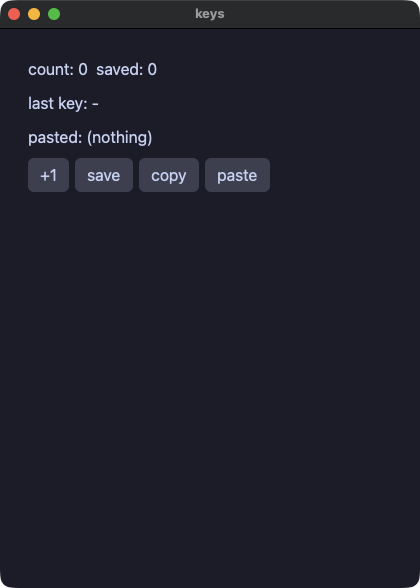
keys.py
# /// script
# requires-python = ">=3.14"
# ///
"""Keys and the clipboard. `shortcut(chord, handler)` declares a chord
the app answers, and `on_key(handler)` sees every key as the chord it
was. The chord is spelled the way the platform spells it (`cmd+s`,
`shift-tab`, `ctrl+alt+k`); a headless script presses one with
`key:cmd+s`, so a shortcut is checked by the gate like any other
interaction. `clipboard.set_text` / `get_text` copy and paste: a
window exchanges the text with every other application, a headless
run keeps it to itself. `menu_item(menu, name, handler)` puts the
same handlers in the application's menu bar, and a script picks one
with `menu:Save`.
"""
import os
import sys

sys.path.insert(0, os.path.join(os.path.dirname(os.path.abspath(__file__)), ".."))

from yokan import (  # noqa: E402
    button,
    column,
    menu_item,
    on_key,
    row,
    run,
    shortcut,
    State,
    text,
)
from yokan import clipboard  # noqa: E402

count: State[int] = State(0)
saved: State[int] = State(0)
last: State[str] = State("-")
pasted: State[str] = State("(nothing)")


def bump():
    count.set(count() + 1)


def save():
    saved.set(count())


def clear():
    count.set(0)
    saved.set(0)


def typed(key: str):
    last.set(key)


def copy_count():
    clipboard.set_text(f"count={count()}")


def paste():
    pasted.set(clipboard.get_text())


menu_item("Count", "Save", save)
menu_item("Count", "Clear", clear)

shortcut("cmd+s", save)
shortcut("cmd+shift+r", clear)
shortcut("cmd+shift+c", copy_count)
shortcut("cmd+shift+v", paste)
on_key(typed)


def view():
    with column(spacing=8, padding=12):
        text(f"count: {count()}  saved: {saved()}")
        text(f"last key: {last()}")
        text(f"pasted: {pasted()}")
        with row(spacing=6):
            button("+1", on_click=bump)
            button("save", on_click=save)
            button("copy", on_click=copy_count)
            button("paste", on_click=paste)


if __name__ == "__main__":
    run(view, title="keys")
files — yokan.fs: write, append, list a directory, remove, and what a file is without reading it (its size, whether it is a directory, when it was written) and the rest of it after an offset (both runs call the same implementation)
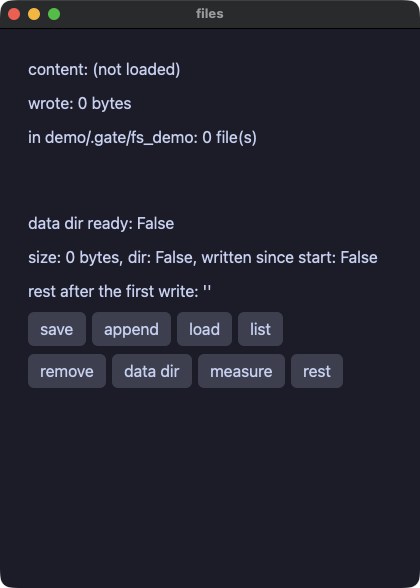
files.py
# /// script
# requires-python = ">=3.14"
# ///
"""`yokan.fs` from the standard library: the interpreted and the
compiled app call the SAME implementation, so the gate arbitrates a
single truth (write 25 bytes, read them back). The rest of a file
app is here too — make a directory, append to a file, list what is
in it, remove one — and `fs.app_dir(name)` answers the directory
this app may keep its own files in, created if it is not there yet.
What a file IS comes without reading it: `fs.size`, `fs.is_dir`,
and `fs.modified_ms`, in the unit `clock.format_ms` reads. And
`fs.read_text_from(path, offset)` answers the rest of a file a read
already reached the end of once, which is how a growing log is
followed without reading it again from the top.
"""
import os
import sys
import time

sys.path.insert(0, os.path.join(os.path.dirname(os.path.abspath(__file__)), ".."))

from yokan import button, column, list_view, row, run, State, text  # noqa: E402
from yokan import fs  # noqa: E402

DIR = "demo/.gate/fs_demo"
NOTE = "demo/.gate/fs_demo/note.txt"

content: State[str] = State("(not loaded)")
wrote: State[int] = State(0)
names: State[list[str]] = State([])
ready: State[bool] = State(False)
size: State[int] = State(0)
in_dir: State[bool] = State(False)
fresh: State[bool] = State(False)
tail: State[str] = State("")
started: State[float] = State(0.0)


def boot():
    started.set(time.time())


def save():
    fs.make_dir(DIR)
    wrote.set(fs.write_text(NOTE, "hello from one rust crate"))


def add_line():
    fs.append_text(NOTE, " (and again)")


def load():
    content.set(fs.read_text(NOTE))


def listing():
    names.set(fs.list_dir(DIR))


def clean():
    fs.remove(NOTE)
    names.set(fs.list_dir(DIR))


def data_dir():
    # the app's own directory, made on the way out
    ready.set(fs.exists(fs.app_dir("yokan-files-demo")))


def measure():
    # what the file is, without reading it: its length, whether the
    # path is a directory, and whether it was written since the app
    # started (a second of slack for a file system that keeps whole
    # seconds)
    size.set(fs.size(NOTE))
    in_dir.set(fs.is_dir(DIR))
    at = fs.modified_ms(NOTE)
    since = int(started() * 1000.0) - 2000
    if at >= since:
        fresh.set(True)
    else:
        fresh.set(False)


def rest():
    # the rest of the file after the first write — the follower's
    # read: from where it stopped, not from the top
    tail.set(fs.read_text_from(NOTE, wrote()))


def entry(i):
    return text(names()[i])


def view():
    with column(spacing=8, padding=12):
        text(f"content: {content()}")
        text(f"wrote: {wrote()} bytes")
        text(f"in {DIR}: {len(names())} file(s)")
        list_view(len(names()), entry, item_height=20.0, height=44.0)
        text(f"data dir ready: {ready()}")
        text(f"size: {size()} bytes, dir: {in_dir()}, written since start: {fresh()}")
        text(f"rest after the first write: '{tail()}'")
        with row(spacing=6):
            button("save", on_click=save)
            button("append", on_click=add_line)
            button("load", on_click=load)
            button("list", on_click=listing)
        with row(spacing=6):
            button("remove", on_click=clean)
            button("data dir", on_click=data_dir)
            button("measure", on_click=measure)
            button("rest", on_click=rest)


if __name__ == "__main__":
    run(view, title="files", on_start=boot)
dbnotes — yokan.sqlite: shape rows with SQL, order with ORDER BY
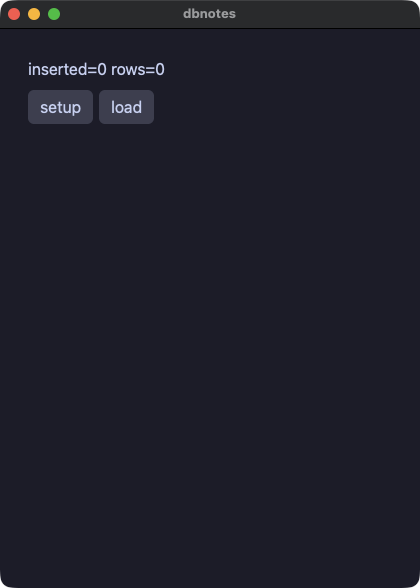
dbnotes.py
# /// script
# requires-python = ">=3.14"
# ///
"""sqlite from the standard library: one bundled implementation
serves the interpreted and the compiled app alike. Rows come back
as column-0 text — shape the row with SQL, order with ORDER BY
(determinism is the app's SQL, not the module's guess).
"""
import os
import sys

sys.path.insert(0, os.path.join(os.path.dirname(os.path.abspath(__file__)), ".."))

from yokan import button, column, list_view, row, run, State, text  # noqa: E402
from yokan import sqlite  # noqa: E402

changed: State[int] = State(0)
rows: State[list[str]] = State([])


def setup():
    sqlite.exec("demo/.gate/notes.db", "CREATE TABLE IF NOT EXISTS notes(t TEXT)")
    sqlite.exec("demo/.gate/notes.db", "DELETE FROM notes")
    changed.set(sqlite.exec("demo/.gate/notes.db", "INSERT INTO notes VALUES ('alpha'),('beta'),('gamma')"))


def load():
    rows.set(sqlite.query_text("demo/.gate/notes.db", "SELECT t FROM notes ORDER BY t"))


def note_row(i):
    return text(rows()[i])


def view():
    with column(spacing=8, padding=12):
        text(f"inserted={changed()} rows={len(rows())}")
        with row(spacing=6):
            button("setup", on_click=setup)
            button("load", on_click=load)
        list_view(len(rows()), note_row, item_height=22.0, height=120.0)


if __name__ == "__main__":
    run(view, title="dbnotes")
ledger — a practical app: a household ledger in sqlite, every value a bound parameter
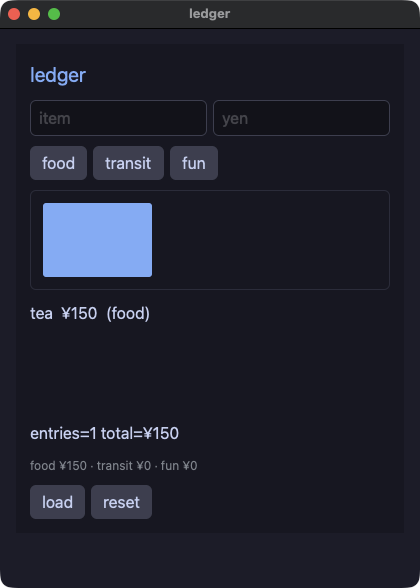
ledger.py
# /// script
# requires-python = ">=3.14"
# ///
"""A practical app: a household ledger. Everything on the stack at
once — a named store with methods over sqlite, dict/list fields, a
chart, styles, typed text input (`strings.to_int` is total: bad
input becomes the default, identically in both tiers) — and it
ships as one file.

Every value reaches the database as a bound parameter: a `?` in the
statement and the value beside it, so an apostrophe in an item name
is an apostrophe and never a piece of SQL.
"""
import os
import sys

sys.path.insert(0, os.path.join(os.path.dirname(os.path.abspath(__file__)), ".."))

from yokan import (
    bar_chart,
    button,
    column,
    list_view,
    row,
    run,
    State,
    store,
    style,
    text,
    text_field,
)
from yokan import sqlite, strings  # noqa: E402

DB = "demo/.gate/ledger.db"

heading = style(size=20, color="accent")
faint = style(size=12, color="#8a8f98")

name: State[str] = State("")
amount: State[str] = State("")


@store
class Ledger:
    count: int = 0
    grand: int = 0
    food: int = 0
    transit: int = 0
    fun: int = 0
    totals: dict[str, int] = {}
    chart: list[float] = []
    rows: list[str] = []
    raw: list[list[str]] = []

    def reset(self) -> None:
        sqlite.exec(DB, "CREATE TABLE IF NOT EXISTS expenses(name TEXT, amount INTEGER, cat TEXT)")
        sqlite.exec(DB, "DELETE FROM expenses")
        self.load()

    def add(self, item: str, yen: int, cat: str) -> None:
        if yen > 0:
            sqlite.exec(DB, "INSERT INTO expenses VALUES (?, ?, ?)", [item, str(yen), cat])
            self.load()

    def load(self) -> None:
        # the *_or family: a missing table reads as clean zeros —
        # return-value defaults are the ergonomic default; try/except
        # is for when the failure REASON matters (see tryfetch).
        self.count = sqlite.query_int_or(DB, "SELECT COUNT(*) FROM expenses", 0)
        self.grand = sqlite.query_int_or(DB, "SELECT COALESCE(SUM(amount),0) FROM expenses", 0)
        by_cat = "SELECT COALESCE(SUM(amount),0) FROM expenses WHERE cat=?"
        f = sqlite.query_int_or(DB, by_cat, 0, ["food"])
        t = sqlite.query_int_or(DB, by_cat, 0, ["transit"])
        n = sqlite.query_int_or(DB, by_cat, 0, ["fun"])
        self.food = f
        self.transit = t
        self.fun = n
        self.totals = {}
        self.totals["food"] = f
        self.totals["transit"] = t
        self.totals["fun"] = n
        self.chart = []
        self.chart = self.chart + [1.0 * f]
        self.chart = self.chart + [1.0 * t]
        self.chart = self.chart + [1.0 * n]
        # whole rows, every column as text — the line is written here
        # rather than assembled in SQL
        self.raw = sqlite.query_rows_or(DB, "SELECT name, amount, cat FROM expenses ORDER BY rowid")
        self.rows = []
        for r in self.raw:
            self.rows = self.rows + [f"{r[0]}  ¥{r[1]}  ({r[2]})"]


def entry_row(i):
    return text(Ledger.rows[i])


def add_food():
    Ledger.add(name(), strings.to_int(amount(), 0), "food")


def add_transit():
    Ledger.add(name(), strings.to_int(amount(), 0), "transit")


def add_fun():
    Ledger.add(name(), strings.to_int(amount(), 0), "fun")


def view():
    with column(spacing=10, padding=14, background="panel"):
        text("ledger", **heading)
        with row(spacing=6):
            text_field(name(), placeholder="item", on_change=name.set)
            text_field(amount(), placeholder="yen", on_change=amount.set)
        with row(spacing=6):
            button("food", on_click=add_food)
            button("transit", on_click=add_transit)
            button("fun", on_click=add_fun)
        bar_chart(Ledger.chart, height=100.0)
        list_view(len(Ledger.rows), entry_row, item_height=22.0, height=110.0)
        text(f"entries={Ledger.count} total=¥{Ledger.grand}")
        text(f"food ¥{Ledger.food} · transit ¥{Ledger.transit} · fun ¥{Ledger.fun}", **faint)
        with row(spacing=6):
            button("load", on_click=Ledger.load)
            button("reset", on_click=Ledger.reset)


if __name__ == "__main__":
    run(view, title="ledger", on_start=Ledger.load)
webfetch — yokan.http: GET, headers, POST, status (an @py fixture server runs in both runs, so the gate needs no network)
webfetch.py
# /// script
# requires-python = ">=3.14"
# ///
"""http from the standard library: GET with a deadline, GET with
headers, POST, and the status code on its own. Every one of them
blocks until the answer arrives — the interpreted and the compiled
app both block on that same statement (put one in a `task` to keep
the window live). The gate needs no network: an @py escape starts
an in-process fixture server in both runs, because escapes run the
same CPython either way.
"""
import os
import sys

sys.path.insert(0, os.path.join(os.path.dirname(os.path.abspath(__file__)), ".."))

from yokan import button, column, py, row, run, State, text  # noqa: E402
from yokan import http  # noqa: E402


@py
def serve() -> int:
    import http.server
    import threading

    class H(http.server.BaseHTTPRequestHandler):
        def do_GET(self):
            who = self.headers.get("X-Who", "nobody")
            body = f"hello from fixture (for {who})".encode()
            self.send_response(200)
            self.send_header("Content-Length", str(len(body)))
            self.end_headers()
            self.wfile.write(body)

        def do_POST(self):
            n = int(self.headers.get("Content-Length", "0"))
            body = b"echo: " + self.rfile.read(n)
            self.send_response(200)
            self.send_header("Content-Length", str(len(body)))
            self.end_headers()
            self.wfile.write(body)

        def log_message(self, format: str, *args: object) -> None:
            pass

    srv = http.server.HTTPServer(("127.0.0.1", 0), H)
    threading.Thread(target=srv.serve_forever, daemon=True).start()
    return srv.server_address[1]


port: State[int] = State(0)
content: State[str] = State("(none)")
code: State[int] = State(0)


def start():
    port.set(serve())


def fetch():
    # a second argument is the deadline in milliseconds
    content.set(http.get_text(f"http://127.0.0.1:{port()}/", 2000))


def introduce():
    content.set(http.get_text_with(f"http://127.0.0.1:{port()}/", {"X-Who": "yokan"}))


def send():
    content.set(http.post_text(f"http://127.0.0.1:{port()}/", "ping"))


def check():
    code.set(http.status(f"http://127.0.0.1:{port()}/"))


def view():
    with column(spacing=8, padding=12):
        text(f"got: {content()}")
        text(f"status: {code()}")
        with row(spacing=6):
            button("start", on_click=start)
            button("fetch", on_click=fetch)
            button("headers", on_click=introduce)
            button("post", on_click=send)
            button("status", on_click=check)


if __name__ == "__main__":
    run(view, title="webfetch")
reader — an http + jsondoc feed reader: every field of every item read in one parse with jsondoc.get_texts
reader.py
# /// script
# requires-python = ">=3.14"
# ///
"""A feed reader: http + json over a realistic nested payload. The
fixture is an @py escape serving JSON in BOTH tiers, the paths are
built per item (f"items.{i}.title") and read in ONE parse with
`jsondoc.get_texts`, and the list renders through the virtualized
list_view.
"""
import os
import sys

sys.path.insert(0, os.path.join(os.path.dirname(os.path.abspath(__file__)), ".."))

from yokan import (
    button,
    column,
    list_view,
    py,
    row,
    run,
    State,
    store,
    text,
)
from yokan import http, jsondoc, strings  # noqa: E402


@py
def serve() -> int:
    import http.server
    import threading

    body = (
        '{"items": ['
        '{"title": "yokan ships native python apps", "points": 128},'
        '{"title": "one rust crate, two doors", "points": 64},'
        '{"title": "the gate arbitrates", "points": 256}'
        "]}"
    ).encode()

    class H(http.server.BaseHTTPRequestHandler):
        def do_GET(self):
            self.send_response(200)
            self.send_header("Content-Length", str(len(body)))
            self.end_headers()
            self.wfile.write(body)

        def log_message(self, format: str, *args: object) -> None:
            pass

    srv = http.server.HTTPServer(("127.0.0.1", 0), H)
    threading.Thread(target=srv.serve_forever, daemon=True).start()
    return srv.server_address[1]


port: State[int] = State(0)


@store
class Feed:
    rows: list[str] = []
    total_points: int = 0

    def refresh(self, src: str) -> None:
        n = jsondoc.length(src, "items")
        paths: list[str] = []
        for i in range(n):
            paths = paths + [f"items.{i}.title", f"items.{i}.points"]
        # every field of every item, in one parse of the document;
        # a number comes back as its text, so it is read as one here
        cells = jsondoc.get_texts(src, paths, "")
        self.rows = []
        self.total_points = 0
        for i in range(n):
            self.rows = self.rows + [cells[2 * i]]
            self.total_points += strings.to_int(cells[2 * i + 1], 0)


def start():
    port.set(serve())


def fetch():
    Feed.refresh(http.get_text(f"http://127.0.0.1:{port()}/feed"))


def item_row(i):
    return text(Feed.rows[i])


def view():
    with column(spacing=8, padding=12):
        text(f"stories={len(Feed.rows)} points={Feed.total_points}", size=16)
        list_view(len(Feed.rows), item_row, item_height=22.0, height=90.0)
        with row(spacing=6):
            button("start", on_click=start)
            button("fetch", on_click=fetch)


if __name__ == "__main__":
    run(view, title="reader")
stdlib — Python's math, random, statistics, json, datetime, time, re, collections and itertools, and Yokan's jsondoc and clock
stdlib.py
# /// script
# requires-python = ">=3.14"
# ///
"""The standard library, in its two halves.

`math`, `random` and `statistics` are Python's own, written the way
Python writes them. During development the app imports CPython's
module; the shipped binary calls a twin written against it, and a
table of answers CPython printed holds the twin to CPython. Seed the
generator and the two runs walk the same sequence.

`json.dumps` is Python's too, and writes what CPython writes: keys in
the order they went in, `", "` between the parts, non-ASCII escaped.
Reading a path out of a document is Yokan's own, under `jsondoc`,
because Python's `json` has no such thing;
`datetime` is Python's as well: a date is a value that adds a
timedelta, subtracts another date and formats itself, and the twin
answers what CPython answers. So are `re` (the pattern is compiled by
CPython while the app translates, and the shipped binary runs that
array), `string`, `textwrap`, `bisect` and `heapq`.

`collections` and `itertools` are Python's too, and the pieces of
them that have a shape here are written out rather than called:
`Counter` is the dict of counts, and `itertools`' combinators are
what a `for` walks. The interpreted run is the real module, so the
gate is comparing against CPython itself.

`clock.format_ms` is UTC and `clock.format_local_ms` is the machine's
own zone, from the same zone database in both runs. Python's own
`time` is there too, for the clock itself.
"""
import itertools
import json
import math
import os
import random
import re
import statistics
import string
import sys
import textwrap
import time
from collections import Counter
from datetime import date, timedelta

sys.path.insert(0, os.path.join(os.path.dirname(os.path.abspath(__file__)), ".."))

from yokan import button, column, row, run, State, text  # noqa: E402
from yokan import clock, jsondoc  # noqa: E402

hyp: State[float] = State(0.0)
spread: State[str] = State("-")
rolls: State[str] = State("-")
who: State[str] = State("-")
score: State[int] = State(0)
day: State[str] = State("-")
here: State[str] = State("-")
ticked: State[str] = State("-")
due: State[date] = State(date(2026, 1, 1))
plan: State[str] = State("-")
words: State[str] = State("-")
doc: State[str] = State("-")
scores: State[list[int]] = State([3, 5, 8])
# momo and ada both land on two, and momo was seen first — which is
# the order `most_common` puts them in, and where its second slot goes
votes: State[list[str]] = State(["ivy", "momo", "ivy", "ada", "momo", "ivy", "ada"])
tally: State[str] = State("-")
runs: State[str] = State("-")


def measure():
    hyp.set(math.sqrt(3.0 * 3.0 + 4.0 * 4.0))


def schedule():
    # A date is a value: arithmetic, comparison and formatting all
    # answer what Python answers, down to the weekday's name.
    due.set(date(2026, 1, 1) + timedelta(weeks=6))
    span = due() - date(2026, 1, 1)
    plan.set(f"{due()} ({due().strftime('%A')}) in {span.days} days")


def sift():
    # A pattern is compiled by CPython while the app translates, so
    # the shipped binary runs the array CPython itself would run.
    line = "order 42 from momo@example.com"
    got = re.findall(r"\w+@[\w.]+", line)
    tidy = re.sub(r"\s+", " ", textwrap.dedent("  a   b  "))
    words.set(f"{len(got)} {tidy.strip().title()} {string.digits[:3]}")


def summarize():
    xs: list[float] = [0.1, 0.2, 0.3]
    # An exact mean, as CPython computes it: 0.2, not the
    # 0.20000000000000004 a plain sum would give.
    spread.set(f"{statistics.mean(xs)} sd={statistics.stdev([1.5, 2.5, 4.75]):.4f}")


def roll():
    # Seeded, so both runs walk the same sequence.
    random.seed(20260904)
    out = ""
    for _i in range(5):
        out = out + f"{random.randint(1, 6)}"
    rolls.set(f"{out} u={random.uniform(0.0, 1.0):.4f}")


def count():
    # A Counter is a dict of counts, keyed in first-seen order, and
    # `most_common` orders by the count and keeps that order among
    # equals — which is what CPython's does.
    c = Counter(votes())
    top = c.most_common(2)
    board = ""
    for name, n in top:
        board = board + f"{name}:{n} "
    tally.set(f"{board}of {c.total()} in {len(c)} names")


def combine():
    # Every one of these answers an iterator in Python, so a `for` is
    # what walks them — the loop the translator writes is that walk.
    totals = ""
    for v in itertools.accumulate(scores()):
        totals = totals + f"{v} "
    steps = ""
    for a, b in itertools.pairwise(scores()):
        steps = steps + f"{b - a} "
    both = ""
    for a, b in itertools.combinations(votes()[:3], 2):
        both = both + a[0] + b[0] + " "
    order = ""
    for a, b in itertools.permutations(votes()[:2], 2):
        order = order + a[0] + b[0] + " "
    grid = ""
    for a, b in itertools.product(votes()[:2], scores()):
        grid = grid + f"{a[0]}{b}"
    long = 0
    for w in itertools.chain(votes(), votes()[:2]):
        long = long + len(w)
    runs.set(f"{totals}| {steps}| {both}| {order}| {grid} {long}")


def parse():
    who.set(jsondoc.get_text('{"name": "momo", "scores": [3, 5, 8]}', "name"))
    score.set(jsondoc.get_int('{"name": "momo", "scores": [3, 5, 8]}', "scores.2"))


def stamp():
    # A clock reads differently in every run, so what a gate compares
    # is the shape, not the moment: this one only asks that the two
    # readings are ordered.
    lo = time.monotonic()
    time.sleep(0.001)
    if time.monotonic() > lo:
        ticked.set("yes")
    else:
        ticked.set("no")
    day.set(clock.format_ms(0, "%Y-%m-%d"))
    here.set(clock.format_local_ms(0, "%Y-%m-%d %H:%M"))


def write():
    # A literal nests as deep as it is written out.
    doc.set(json.dumps({"name": "momo", "team": "yokan", "tags": ["a", "b"]}))


def write_list():
    doc.set(json.dumps(scores()))


def view():
    with column(spacing=8, padding=12):
        text(f"hyp={hyp():.1f} who={who()} score={score()} day={day()}")
        text(f"local={here()}  ticked={ticked()}")
        text(f"exact={spread()}")
        text(f"due={due()} plan={plan()}")
        text(f"words={words()}")
        text(f"rolls={rolls()}")
        text(f"tau={math.tau:.5f} floor={math.floor(hyp())}")
        text(f"doc={doc()}")
        text(f"tally={tally()}")
        text(f"runs={runs()}")
        with row(spacing=6):
            button("measure", on_click=measure)
            button("stats", on_click=summarize)
            button("due", on_click=schedule)
            button("sift", on_click=sift)
            button("roll", on_click=roll)
        with row(spacing=6):
            button("count", on_click=count)
            button("combine", on_click=combine)
        with row(spacing=6):
            button("parse", on_click=parse)
            button("stamp", on_click=stamp)
            button("write", on_click=write)
            button("write list", on_click=write_list)


if __name__ == "__main__":
    run(view, title="stdlib")
zones — zoneinfo: one meeting read in four places, astimezone between them, and the gap between two instants (both runs read the machine's own zone files, so they cannot disagree about an offset)
zones.py
# /// script
# requires-python = ">=3.14"
# ///
"""`zoneinfo` in the dialect: one meeting, read in four places.

A zone is named where it is written — `ZoneInfo("Asia/Tokyo")` — and
both runs read the same zone files off the machine, so they cannot
disagree about an offset. `datetime(..., tzinfo=TOKYO)` is the wall
clock in that zone; `astimezone` moves it to another; `isoformat`,
`tzname`, `utcoffset` and `strftime`'s `%z` / `%Z` say where it is,
and a subtraction between two of them is the difference between the
instants, not between the clocks.

The zone rides in the type rather than in the value, so a key is a
literal: the compiled side reads it while it translates. What a State
or a field holds is the naive `datetime` it always held.
"""
import os
import sys
from datetime import datetime, timedelta
from zoneinfo import ZoneInfo

sys.path.insert(0, os.path.join(os.path.dirname(os.path.abspath(__file__)), ".."))

from yokan import State, button, column, row, run, text  # noqa: E402

TOKYO = ZoneInfo("Asia/Tokyo")
NEW_YORK = ZoneInfo("America/New_York")
LONDON = ZoneInfo("Europe/London")
KOLKATA = ZoneInfo("Asia/Kolkata")

# The meeting, in the clock of the room it is booked in.
lines: State[list[str]] = State([])
gap: State[str] = State("")
zone_now: State[str] = State("")


def elsewhere() -> None:
    here = datetime(2026, 7, 14, 9, 30, tzinfo=TOKYO)
    there = here.astimezone(NEW_YORK)
    over = here.astimezone(LONDON)
    east = here.astimezone(KOLKATA)
    lines.set(
        [
            f"Tokyo     {here.strftime('%a %d %b %H:%M %Z %z')}",
            f"New York  {there.strftime('%a %d %b %H:%M %Z %z')}",
            f"London    {over.strftime('%a %d %b %H:%M %Z %z')}",
            f"Kolkata   {east.strftime('%a %d %b %H:%M %Z %z')}",
        ]
    )


def winter() -> None:
    # The same hour six months later: New York is on standard time,
    # so the difference from Tokyo is an hour wider.
    here = datetime(2026, 1, 14, 9, 30, tzinfo=TOKYO)
    there = here.astimezone(NEW_YORK)
    lines.set(
        [
            f"Tokyo     {here.isoformat()}",
            f"New York  {there.isoformat()}",
            f"New York offset {there.strftime('%z')}",
            f"the name it goes by {there.tzname()}",
        ]
    )


def difference() -> None:
    # Two clocks, one instant: the difference is zero. Move one of
    # them and the difference is what moved.
    start = datetime(2026, 7, 14, 9, 30, tzinfo=TOKYO)
    end = start.astimezone(NEW_YORK) + timedelta(hours=2)
    gap.set(f"{(end - start).total_seconds() / 3600.0} hours apart")


def right_now() -> None:
    # The clock itself is not the same in two runs, so what the demo
    # shows is what the zone says about now: its name and its offset.
    n = datetime.now(TOKYO)
    zone_now.set(f"Tokyo is {n.tzname()} at {n.strftime('%z')}")


def view() -> None:
    with column(spacing=10, padding=14):
        text("one meeting, four clocks", size=20)
        with row(spacing=6):
            button("summer", on_click=elsewhere)
            button("winter", on_click=winter)
            button("difference", on_click=difference)
            button("now", on_click=right_now)
        for line in lines():
            text(line)
        text(f"{gap()}")
        text(f"{zone_now()}")


if __name__ == "__main__":
    run(view, title="zones", on_start=elsewhere)
dice — Python's random: seed it and both runs draw the same sequence
dice.py
# /// script
# requires-python = ">=3.14"
# ///
"""Python's `random`, seeded so both runs walk the same sequence, and
helpers grown up: full statement bodies,
callable from VIEW text because they compile to native `static fn`s
(no receiver, no World — view-safe by definition; making that true
took teaching pixie's view lowering AND its interpreter to call
statics).
"""
import os
import random
import sys

sys.path.insert(0, os.path.join(os.path.dirname(os.path.abspath(__file__)), ".."))

from yokan import button, column, row, run, State, text  # noqa: E402

rolls: State[list[int]] = State([])
total: State[int] = State(0)


def rank(v: int) -> str:
    label = "low"
    if v > 9:
        label = "high"
    return label


def reset():
    random.seed(42)
    rolls.set([])
    total.set(0)


def roll():
    v = random.randint(1, 6)
    rolls.set(rolls() + [v])
    total.set(total() + v)


def view():
    with column(spacing=8, padding=12):
        text(f"rolls={len(rolls())} total={total()} rank={rank(total())}")
        with row(spacing=6):
            button("reset", on_click=reset)
            button("roll", on_click=roll)


if __name__ == "__main__":
    run(view, title="dice")
postcard — an image, a vector icon, and notify.send (delivered through Notification Center when the app runs as an .app bundle)
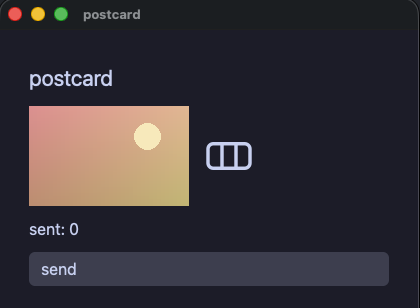
postcard.py
# /// script
# requires-python = ">=3.14"
# ///
"""An image, a vector icon, and an OS notification. `image` and
`svg` take a path (resolved from the run directory in development
and from beside the executable after shipping) with `width=` /
`height=`; an svg renders as a monochrome icon, tinted with the
theme's text color. `notify.send(title, body)` queues an OS notification:
delivered through Notification Center when the app runs as an
`.app` bundle; a bare dev run and headless runs drop it quietly."""
import os
import sys

sys.path.insert(0, os.path.join(os.path.dirname(os.path.abspath(__file__)), ".."))

from yokan import State, button, column, image, notify, row, run, svg, text  # noqa: E402

sent: State[int] = State(0)


def send():
    notify.send("Yokan", "a postcard from the demo")
    sent.set(sent() + 1)


def view():
    with column(spacing=10, padding=14):
        text("postcard", size=22)
        with row(spacing=12):
            image("demo/assets/postcard.png", width=160.0, height=100.0)
            svg("demo/assets/yokan.svg", width=56.0, height=56.0)
        text(f"sent: {sent()}")
        button("send", on_click=send)


if __name__ == "__main__":
    run(view, title="postcard")
A Rust crate of your own
rustcrate — Rust crates, added with yokan add: a local path crate and a crates.io version crate side by side, called by their own snake_case names. The pyproject spelling of the same declaration is demo/proj/
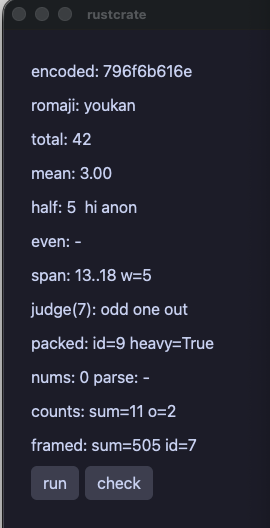
rustcrate.py
# /// script
# requires-python = ">=3.14"
#
# [tool.yokan.crates]
# deunicode = "1"
# hexfmt = { path = "native/hexfmt" }
# ///
"""Rust crates, declared and called — one by path, one by
crates.io version (added with `yokan add`). The `[tool.yokan.crates]` block
names it; `crates.hexfmt.…` calls it — through an auto-built pyo3
door while developing, through the derived binding in the release
build. One implementation, both runs, and the gate compares them.
"""
import os
import sys

sys.path.insert(0, os.path.join(os.path.dirname(os.path.abspath(__file__)), ".."))

from enum import Enum

from yokan import button, column, crates, row, run, store, text, value  # noqa: E402


@value
class Span:
    lo: int
    hi: int


class Grade(Enum):
    Fine = 1
    Odd = 2


@value
class Packed:
    id: int
    weight: int


@value
class Framed:
    span: Span
    packed: Packed


@store
class Out:
    samples: list[float] = [1.0, 2.0, 6.0]
    encoded: str = "-"
    romaji: str = "-"
    total: int = 0
    mean: float = 0.0
    half: int | None = None
    span_lo: int = 0
    span_hi: int = 0
    span_w: int = 0
    verdict: str = "-"
    pack_id: int = 0
    heavy: bool = False
    nums: list[int] = []
    parse_msg: str = "-"

    hello: str = "-"
    even_msg: str = "-"
    csum: int = 0
    o_count: int = 0
    fr_sum: int = 0
    fr_id: int = 0

    def run(self) -> None:
        self.encoded = crates.hexfmt.encode("yokan")
        self.total = crates.hexfmt.add(40, 2)
        self.mean = crates.hexfmt.avg(self.samples)
        self.romaji = crates.deunicode.deunicode("ようかん")
        self.half = crates.hexfmt.halve(10)
        self.hello = crates.hexfmt.greet(None)
        moved = crates.hexfmt.shift(Span(3, 8), 10)
        self.span_lo = moved.lo
        self.span_hi = moved.hi
        self.span_w = crates.hexfmt.width(moved)
        g = crates.hexfmt.judge(7)
        self.verdict = crates.hexfmt.describe(g)
        p = crates.hexfmt.pack(9, 1200)
        self.pack_id = p.id
        self.heavy = crates.hexfmt.heavier(p, 1000)
        counts = crates.hexfmt.char_counts("yokan yokan")
        self.csum = crates.hexfmt.total_counts(counts)
        self.o_count = counts.get("o", 0)
        fr = crates.hexfmt.frame(Span(3, 8), Packed(7, 500))
        self.fr_sum = crates.hexfmt.frame_sum(fr)
        self.fr_id = fr.packed.id

    def check(self) -> None:
        try:
            self.total = crates.hexfmt.parse_even("41")
        except Exception as e:
            self.even_msg = f"{e}"
        try:
            self.nums = crates.hexfmt.parse_all("4, 5, six")
        except Exception as e:
            self.parse_msg = f"{e}"
        try:
            self.nums = crates.hexfmt.parse_all("4, 5, 6")
        except Exception as e:
            self.parse_msg = f"{e}"


def view():
    with column(spacing=8, padding=12):
        text(f"encoded: {Out.encoded}")
        text(f"romaji: {Out.romaji}")
        text(f"total: {Out.total}")
        text(f"mean: {Out.mean:.2f}")
        if (h := Out.half) is not None:
            text(f"half: {h}  {Out.hello}")
        else:
            text(f"half: (none)  {Out.hello}")
        text(f"even: {Out.even_msg}")
        text(f"span: {Out.span_lo}..{Out.span_hi} w={Out.span_w}")
        text(f"judge(7): {Out.verdict}")
        text(f"packed: id={Out.pack_id} heavy={Out.heavy}")
        text(f"nums: {len(Out.nums)} parse: {Out.parse_msg}")
        text(f"counts: sum={Out.csum} o={Out.o_count}")
        text(f"framed: sum={Out.fr_sum} id={Out.fr_id}")
        with row(spacing=6):
            button("run", on_click=Out.run)
            button("check", on_click=Out.check)


if __name__ == "__main__":
    run(view, title="rustcrate", on_start=Out.run)
dashboard — every(): a timer declared at module level, ticking in both runs (the gate steps it with advance:)
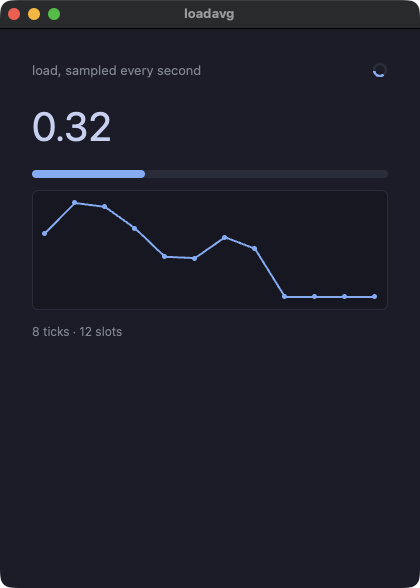
dashboard.py
# /// script
# requires-python = ">=3.14"
# ///
"""A live dashboard: every() drives the updates, in both runs.

`every(1.0, tick)` at module level is a declaration — the compiled
app starts the timer with the app, and a headless run steps it with
`advance:<ms>`, so a minute of ticks is gate-checkable. The samples
come from the seeded RNG both runs share, and the history is a
fixed ring the tick writes by index.
"""
import os
import random
import sys

sys.path.insert(0, os.path.join(os.path.dirname(os.path.abspath(__file__)), ".."))

from yokan import (  # noqa: E402
    State,
    column,
    every,
    line_chart,
    progress,
    row,
    run,
    spinner,
    text,
)

SLOTS = 12

hist: State[list[float]] = State([0.0, 0.0, 0.0, 0.0, 0.0, 0.0, 0.0, 0.0, 0.0, 0.0, 0.0, 0.0])
at: State[int] = State(0)
ticks: State[int] = State(0)
cur: State[float] = State(0.25)


def setup():
    random.seed(7)


def tick():
    step = random.random() * 0.4 - 0.2
    v = cur() + step
    if v < 0.0:
        v = 0.0
    if v > 1.0:
        v = 1.0
    cur.set(v)
    hist[at()] = v
    at.set((at() + 1) % SLOTS)
    ticks.set(ticks() + 1)


every(1.0, tick)


def view():
    with column(spacing=12, padding=16):
        with row(spacing=8):
            text("load, sampled every second", size=13, color="#8a8f98", grow=1.0)
            spinner(size=16.0)
        text(f"{cur():.2f}", size=40)
        progress(cur())
        line_chart(hist(), height=120.0)
        text(f"{ticks()} ticks · {SLOTS} slots", size=12, color="#8a8f98")


if __name__ == "__main__":
    run(view, title="loadavg", on_start=setup)
tasks — task(): slow work off the UI thread, in both runs
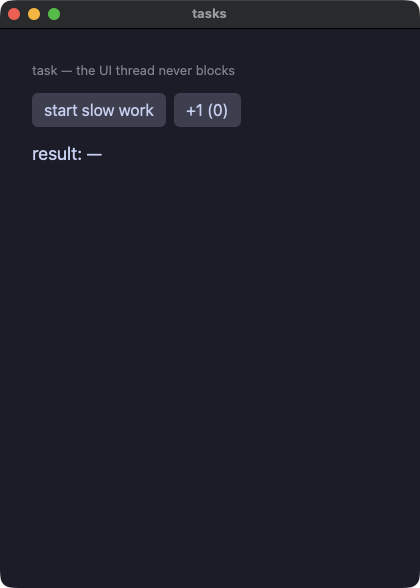
tasks.py
# /// script
# requires-python = ">=3.14"
# ///
"""task — slow work off the UI thread, in both runs.

`task(work, on_done=..., on_progress=...)` hands the work to a
worker: during development that is a Python thread, and the compiled
app awaits the standard-library call inside it, which puts it on the
engine's pool. Either way the window keeps drawing — the counter
button stays clickable while the work runs — and `on_done` lands the
result.

The work is not silent while it runs: `report(fraction, note)` says
where it has got to, from wherever it is running, and `on_progress`
hears it on the UI thread. Every report is heard, and the last one
lands before `on_done` does.
"""
import os
import sys
import time

sys.path.insert(0, os.path.join(os.path.dirname(os.path.abspath(__file__)), ".."))

from yokan import (  # noqa: E402
    State,
    button,
    column,
    progress,
    report,
    row,
    run,
    task,
    text,
)

busy: State[bool] = State(False)
result: State[str] = State("—")
done: State[float] = State(0.0)
step: State[str] = State("")
heard: State[int] = State(0)
n: State[int] = State(0)


def slow_work() -> int:
    time.sleep(0.5)
    report(0.33, "500 ms")
    time.sleep(0.5)
    report(0.66, "1000 ms")
    time.sleep(0.5)
    report(1.0, "1500 ms")
    return 1_500


def moved(fraction: float, note: str):
    done.set(fraction)
    step.set(note)
    heard.set(heard() + 1)


def start():
    busy.set(True)
    task(
        slow_work,
        on_done=lambda v: (busy.set(False), result.set(f"waited {v} ms")),
        on_progress=moved,
    )


def view():
    with column(spacing=12, padding=16):
        text("task — the UI thread never blocks", size=13, color="#8a8f98")
        with row(spacing=8):
            button("start slow work", on_click=start)
            button(f"+1 ({n()})", on_click=lambda: n.set(n() + 1))
        progress(done(), width=260.0)
        text(f"{step()} · {heard()} reports", size=13, color="#8a8f98")
        if busy():
            text("working…", color="#8a8f98")
        else:
            text(f"result: {result()}", size=18)


if __name__ == "__main__":
    run(view, title="tasks")
Escapes and development-only
pystats — @py + numpy: escaped functions ship with CPython embedded in the release binary
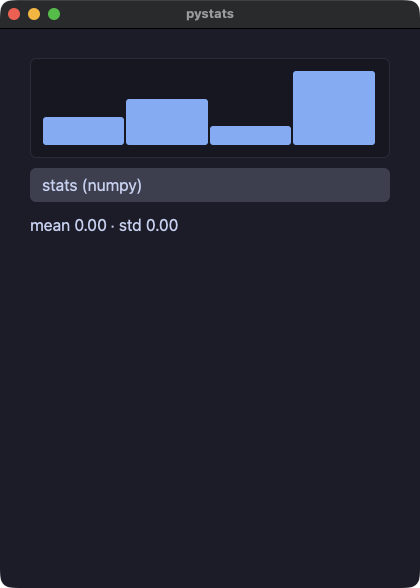
pystats.py
# /// script
# requires-python = ">=3.14"
# dependencies = ["numpy"]
# ///
"""numpy inside the native app: the escape imports numpy, and
--bundle installs it (from this file's own PEP 723 block) into the
shipped runtime's site-packages.

The escape runs inside a `task`, which is what keeps a long Python
call off the UI thread in the compiled app as well as in the
development run. From in there it can say where it has got to:
`report(fraction, note)` inside the escape reaches this app's
`on_progress`, on whatever thread the Python happened to run on.
"""
import os
import sys

sys.path.insert(0, os.path.join(os.path.dirname(os.path.abspath(__file__)), ".."))

from yokan import bar_chart, button, column, py, progress, run, State, task, text  # noqa: E402


@py
def stats(xs: list[float]) -> list[float]:
    from yokan import report

    import numpy as np

    report(0.5, "mean")
    a = np.array(xs)
    m = float(a.mean())
    report(1.0, "spread")
    return [m, float(a.std())]


values: State[list[float]] = State([3.0, 5.0, 2.0, 8.0])
mean: State[float] = State(0.0)
std: State[float] = State(0.0)
done: State[float] = State(0.0)
step: State[str] = State("idle")


def landed(r: list[float]):
    mean.set(r[0])
    std.set(r[1])


def moved(fraction: float, note: str):
    done.set(fraction)
    step.set(note)


def compute():
    xs = values()
    task(lambda: stats(xs), on_done=landed, on_progress=moved)


def view():
    with column(spacing=10, padding=14):
        bar_chart(values(), height=100.0)
        button("stats (numpy)", on_click=compute)
        progress(done(), width=220.0, label=step())
        text(f"mean {mean():.2f} · std {std():.2f}", size=16)


if __name__ == "__main__":
    run(view, title="pystats")
pyjob — a slow Python job inside a @py escape, run through a task: the window keeps drawing, and the escape reports its progress from the worker thread it landed on
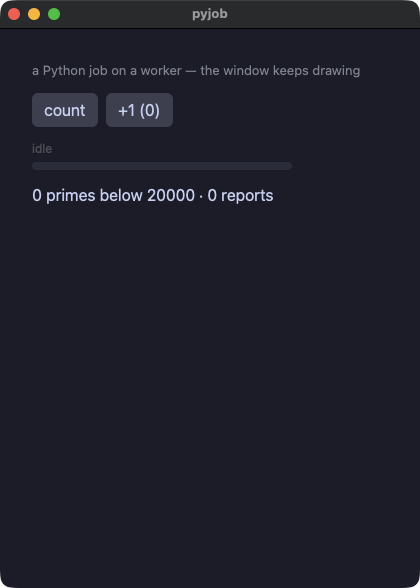
pyjob.py
# /// script
# requires-python = ">=3.14"
# ///
"""A long Python job, off the UI thread, saying where it has got to.

The work is a `@py` escape — real Python, run on an embedded CPython
inside the compiled binary — and `task` puts it on a worker in both
runs, so the window keeps drawing while it grinds: the counter button
stays clickable throughout.

From inside the escape, `report(fraction, note)` reaches this app's
`on_progress`, which runs on the UI thread like any other handler.
Every report is heard, and the last one lands before `on_done` does —
which is what makes `4 reports` in the dump a checked claim rather
than a hope.
"""
import os
import sys

sys.path.insert(0, os.path.join(os.path.dirname(os.path.abspath(__file__)), ".."))

from yokan import (  # noqa: E402
    State,
    button,
    column,
    progress,
    py,
    row,
    run,
    task,
    text,
)


@py
def count_primes(limit: int, chunks: int) -> int:
    from yokan import report

    found = 0
    step = limit // chunks
    for c in range(chunks):
        lo = c * step + 2
        hi = lo + step
        found += sum(
            1
            for n in range(lo, hi)
            if all(n % d for d in range(2, int(n**0.5) + 1))
        )
        report((c + 1) / chunks, f"below {hi}")
    return found


limit: State[int] = State(20_000)
found: State[int] = State(0)
done: State[float] = State(0.0)
step: State[str] = State("idle")
heard: State[int] = State(0)
n: State[int] = State(0)


def counted(total: int):
    found.set(total)


def moved(fraction: float, note: str):
    done.set(fraction)
    step.set(note)
    heard.set(heard() + 1)


def start():
    n_max = limit()
    task(lambda: count_primes(n_max, 4), on_done=counted, on_progress=moved)


def view():
    with column(spacing=12, padding=16):
        text("a Python job on a worker — the window keeps drawing", size=13, color="#8a8f98")
        with row(spacing=8):
            button("count", on_click=start)
            button(f"+1 ({n()})", on_click=lambda: n.set(n() + 1))
        progress(done(), width=260.0, label=step())
        text(f"{found()} primes below {limit()} · {heard()} reports", size=16)


if __name__ == "__main__":
    run(view, title="pyjob")
transcribe — the Buzz port: Whisper transcription through @py + mlx-whisper, with a progress bar, a table of segments and TXT / SRT / VTT export
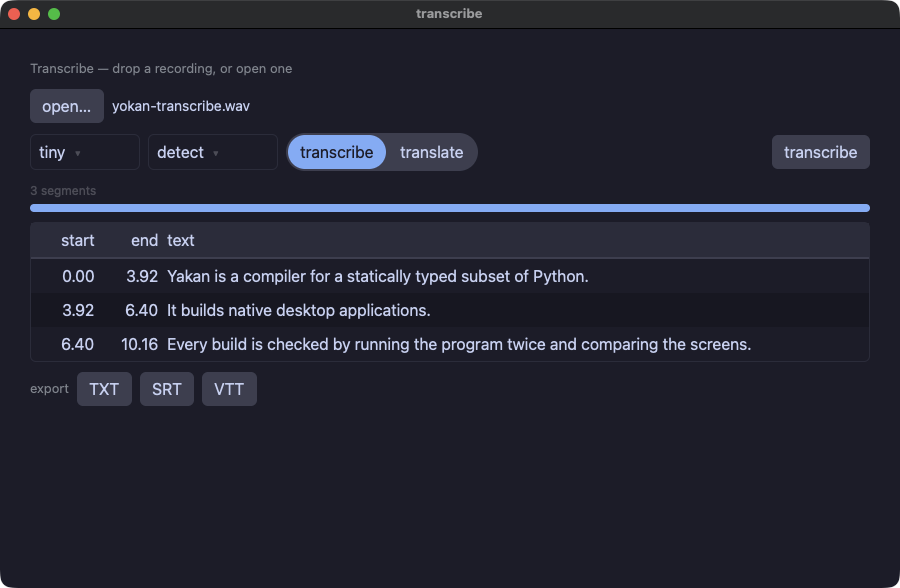
app.py
# /// script
# requires-python = ">=3.14"
# dependencies = ["mlx-whisper", "static-ffmpeg"]
# ///
"""Transcribe — Buzz's screen and flow, ported.

Buzz (MIT, github.com/chidiwilliams/buzz) is a desktop app that turns
recordings into text with Whisper, offline. What is ported here is
its screen and its flow: drop a file, pick a model, a language and
whether to transcribe or translate, watch it work, read the segments,
export TXT / SRT / VTT. The transcription itself is not Buzz's code
and not this app's either — it is mlx-whisper, called from a `@py`
escape. That is the point of the pair: the model stays real Python,
and everything around it — the window, the table, the timestamps, the
three exports — is compiled.

The escape runs inside a `task`, so a recording that takes a minute
leaves the window drawing, and `report(fraction, note)` from in there
moves the bar as the audio goes by.

    uv run demo/transcribe/app.py

The first run downloads the model from Hugging Face; after that it is
offline. ffmpeg reads the audio: the system's is used when there is
one, and `static-ffmpeg` fetches a copy when there is not. With no
recording to hand, this machine can speak one:

    say -v Samantha -o /tmp/hello.wav --data-format=LEI16@16000 \
        "It builds native desktop applications."
"""
import os
import sys

sys.path.insert(0, os.path.join(os.path.dirname(os.path.abspath(__file__)), "..", ".."))

from yokan import (  # noqa: E402
    State,
    button,
    column,
    data_table,
    on_file_drop,
    progress,
    py,
    row,
    run,
    scroll_view,
    segmented,
    select,
    spacer,
    task,
    text,
    value,
)
from yokan import fs, strings  # noqa: E402


@value
class Seg:
    start: float
    end: float
    text: str


@py
def transcribe_file(path: str, repo: str, language: str, job: str) -> list[str]:
    """One call to mlx-whisper, with the bar wired to the window.

    `transcribe` has no progress callback: it counts audio frames
    through a tqdm bar, so the bar is what this replaces — every
    window it decodes becomes a `report`. If a future mlx-whisper
    counts differently the transcription is unaffected; only the bar
    would stop moving.
    """
    import shutil

    from yokan import report

    # The three imports a type checker cannot resolve without the
    # model stack installed. They are the escape's own dependencies,
    # declared in the block at the top of this file; `uv run` fetches
    # them, and pyright is not asked to.
    if shutil.which("ffmpeg") is None:
        import static_ffmpeg  # pyright: ignore[reportMissingImports]

        static_ffmpeg.add_paths()

    import mlx_whisper  # pyright: ignore[reportMissingImports]
    import mlx_whisper.transcribe as engine  # pyright: ignore[reportMissingImports]

    class Bar:
        def __init__(self, total=0, **kw):
            self.total = max(1, total)
            self.n = 0

        def __enter__(self):
            return self

        def __exit__(self, *exc):
            return False

        def update(self, k):
            self.n += k
            secs = self.n // 100
            report(min(1.0, self.n / self.total), f"{secs // 60}:{secs % 60:02d}")

    class Counter:
        tqdm = Bar

    report(0.0, "loading the model")
    engine.tqdm = Counter
    r = mlx_whisper.transcribe(
        path,
        path_or_hf_repo=repo,
        language=language or None,
        task=job,
        temperature=0.0,
        verbose=None,
    )
    return [
        f"{s['start']:.3f}\t{s['end']:.3f}\t{s['text'].strip()}"
        for s in r["segments"]
    ]


# What the chooser shows, and what Hugging Face calls it. The lists
# are held in State rather than written as module constants because
# that is what `select(options=…)` reads, and what an index into one
# can be looked up in.
models: State[list[str]] = State(["tiny", "base", "small", "medium", "large-v3"])
repos: State[list[str]] = State(
    [
        "mlx-community/whisper-tiny",
        "mlx-community/whisper-base-mlx",
        "mlx-community/whisper-small-mlx",
        "mlx-community/whisper-medium-mlx",
        "mlx-community/whisper-large-v3-mlx",
    ]
)
langs: State[list[str]] = State(
    ["detect", "English", "Japanese", "German", "French", "Spanish"]
)
codes: State[list[str]] = State(["", "en", "ja", "de", "fr", "es"])
jobs: State[list[str]] = State(["transcribe", "translate"])

path: State[str] = State("")
model_ix: State[int] = State(0)
lang_ix: State[int] = State(0)
job_ix: State[int] = State(0)
segs: State[list[Seg]] = State([])
pct: State[float] = State(0.0)
note: State[str] = State("")
busy: State[bool] = State(False)
saved: State[str] = State("")


def name_of(p: str) -> str:
    if p == "":
        return "(nothing yet)"
    cut = p.rfind("/")
    return p[cut + 1 :]


def stamp(t: float, comma: bool) -> str:
    ms = int(t * 1000)
    sep = "."
    if comma:
        sep = ","
    return f"{ms // 3600000:02d}:{(ms // 60000) % 60:02d}:{(ms // 1000) % 60:02d}{sep}{ms % 1000:03d}"


def pick_model(i: int):
    model_ix.set(i)


def pick_lang(i: int):
    lang_ix.set(i)


def pick_job(i: int):
    job_ix.set(i)


def took(p: str):
    if p != "":
        path.set(p)
        segs.set([])
        saved.set("")


def open_one():
    task(lambda: fs.open_dialog("Choose a recording"), on_done=took)


def to_seg(line: str) -> Seg:
    part: list[str] = line.split("\t")
    return Seg(
        strings.to_float(part[0], 0.0),
        strings.to_float(part[1], 0.0),
        part[2],
    )


def landed(lines: list[str]):
    segs.set([to_seg(line) for line in lines])
    busy.set(False)
    pct.set(1.0)
    note.set(f"{len(lines)} segments")


def moved(fraction: float, mark: str):
    pct.set(fraction)
    note.set(mark)


def start():
    if path() == "":
        return
    audio = path()
    repo = repos()[model_ix()]
    code = codes()[lang_ix()]
    job = jobs()[job_ix()]
    busy.set(True)
    pct.set(0.0)
    task(
        lambda: transcribe_file(audio, repo, code, job),
        on_done=landed,
        on_progress=moved,
    )


def wrote_txt(p: str):
    if p != "":
        body = ""
        for s in segs():
            body = body + s.text + "\n"
        fs.write_text(p, body)
        saved.set(f"wrote {name_of(p)}")


def wrote_srt(p: str):
    if p != "":
        body = ""
        n = 0
        for s in segs():
            n = n + 1
            head = f"{stamp(s.start, True)} --> {stamp(s.end, True)}"
            body = body + f"{n}\n{head}\n{s.text}\n\n"
        fs.write_text(p, body)
        saved.set(f"wrote {name_of(p)}")


def wrote_vtt(p: str):
    if p != "":
        body = "WEBVTT\n\n"
        for s in segs():
            head = f"{stamp(s.start, False)} --> {stamp(s.end, False)}"
            body = body + f"{head}\n{s.text}\n\n"
        fs.write_text(p, body)
        saved.set(f"wrote {name_of(p)}")


def export_txt():
    task(lambda: fs.save_dialog("transcript.txt"), on_done=wrote_txt)


def export_srt():
    task(lambda: fs.save_dialog("transcript.srt"), on_done=wrote_srt)


def export_vtt():
    task(lambda: fs.save_dialog("transcript.vtt"), on_done=wrote_vtt)


on_file_drop(took)


def view():
    with column(spacing=10, padding=14):
        text("Transcribe — drop a recording, or open one", size=13, color="#8a8f98")
        with row(spacing=8):
            button("open…", on_click=open_one)
            text(f"{name_of(path())}", size=14)
        with row(spacing=8):
            select(options=models(), selected=model_ix(), on_change=pick_model, width=110.0)
            select(options=langs(), selected=lang_ix(), on_change=pick_lang, width=130.0)
            segmented(options=jobs(), selected=job_ix(), on_change=pick_job)
            spacer()
            button("transcribe", on_click=start, disabled=busy())
        progress(pct(), label=note())
        with scroll_view(height=260.0):
            with data_table():
                # The two time columns are given a WIDTH rather than a
                # share: a share is what is left after the content, so
                # a longer timestamp in one row would move that row's
                # text and the column would stop being a column.
                with row(spacing=8):
                    text("start", width=56.0, align="right")
                    text("end", width=56.0, align="right")
                    text("text", grow=1.0)
                for s in segs():
                    with row(spacing=8):
                        text(f"{s.start:.2f}", width=56.0, align="right")
                        text(f"{s.end:.2f}", width=56.0, align="right")
                        text(s.text, grow=1.0)
        with row(spacing=8):
            text("export", size=13, color="#8a8f98")
            button("TXT", on_click=export_txt)
            button("SRT", on_click=export_srt)
            button("VTT", on_click=export_vtt)
            spacer()
            text(f"{saved()}", size=13, color="#8a8f98")


if __name__ == "__main__":
    run(view, title="transcribe", width=900, height=560)
multi — a multi-module app (state.py and widgets.py; helpers become components)
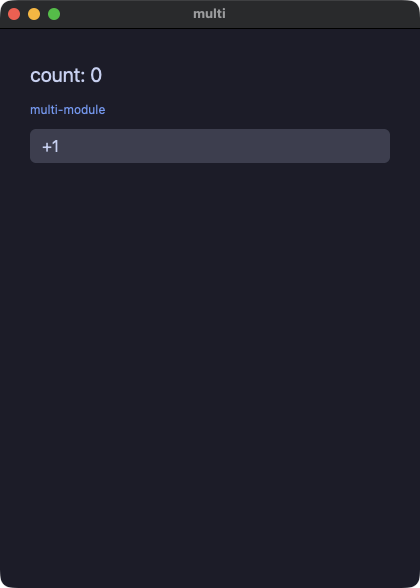
app.py
# /// script
# requires-python = ">=3.14"
# ///
"""Multi-module apps: state lives in state.py, view helpers in
widgets.py. Helpers compile as reusable components; the build
flattens the module graph into the one compiled program.
"""
import os
import sys
from yokan import button, column, run

sys.path.insert(0, os.path.join(os.path.dirname(os.path.abspath(__file__)), "..", ".."))

from state import count  # noqa: E402
from widgets import badge, header  # noqa: E402


def view():
    with column(spacing=10, padding=14):
        header()
        badge("multi-module")
        button("+1", on_click=lambda: count.set(count() + 1))


if __name__ == "__main__":
    run(view, title="multi")
widgets.py
app — a dashboard with numpy (development-only: dict state)
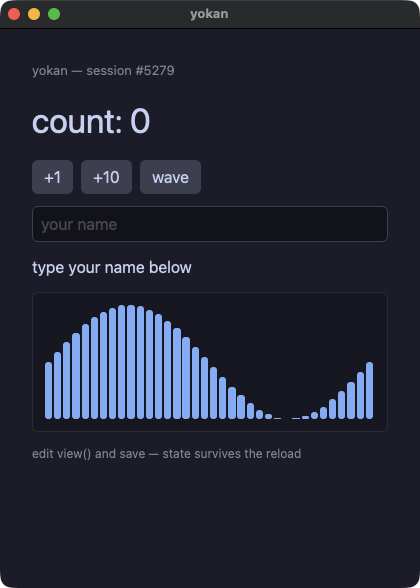
app.py
# /// script
# requires-python = ">=3.14"
# dependencies = ["numpy"]
# ///
"""yokan demo: real CPython + numpy driving pixie's gpui engine.

Build the module, then run:
    just dev-so
    uv run crates/yokan/demo/app.py

While it runs, edit view() below and save — the window updates in
place; the session id, the count and the typed name all survive
(state lives on, only the view function is re-executed).
"""
import os
import random
import sys
from yokan import bar_chart, button, column, row, run, text, text_field

sys.path.insert(0, os.path.join(os.path.dirname(os.path.abspath(__file__)), ".."))

import numpy as np  # noqa: E402


def view(s):
    xs = np.linspace(0.0, 2.0 * np.pi, 36)
    wave = ((np.sin(xs + s["phase"]) + 1.0) * 0.5).tolist()
    greeting = f"Hello, {s['name']}!" if s["name"] else "type your name below"
    return column(
        text(f"yokan — session #{s['sid']}", size=13, color="#8a8f98"),
        text(f"count: {s['count']}", size=34),
        row(
            button("+1", on_click=lambda: s.update(count=s["count"] + 1)),
            button("+10", on_click=lambda: s.update(count=s["count"] + 10)),
            button("wave", on_click=lambda: s.update(phase=s["phase"] + 0.7)),
            spacing=8,
        ),
        text_field(
            s["name"],
            placeholder="your name",
            on_change=lambda t: s.update(name=t),
        ),
        text(greeting, size=16),
        bar_chart(wave, height=140.0),
        text("edit view() and save — state survives the reload", size=12, color="#8a8f98"),
        spacing=12,
        padding=16,
    )


if __name__ == "__main__":
    run(
        view,
        state={"sid": random.randint(1000, 9999), "count": 0, "phase": 0.0, "name": ""},
        title="yokan",
    )
csv_viewer — a 100k-row virtualized table + numpy (development-only: dict state)
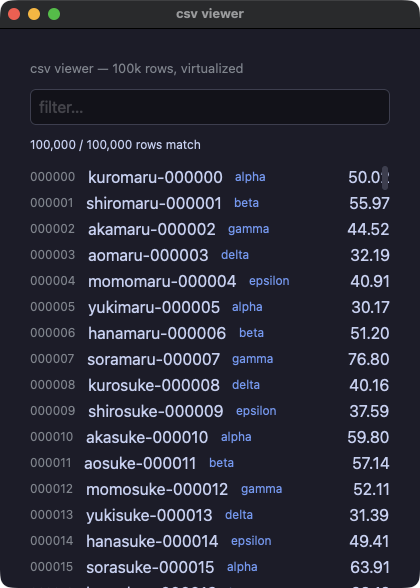
csv_viewer.py
# /// script
# requires-python = ">=3.14"
# dependencies = ["numpy"]
# ///
"""yokan dogfood #1: 100,000 rows at native scroll speed.

Type in the filter box; rows render through a virtualized ListView,
so Python builds only the visible window (~14 rows of 100k). Run
with PIXIE_TRACE_LAZY=1 to watch the requested ranges.
"""
import os
import sys
from yokan import column, list_view, row, run, text, text_field

sys.path.insert(0, os.path.join(os.path.dirname(os.path.abspath(__file__)), ".."))

import numpy as np  # noqa: E402

N = 100_000
rng = np.random.default_rng(7)
CATS = ["alpha", "beta", "gamma", "delta", "epsilon"]
STEMS = ["kuro", "shiro", "aka", "ao", "momo", "yuki", "hana", "sora"]
TAILS = ["maru", "suke", "chan", "gou", "ta", "emon"]
names = [f"{STEMS[i % 8]}{TAILS[(i // 8) % 6]}-{i:06d}" for i in range(N)]
cats = [CATS[i % 5] for i in range(N)]
values = np.round(rng.normal(50.0, 20.0, N), 2)


def matches(q):
    if not q:
        return list(range(N))
    q = q.lower()
    return [i for i in range(N) if q in names[i] or q in cats[i]]


def view(s):
    idx = s["idx"]

    def render_row(k):
        i = idx[k]
        return row(
            text(f"{i:06d}", size=12, color="#8a8f98"),
            text(names[i], grow=1.0),
            text(cats[i], size=12, color="#7aa2f7"),
            text(f"{values[i]:.2f}", align="right"),
            spacing=12,
        )

    return column(
        text("csv viewer — 100k rows, virtualized", size=13, color="#8a8f98"),
        text_field(s["q"], placeholder="filter…", on_change=lambda t: s.update(q=t, idx=matches(t))),
        text(f"{len(idx):,} / {N:,} rows match", size=12),
        list_view(len(idx), render_row, item_height=26.0, height=430.0),
        spacing=10,
        padding=14,
    )


if __name__ == "__main__":
    run(view, state={"q": "", "idx": list(range(N))}, title="csv viewer")