Building with an agent
An agent writes a file and reads what comes back. How the session goes — how many turns it takes, whether the agent finds its own mistakes, whether a person has to sit and watch — follows from what comes back.
Wakakusa's commands are shaped for that reading. Two of them start no compiler and open no window, and each answers one question: can Wakakusa take this, what does it draw, and will the shipped app do the same.
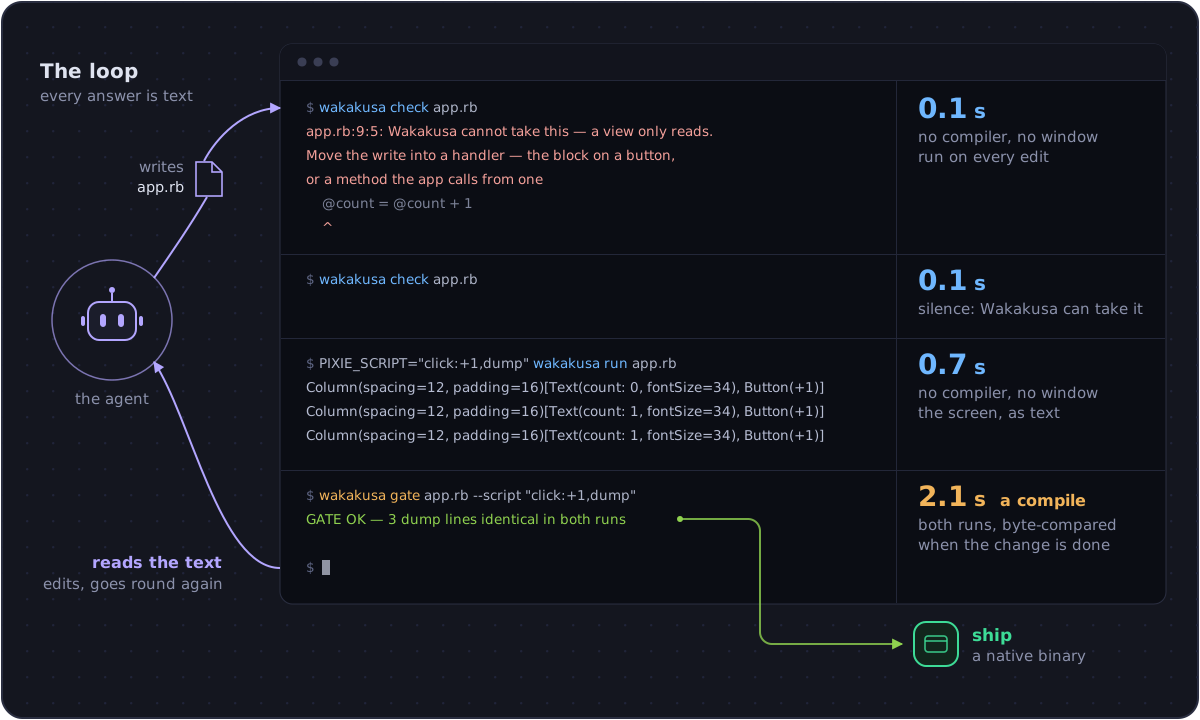
Three commands, three answers
wakakusa check — can Wakakusa take this?
$ ./bin/wakakusa check app.rb
app.rb:5:19: Wakakusa cannot take this — `text` has no `weight:`. It takes a11y_label, align, animate, background, bold, border_color, border_radius, border_width, col_span, color, disabled, easing, enter, exit, grow, height, italic, max_lines, max_width, min_width, mono, padding, role, row_span, size, text, theme, tooltip, underline, width, wrap
    text("hello", weight: 700.0)
                  ^
It prints the refusal in file:line:col form with the line under it,
and says nothing at all when it can take the app. No
compiler is started, so the answer comes back in about a tenth of a
second.
The message is not "no": it is the repair, at the line where the repair goes. What Wakakusa refuses is the whole list, each with the code that triggers it.
A headless run — what does it draw?
$ PIXIE_SCRIPT="click:+1,dump" ./bin/wakakusa run app.rb
Column(spacing=12, padding=16)[Text(count: 0, fontSize=34), Row(spacing=8)[Button(+1), Button(+10), Button(reset)], TextField(), Text(hello, )]
Column(spacing=12, padding=16)[Text(count: 1, fontSize=34), Row(spacing=8)[Button(+1), Button(+10), Button(reset)], TextField(), Text(hello, )]
Column(spacing=12, padding=16)[Text(count: 1, fontSize=34), Row(spacing=8)[Button(+1), Button(+10), Button(reset)], TextField(), Text(hello, )]
With PIXIE_SCRIPT set, run opens no window: it builds the tree,
drives it with the steps and prints the screen as text — once at the
start, once for every dump, once at the end. About seven tenths of a
second, again with no compiler.
This is the answer to "did the button do what I meant", and it is readable without a screen. The steps are listed on Verify and ship.
For anything drawn on a canvas, WAKAKUSA_FRAMES=<dir> writes a PNG
after every step, painted by the same rasterizer the window uses — so
an agent can look at what it drew, not only read it.
wakakusa gate — will the shipped app do the same?
This one compiles, so it costs about two seconds. It is the proof at the end of a piece of work, not the thing to run on every edit.
When it fails it says where:
The cruby: line is the one that is right — that run is the real
interpreter. A divergence is a bug in the compiled run, and
The two runs lists the handful of places where one is
already known.
The loop, in one session
$ ./bin/wakakusa check app.rb                       # refusal → fix it, in place
$ ./bin/wakakusa check app.rb                       # silence
$ PIXIE_SCRIPT="click:add,dump" ./bin/wakakusa run app.rb   # read the screen
$ ./bin/wakakusa gate app.rb --script "click:add,dump"      # both runs agree
The first three are under a second each, which is what makes them worth running on every edit. The last one is the promise, and it is the one to run before saying the work is done.
What to hand an agent
Three pages, in this order:
- First app and the rest of the tour — the language, in the order you meet it.
- What Wakakusa refuses — the shapes to write instead, with the exact message each one prints.
- Elements — every element, every keyword, its type and its default, generated from the one table the engine is built from.
An agent that has read those gets the elements and their keywords right the first time, instead of learning them from refusals one build at a time.
Two things worth telling it
A view only reads. The commonest refusal by far is a write inside
view. The state changes in a handler, and the view is rebuilt from
what the state now says.
A block on an element cannot be written inside a loop. The rewrite is always the same shape: a method that takes what the row needs, called from the loop.